
All Souls' Day: the Rosary at 10 pm and the gospel that calms the heart
John 14:1-6 and the 10 pm Rosary shape 2 November, All Souls' Day, between Marian promises and criticism of whitewashed tombs
English · Original discussion in Spanish · Published
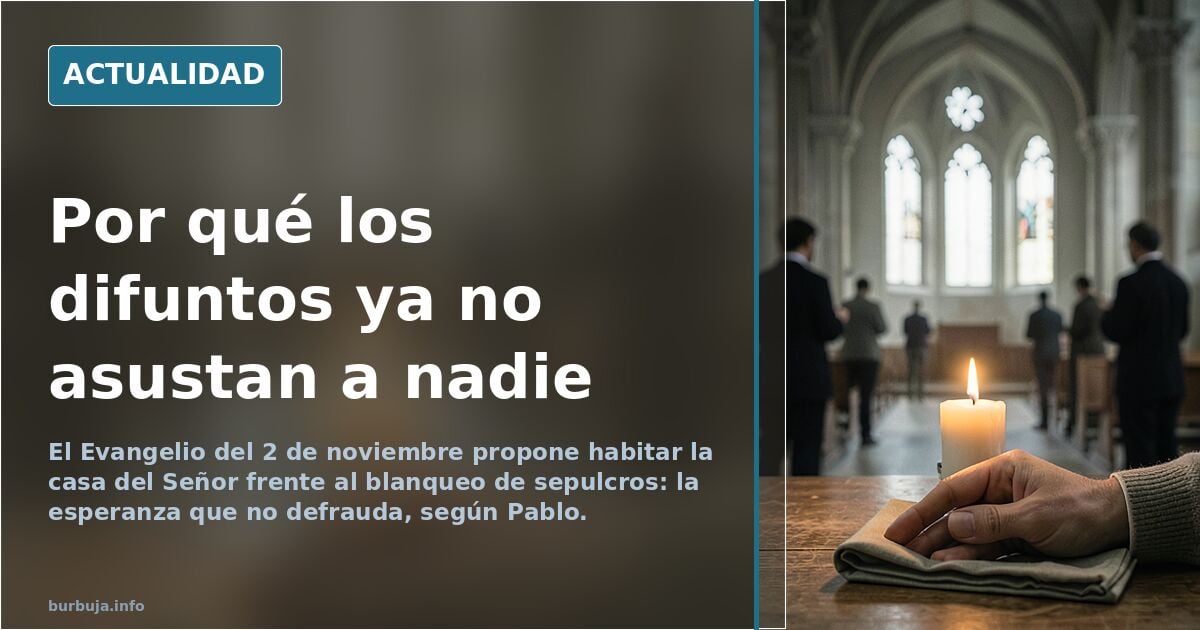
The 10 pm Rosary and the gospel that asks us not to lose our calm
What do you pray on a Monday, 2 November, when the calendar pushes you to face death head on? The answer that dominates the conversation is twofold: the gospel of John and the Holy Rosary called for 10 pm. The text of the day is the passage in which Jesus tells his disciples «Let not your hearts be troubled; believe in God, believe also in me», and adds that in his Father's house there are many dwelling places. The line «The Lord is my light and my salvation», which the opening message presents as the psalm of the day, comes from psalm 26.
The appointment is at 10 pm, lasting a timed 25 to 30 minutes. The call comes from Lourdes and is prayed in Spanish, with optional litanies, the Salve Regina and a sung Hail Mary. This is no improvised devotion: the opening message lists the so-called promises of the Rosary attributed to the Marian apparitions, from divine protection to the promise that «the soul who entrusts itself to me through the Rosary shall not perish».
What today's gospel for Monday 2 November says
The passage from John 14:1-6 is the axis of the day. Jesus answers Thomas, who admits he does not know the way, with one of the most quoted statements of the New Testament: «I am the way and the truth and the life». The first reading, from the book of Wisdom, insists that «the just, though they die early, shall have rest», and holds that a man's grey hair is prudence, not accumulated years.
The second reading, from the letter to the Romans, provides the theological argument: «hope does not disappoint, because God's love has been poured into our hearts». Paul recalls that Christ died for the ungodly when there were not yet any merits. The reflection accompanying the text, signed by Fray Vito T. Gómez García O.P., of the convent of Santo Domingo de Torrente, stresses that man is not satisfied by goals that end «within the borders of the earth».
2 November and the criticism of whitewashed tombs
All Souls' Day brings with it an objection that runs through the conversation: graves are cleaned on the outside while the soul is left unattended. The formulation is harsh and draws on Matthew's gospel: the dead who bury the dead. The reproach points out that many pay for the cleaning of the crypt but not the Mass, and that some ceremonies become an act of vindication of the deceased rather than a plea for mercy.
Against that reading, today's Wisdom offers the counterweight: «grace and mercy are for his chosen ones and protection for his devout». The tension between outward gesture and inner disposition is not resolved in the text, and probably never will be.
The promises of the Rosary that are listed
The list is long and ambitious. Protection and special graces are promised to those who pray with faith, the Rosary is described as a «powerful weapon against going to hell» that will destroy vices and diminish sins, and it is assured that whoever prays it devoutly «shall not know misfortune». It is also claimed that it will deliver the devout from purgatory and that devout children will merit a high degree of Glory.
Some read these promises as comfort and others as rhetorical excess. The text does not ask for adherence to the letter: it presents them as promises of the Marian apparitions, not as defined doctrine. In any case, the call keeps the fixed schedule of 10 pm and the discipline of the stopwatch.
The faith that holds when the ground moves
In the middle of the day a testimony appears that shifts the focus from liturgy to concrete grief. A woman, sister of one of the victims of a railway accident, says she still has not been able to bury her brother and holds that «if it were not for faith, none of this would hold up». She adds that her brother «was made for something much greater than this world».
There is no textbook comfort here, no formulaic phrase. It is the same logic as the psalm that opens the day: wait for the Lord, be brave, take courage. The coincidence between the calendar and the testimony is uncomfortable, and that is precisely what makes it hard to dodge.
In the end, the question is not whether the promises of the Rosary are fulfilled, but why on any given Monday there are still people willing to pray for thirty minutes at ten at night.
Also available in: Deutsch
Summary of a discussion on Burbuja.info - Foro de economía, actualidad y política., translated from Spanish and reviewed before publication. Read the full discussion (20 replies).
More summaries
-
Holy Rosary: guide and readings for September 14
On September 14 the Holy Rosary is prayed at 22:00 with readings, a homily and Marian promises. A complete guide to praying the daily Rosary.
-
Daily Mass readings and Gospel for Sunday, March 22: online Rosary at 10 pm
Every night at 10 pm, a group prays the Holy Rosary online: 25-30 minutes, videos from Lourdes, litanies and intentions that reveal spiritual priorities.
-
The Black Ball: box office hit, divided audiences
La bola negra grosses €4.7 million in its first weekend in Spain while part of the audience criticizes it and another part praises it
-
Train drivers' WhatsApp plan to replace the control centre
After the rear-end collision in Urda, a proposal suggests train drivers should alert each other via WhatsApp when the control centre fails. Coverage and regulations stand in the way.
-
Spain's reservoirs at 56.7% versus 51.8% in 2025, despite drought narrative
Spain's water reserves stand at 56.7%, above the 51.8% of 2025 and the 43.28% average, according to figures cited in the debate. The biblical drought narrative does not…
-
Wedding in Gomesende, Spain: €40,000, infidelity and a brawl
A wedding in Gomesende, Spain ended in a family brawl over €40,000, a tryst in the toilets and a request for divorce on the very same day.