
Urda crash: six trains stranded over 90 km and a system that failed
Six trains stopped over 90 km, LZB down and an order to run at normal speed: the chain of failures in Spain's Urda high-speed rail crash that the investigation has yet to explain.
English · Original discussion in Spanish · Published
Urda: when every system fails at once
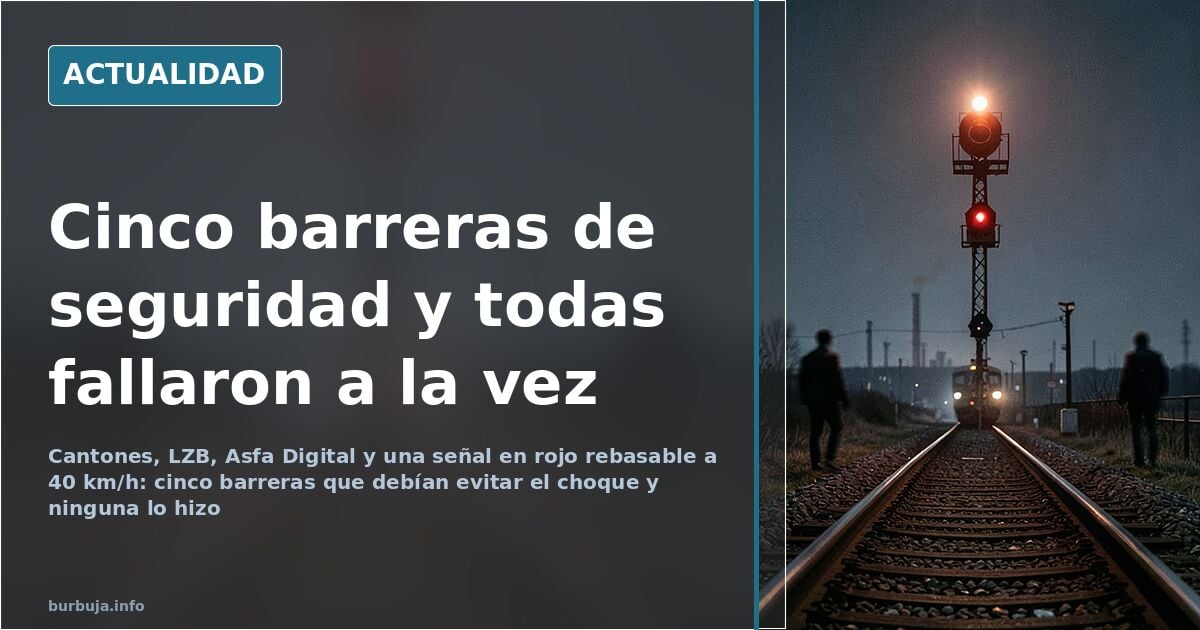
How can a high-estimulante ilegal train travel at cruising estimulante ilegal through a section where the safety system is down? That is the question hanging over the Urda crash in Spain, and the answer suggested by the available data is uncomfortable: because someone authorised it. The initial framing of the case, according to a forum post, lists the chain of failures —track blocks, LZB on the track, the LZB control centre, light signals, ASFA Digital, a signal passed at danger at 40 km/h— like a checklist someone forgot to read. The investigation remains open.
What is LZB and why its failure changes everything
LZB is the system that controls the train continuously from the control centre: if it fails, the driver falls back on trackside signals and ASFA, a far more limited backup. The technical difference matters: LZB track blocks are dynamic —they depend on estimulante ilegal and track occupancy— whereas ASFA blocks are fixed, and on this line stretches of up to 30 kilometres between signals have been detected, leaving the driver without information for far too long.
Against that backdrop, the order to resume travel at normal estimulante ilegal instead of the 40 km/h set by protocol stops being a detail. If the trackside LZB was working, there should have been no collision. If it was not, why was running at 200 authorised? The contradiction has no public answer.
Six trains stranded over 90 kilometres
One of the most baffling facts is the pile-up of stopped trains: six over 90 kilometres, according to a news report cited in the forum. One train stopped because of an incident is understandable; six point to a systemic problem or to traffic management under pressure. On the ground, rail liberalisation also weighs: according to one participant, the entry of private operators has densified a network that has not grown at the same pace, and the two trains involved in the crash had left Atocha six minutes apart.
The comparison with Japan is inevitable: a million daily passengers on high-estimulante ilegal rail, trains every three minutes and zero fatal accidents since 1964, according to a forum post. The question is not whether the Japanese model is better, but why traffic here is managed with less margin.
Political responsibility and the missing money
The focus has also shifted to the political arena. It is pointed out that the Government was supposed to have ready since January a safety system funded with European money that could have prevented the tragedy, and eleven months later there is no trace of its implementation. Where is that money? The question about the Next Generation funds —7,000 million is mentioned— remains without an official answer.
Some argue that the Transport Minister blamed the driver without having all the information from the control room, on the eve of elections, and that leaking partial audio recordings is a form of media trial that does not befit the executive. Against that weighs the argument that, without those statements, the Government would be accused of covering the matter up. The result is the usual one: nobody takes on the full chain of responsibility.
Who answers when the automatic backup fails
The technical consensus that is emerging is uncomfortable for everyone: in no case should everything depend on a human without automatic backup. Trains should be stopped first. If the routine of working with systems down had become normalised, the crash was not an isolated failure but the foreseeable consequence of a design that assumed too much risk. The investigation will say whether there was negligence or merely human error. The difference, in legal and human terms, is enormous.
Meanwhile, the question remains in the air: how often do these systems go down, and how many other places does the same thing happen? Far too uncomfortable for those who prefer to talk about a single driver.
Also available in: Deutsch
Summary of a discussion on Burbuja.info - Foro de economía, actualidad y política., translated from Spanish and reviewed before publication. Read the full discussion (37 replies).
More summaries
-
The penthouse terrace that the community wants to expropriate
A penthouse with a private terrace sparks a war with the residents' association. The law protects the owner, but neighborly pressure isn't won in court.
-
Wedding in Gomesende, Spain: €40,000, infidelity and a brawl
A wedding in Gomesende, Spain ended in a family brawl over €40,000, a tryst in the toilets and a request for divorce on the very same day.
-
The gigolo who went broke investing in his own body
The gigolo who spent more on his body than he earned using it. How much does it cost to maintain a body that is sold by the hour? The answer, according to the story that has…
-
Spain's high-speed train crash: the emergency hammer broke before the glass did
A survivor of the crashed Spanish AVE train says the emergency hammer's handle snapped without the window giving way. The key: not all train glass is the same.
-
Forum debate on lowering the age of criminal responsibility: security vs rights
A forum thread raises lowering the age of criminal responsibility in Spain after serious crimes committed by minors. Arguments for and against are laid out, with no concrete proposal.
-
Cyberattack hits European supermarket freezers: the flaw already flagged in October
Ica and Coop confirm a cyberattack that pushed freezers to 50 degrees in Sweden, repeating across Belgium, Ireland and the Netherlands, as already happened in October.