
Sotrondio: from 5,700 shelter beds to 180 actual
The national plan distributes 5,700 shelter beds across Spain, but the Sotrondio center drops from 180 to 120 after a €9 million renovation.
English · Original discussion in Spanish · Published
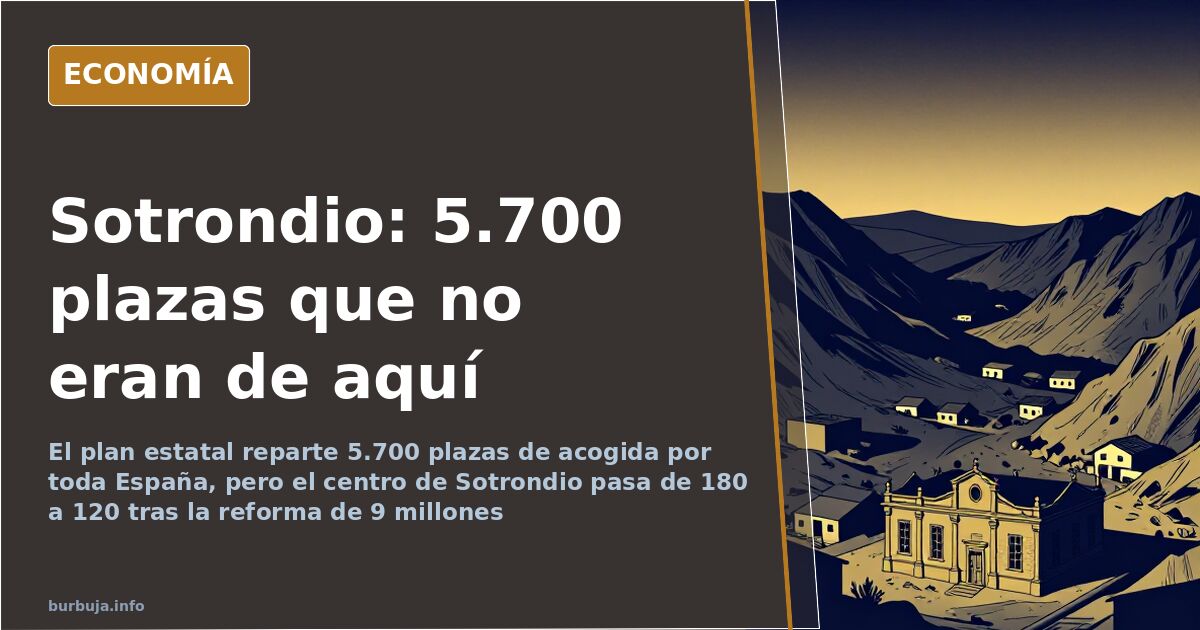
From 5,700 beds to 180: the center being prepared in Sotrondio
A village of 3,000 people. A figure of 5,700. The arithmetic didn’t add up anywhere, yet it circulated for days: Sotrondio, a town in the Asturian municipality of San Martín del Rey Aurelio, was to receive 5,700 unaccompanied migrant minors, almost double its population. The message spread with the warning that the information was official and that the locality was becoming an «international reception center for refugees». The fine print arrived later, stating something far less spectacular.
The starting point was a viral message estimating 5,700 migrant minors destined for the town. Cited media insisted on the context: «It is a mining basin, a land of solidarity». With these credentials, the issue escalated from social media to autonomous politics, with statements, banners, and a race to see who arrived first at the school where the center would be located.
Why was there talk of 5,700 beds in a town of 3,000 inhabitants?
Because the 5,700 beds exist, but they are not in Sotrondio. They correspond to a national plan to expand the reception system that distributes these new beds across Spain. The Asturian center would be the first in the region, not the destination for all of them. The confusion rests on an administrative detail that no one bothered to check before sharing.
The project being processed in the town refers to a building that would go from 180 beds to 120 after renovation, with an investment of €9 million and a planned start in January 2025. Square by square, the property cannot hold more. Those who claimed for days that thousands could fit there were describing a school with the capacity of a neighborhood sports center.
The Nalón basin: 80,000 inhabitants and many empty flats
Sotrondio belongs to the Nalón basin, a long, narrow valley where about 80,000 people live. It is not an isolated wasteland in the middle of nowhere, although it is sometimes portrayed as such. San Martín del Rey Aurelio once had 25,000 inhabitants when mining was active; today, the region lives on pensions, the memory of coal monoculture, and a stock of empty housing that grows each year.
There lies the underlying argument. For some, it is the logical site: abandoned houses, underused public services, and an aging population that needs people. For others, the cited precedent is Siero, where the arrival of several hundred workers linked to logistics activity coincided with tension in the services of a municipality of 50,000 inhabitants. Neither reading holds up with definitive data, and that explains half the noise.
The political clash: VOX in Sotrondio and the left’s response
The VOX party alleged attempts to sabotage its event in the town and spoke of an attack on the freedom of expression of the country’s third political force. Weeks earlier, a news report noted that two hundred people had supported the reception center, rejected by VOX, while IU and PSOE argued that «there are people interested in installing intolerance and hate.» The San José School in Sotrondio appears in all versions as the designated building.
The result is a municipality turned into a symbol before having a single bed operational. And a detail often overlooked: converting classrooms into reception beds is not a repopulation project, it is a budgeted work with a start date. Politics moves faster than bricks.
From Burela to Siero: the cited precedents
In the north, there is memory of previous arrivals. The case of Burela is recalled, where the Cape Verdean community settled decades ago to work at sea, on equal terms with locals, without notable conflicts at the time and with later discontent linked more to the labor market than to origin. It is also recalled that the basin has received people from central Spain for a century to make ends meet, with another outcome.
The difference, according to those who compare, is the context: before they came to work, now they arrive at a reception system. This distinction—between labor migration and subsidized beds—underpins almost all positions, including those defending the center for strictly demographic reasons.
What is expected from the Sotrondio reception center?
The sector supporting it expects population, activity, and maintenance of services in a valley that is fading. Those who reject it anticipate pressure on health, education, and housing, and note that residents leaving the center tend to leave for Oviedo or Gijón as soon as possible. No distribution plan, exit schedule, or estimate of how many will stay in the region has been published yet.
Added to the debate is a figure circulating without a source: 8,000 residents of Segarro origin in all of Asturias. Against it clashes the size of the real project, 120 beds after renovation. The accounts still do not balance for either side.
Sotrondio has 3,000 inhabitants, 120 projected beds, and a registry that has been falling for decades. The viral number, 5,700, was never theirs. The one that is theirs still has no date other than January 2025, which remains to be seen if it is met.
A village of 3,000 people. A figure of 5,700. The arithmetic didn’t add up anywhere, yet it circulated for days: Sotrondio, a town in the Asturian municipality of San Martín del Rey Aurelio, was to receive 5,700 unaccompanied migrant minors, almost double its population. The message spread with the warning that the information was official and that the locality was becoming an «international reception center for refugees». The fine print arrived later, stating something far less spectacular.
The starting point was a viral message estimating 5,700 migrant minors destined for the town. Cited media insisted on the context: «It is a mining basin, a land of solidarity». With these credentials, the issue escalated from social media to autonomous politics, with statements, banners, and a race to see who arrived first at the school where the center would be located.
Why was there talk of 5,700 beds in a town of 3,000 inhabitants?
Because the 5,700 beds exist, but they are not in Sotrondio. They correspond to a national plan to expand the reception system that distributes these new beds across Spain. The Asturian center would be the first in the region, not the destination for all of them. The confusion rests on an administrative detail that no one bothered to check before sharing.
The project being processed in the town refers to a building that would go from 180 beds to 120 after renovation, with an investment of €9 million and a planned start in January 2025. Square by square, the property cannot hold more. Those who claimed for days that thousands could fit there were describing a school with the capacity of a neighborhood sports center.
The Nalón basin: 80,000 inhabitants and many empty flats
Sotrondio belongs to the Nalón basin, a long, narrow valley where about 80,000 people live. It is not an isolated wasteland in the middle of nowhere, although it is sometimes portrayed as such. San Martín del Rey Aurelio once had 25,000 inhabitants when mining was active; today, the region lives on pensions, the memory of coal monoculture, and a stock of empty housing that grows each year.
There lies the underlying argument. For some, it is the logical site: abandoned houses, underused public services, and an aging population that needs people. For others, the cited precedent is Siero, where the arrival of several hundred workers linked to logistics activity coincided with tension in the services of a municipality of 50,000 inhabitants. Neither reading holds up with definitive data, and that explains half the noise.
The political clash: VOX in Sotrondio and the left’s response
The VOX party alleged attempts to sabotage its event in the town and spoke of an attack on the freedom of expression of the country’s third political force. Weeks earlier, a news report noted that two hundred people had supported the reception center, rejected by VOX, while IU and PSOE argued that «there are people interested in installing intolerance and hate.» The San José School in Sotrondio appears in all versions as the designated building.
The result is a municipality turned into a symbol before having a single bed operational. And a detail often overlooked: converting classrooms into reception beds is not a repopulation project, it is a budgeted work with a start date. Politics moves faster than bricks.
From Burela to Siero: the cited precedents
In the north, there is memory of previous arrivals. The case of Burela is recalled, where the Cape Verdean community settled decades ago to work at sea, on equal terms with locals, without notable conflicts at the time and with later discontent linked more to the labor market than to origin. It is also recalled that the basin has received people from central Spain for a century to make ends meet, with another outcome.
The difference, according to those who compare, is the context: before they came to work, now they arrive at a reception system. This distinction—between labor migration and subsidized beds—underpins almost all positions, including those defending the center for strictly demographic reasons.
What is expected from the Sotrondio reception center?
The sector supporting it expects population, activity, and maintenance of services in a valley that is fading. Those who reject it anticipate pressure on health, education, and housing, and note that residents leaving the center tend to leave for Oviedo or Gijón as soon as possible. No distribution plan, exit schedule, or estimate of how many will stay in the region has been published yet.
Added to the debate is a figure circulating without a source: 8,000 residents of Segarro origin in all of Asturias. Against it clashes the size of the real project, 120 beds after renovation. The accounts still do not balance for either side.
Sotrondio has 3,000 inhabitants, 120 projected beds, and a registry that has been falling for decades. The viral number, 5,700, was never theirs. The one that is theirs still has no date other than January 2025, which remains to be seen if it is met.
Summary of a discussion on Burbuja.info - Foro de economía, actualidad y política., translated from Spanish and reviewed before publication. Read the full discussion (356 replies).
More summaries
-
Carlos Latre's Ayuso impression ignites political humour row
Carlos Latre impersonates Isabel Díaz Ayuso on El Hormiguero, reopening the debate over double standards in political humour
-
Spain's military recruitment crisis: lack of vocation or social contract breakdown
Analysis of low military enlistment in Spain: pay, conditions and the collapse of the social contract
-
Granada shaken by earthquakes: damage, evacuations and cost
A 5.2 magnitude earthquake in Granada triggers the evacuation of 600 people, structural damage, and the closure of the Alhambra.
-
Civil Guard agent kills ex-partner in Asturias barracks
A banned officer steals a colleague's weapon and kills his ex-partner at a Llanes barracks, leaving three orphans.
-
Spain's contrail debate: geoengineering, patents, and drought
Satellite data links persistent contrails over Spain to fuel additive patents, with no instrumental evidence.
-
Spain's Spending Paradox: High Inflation Without Protest
200 euros fails to cover ten days of food for two, yet consumption remains strong. Spain's economy defies logic as savings vanish while prices soar.