
Madrid ranks 8th in quality of life: professor on the brink of poverty
Madrid and Málaga top the quality of life list, clashing with real incomes: a full-time teacher says life in Spain's capital is on the brink of poverty.
English · Original discussion in Spanish · Published
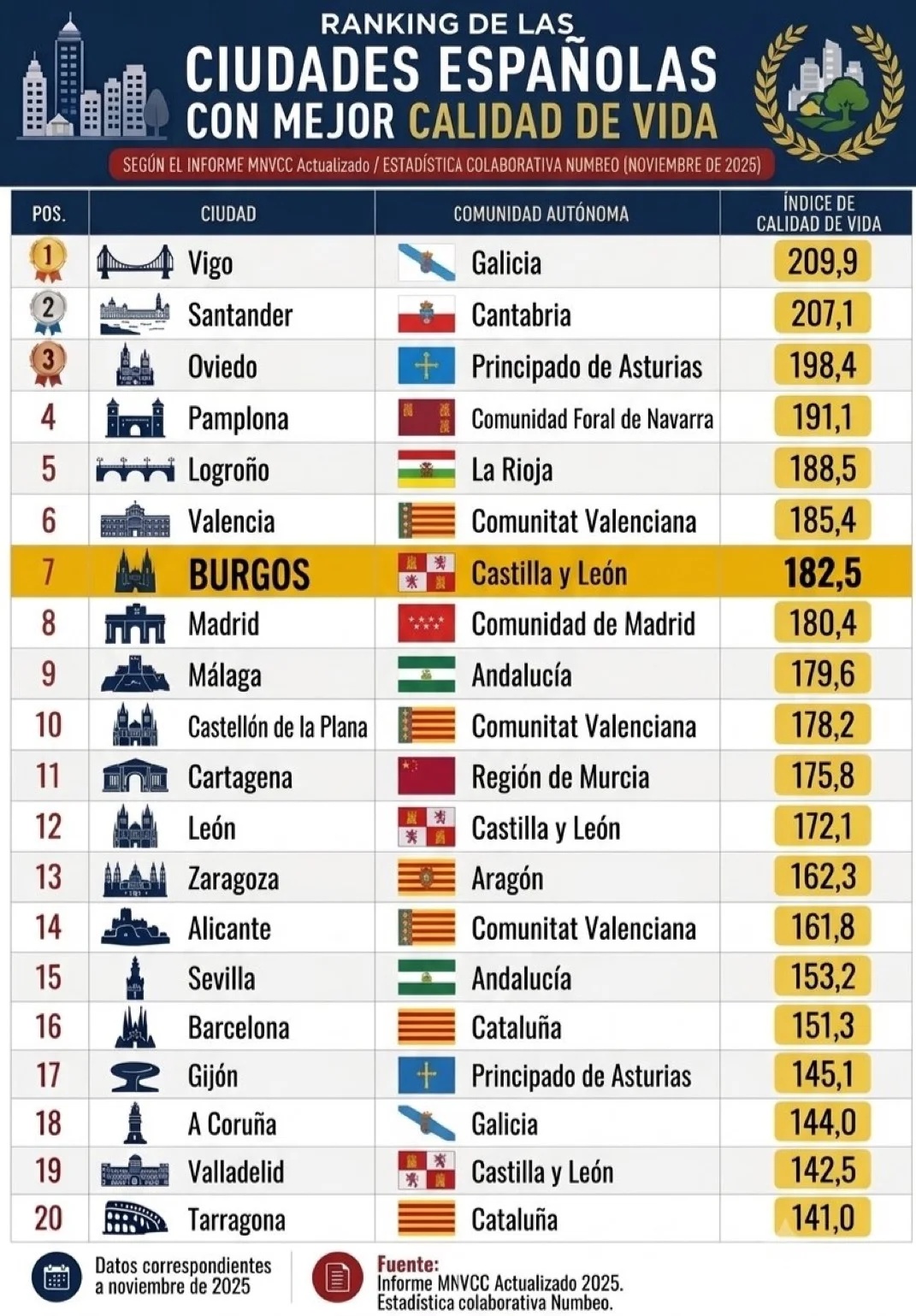
The ranking places Madrid eighth and Vigo at the top
A full-time, accredited university professor with years of achievements insists that life in Madrid leaves him on the brink of poverty. Meanwhile, the capital ranks eighth in Spain's quality of life ranking. Here lies the crux: indices ranking cities by livability collapse when cross-referenced with actual paychecks. Málaga is ninth, and Barcelona outranks A Coruña. Methodology dictates the outcome before the analysis even begins.
Madrid eighth, Málaga ninth: the joke of the year
The podium placing Madrid and Málaga in the top 10 has been the catalyst. Arguments about the Andalusian capital highlight a city turned theme park for visitors and digital nomads, with Oslo-level prices and Murcian wages. Meanwhile, in Madrid, a basement apartment in Carabanchel costs around 1,800 euros monthly, with mortgages stretching to 40 years. The recurring verdict: brochure-quality of life. The usual suspect is that the list rewards tourist appeal rather than the well-being of those living there 365 days a year.
What quality of life truly measures
The disorienting figure is San Sebastián's: 2,300 euros average income versus less than 1,500 in other regions. With this differential, climate takes a back seat. The most repeated proposal emerges: cross-reference each city with disposable income on a grid, scoring how one lives in each specific cell, because with money, one lives well almost anywhere, and without it, Madrid and Barcelona become the worst possible places. Moreover, the answer changes with age: the young seek cheap fun, adults seek jobs and good schools, and seniors escape bad weather. A full breakdown of this equation—income against cost, cell by cell—leaves the official ranking exposed.
The problem of defining what a city is
There is also the trap of the calculation base. If any provincial capital is included for its administrative weight, towns like Teruel (37,000 inhabitants), Soria (41,000), and Segovia (52,000) enter the list. If the threshold drops that low, dozens of medium-sized municipalities should appear. Their absence reshuffles the entire ranking.
Local wars
Settling scores between cities is fierce. Regarding Galicia, it is argued that Pontevedra, Santiago, and Lugo surpass A Coruña and Vigo. Vigo suffers the most: chaotic, poorly designed, with low income within its own community; the defense is scant. In Andalusia, the complaint is different: the presence of Seville and Málaga, but not Granada, Córdoba, or Cádiz, reveals that the index measures employment, not life. A sharp idea summarizes it: a bedroom community with an hour-long commute each way is not quality of life.
Those missing and those redundant
Cartagena at 11th and Tarragona at 20th fuel suspicion of a list that rotates annually based on who pushes. Among the absent, there is agreement in advocating for Burgos—small but highly industrialized with high salaries—and Palencia, one step from Valladolid and two and a half hours from the Cantabrian coast. Ceuta and Melilla are also missed, though the silence there speaks louder than any cell.
With these income differentials between provinces, migration northward and to medium-sized cities should be massive. It remains marginal. Better quality of life for whom and at what age?
A full-time, accredited university professor with years of achievements insists that life in Madrid leaves him on the brink of poverty. Meanwhile, the capital ranks eighth in Spain's quality of life ranking. Here lies the crux: indices ranking cities by livability collapse when cross-referenced with actual paychecks. Málaga is ninth, and Barcelona outranks A Coruña. Methodology dictates the outcome before the analysis even begins.
Madrid eighth, Málaga ninth: the joke of the year
The podium placing Madrid and Málaga in the top 10 has been the catalyst. Arguments about the Andalusian capital highlight a city turned theme park for visitors and digital nomads, with Oslo-level prices and Murcian wages. Meanwhile, in Madrid, a basement apartment in Carabanchel costs around 1,800 euros monthly, with mortgages stretching to 40 years. The recurring verdict: brochure-quality of life. The usual suspect is that the list rewards tourist appeal rather than the well-being of those living there 365 days a year.
What quality of life truly measures
The disorienting figure is San Sebastián's: 2,300 euros average income versus less than 1,500 in other regions. With this differential, climate takes a back seat. The most repeated proposal emerges: cross-reference each city with disposable income on a grid, scoring how one lives in each specific cell, because with money, one lives well almost anywhere, and without it, Madrid and Barcelona become the worst possible places. Moreover, the answer changes with age: the young seek cheap fun, adults seek jobs and good schools, and seniors escape bad weather. A full breakdown of this equation—income against cost, cell by cell—leaves the official ranking exposed.
The problem of defining what a city is
There is also the trap of the calculation base. If any provincial capital is included for its administrative weight, towns like Teruel (37,000 inhabitants), Soria (41,000), and Segovia (52,000) enter the list. If the threshold drops that low, dozens of medium-sized municipalities should appear. Their absence reshuffles the entire ranking.
Local wars
Settling scores between cities is fierce. Regarding Galicia, it is argued that Pontevedra, Santiago, and Lugo surpass A Coruña and Vigo. Vigo suffers the most: chaotic, poorly designed, with low income within its own community; the defense is scant. In Andalusia, the complaint is different: the presence of Seville and Málaga, but not Granada, Córdoba, or Cádiz, reveals that the index measures employment, not life. A sharp idea summarizes it: a bedroom community with an hour-long commute each way is not quality of life.
Those missing and those redundant
Cartagena at 11th and Tarragona at 20th fuel suspicion of a list that rotates annually based on who pushes. Among the absent, there is agreement in advocating for Burgos—small but highly industrialized with high salaries—and Palencia, one step from Valladolid and two and a half hours from the Cantabrian coast. Ceuta and Melilla are also missed, though the silence there speaks louder than any cell.
With these income differentials between provinces, migration northward and to medium-sized cities should be massive. It remains marginal. Better quality of life for whom and at what age?
Summary of a discussion on Burbuja.info - Foro de economía, actualidad y política., translated from Spanish and reviewed before publication. Read the full discussion (291 replies).
More summaries
-
Canal Red: Subscriptions at €25 a month, with up to €100 tier for Latam
Canal Red funds its operation with €25 monthly subscriptions and a Latam tier above €100. A model supporting an entire staff.
-
Granada shaken by earthquakes: damage, evacuations and cost
A 5.2 magnitude earthquake in Granada triggers the evacuation of 600 people, structural damage, and the closure of the Alhambra.
-
Civil Guard agent kills ex-partner in Asturias barracks
A banned officer steals a colleague's weapon and kills his ex-partner at a Llanes barracks, leaving three orphans.
-
Crypto Romance Scam: Man Loses 600,000 Euros to Online Lover
A Spanish man loses 600,000 euros in a crypto romance scam orchestrated by Southeast Asian networks. The case highlights the growing threat of digital fraud targeting vulnerable individuals.
-
Spain's contrail debate: geoengineering, patents, and drought
Satellite data links persistent contrails over Spain to fuel additive patents, with no instrumental evidence.
-
Spain's Spending Paradox: High Inflation Without Protest
200 euros fails to cover ten days of food for two, yet consumption remains strong. Spain's economy defies logic as savings vanish while prices soar.