
Hard Work Doesn't Pay: Spain's Meritocracy Crisis
A Spanish forum exposes how high tuition, low doctoral offers, and 800-euro salaries undermine the meritocracy myth.
English · Original discussion in Spanish · Published
Working Hard in Spain: The Story That Doesn't Fit the Paycheck
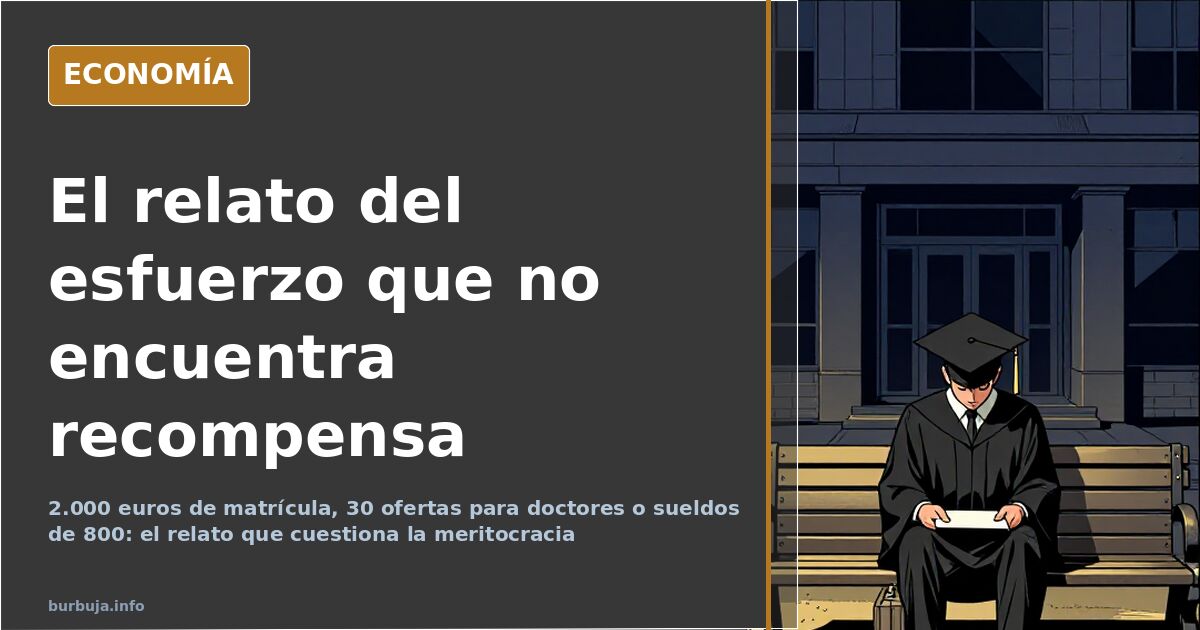
Hard work doesn't pay. Not in school, not at university, and not in the first job interview. This is the bold claim opening a lengthy, anecdote-rich portrait of the Spanish educational journey. The thesis is sharp, but nuance emerges upon reading further.
The narrative begins in primary school: a student striving for a 10 receives the same qualitative grade—PA—as one barely reaching a 5, rendering the scale meaningless. Then comes high school, with mixed ages and levels, and bullying as a threat to those who wish to study. This complaint repeats at every stage: the system levels everyone down.
The 'PA' Grade and 2,000-Euro Tuition
The first bill arrives with tuition: around 2,000 euros, compared to the standard 50 to 100 euros paid across much of Europe, according to this account. On top of that is the penalty for repeating. If you fail or don't register and re-enroll, the credit price is charged double, with no justification that survives scrutiny. This is the part of the story generating the most outrage.
The other front is scholarships. The recurring argument is that aid does not reward performance but is conditioned by family wealth: inheriting 20% of grandparents' house is enough to be excluded from any grant.
Why Doesn't the Transcript Lead to a Job?
The next barrier is the labor market. According to job portal listings, what is most demanded are vocational training and compulsory secondary education (ESO) qualifications, while for PhD holders, only 30 job offers appear. This contrast is summarized by a specific case: a candidate applies for an IT vacancy at a hospital, offers to cover an administrative assistant role if rejected for the first, and receives not a single call.
Job ads, they say, demand someone your age with three degrees, four languages, five master's, and ten years of experience. And salaries don't match: they cite 800 euros for the job studied for, versus 2,500 euros earned cleaning floors in another country. The uncomfortable conclusion: the title certifies effort, not employability.
Meritocracy That Sounds Like 'Emeritocracy'
The focus then shifts to nepotism. Some describe an administration with posts not filled by merit, tenured officials performing below par, and climbers thriving without producing. The phrase capturing the thread's mood best is that meritocracy has always been sold as a lie when they meant Emeritocracy.
The political case cited is the attempt to create elite public institutes for diligent students in the Community of Madrid, which—according to this account—was met with claims of fascism and supremacy. This is not a unanimous reading. The objection comes from another angle: no godfather is needed if one is truly excellent, and outstanding students are snapped up by companies or PhD supervisors. The real risk, they add, is not one's background, but encountering certain teachers or a climber with a golden hand in a leadership position.
The American Dream Doesn't Hold Up Either
The comparison with the United States falls quickly. The garage myth is debunked by a fact: Amazon founder's adoptive father gave him $260,000 to keep the company from collapsing in the 1990s. And some recall that Microsoft's founder was not born in poverty. The fantasy of the capital-free entrepreneur is reduced to motivational propaganda.
Even accepting that social mobility existed in another country decades ago, the prevailing diagnosis is that this ascent has closed there too. The most blunt formulation, from a forum user: those born poor die poor.
Two Paths: Start a Business or Leave
Given this landscape, only two sensible paths are recognized for truly qualified individuals. The first is starting your own business: it requires capital, collaboration, and a loan, and not all specialties allow this equally. The second is emigrating to a country with real economic growth; Switzerland and Austria appear as preferred destinations, though it is admitted they are no longer the panacea of decades past.
The counterpoint comes from those defending upward mobility: a worker who sacrifices holidays, saves, and eventually starts a business. And there remains the classic advice from a well-known TV chef: get a trade first, then study a degree. None of this closes the gap in the initial diagnosis.
Another reading insists the problem is attitude, a defeatist mindset, and blaming others. Against this weighs the rest of the thread: those who trained and find no space, and those who choose to leave.
If the cost of education keeps rising and the return keeps falling, the forecast hovering over the entire conversation is simple: the best will continue to leave. With reservations, because those who stay also find space, but without anyone daring to sign that effort will pay again simply for being effort.
Hard work doesn't pay. Not in school, not at university, and not in the first job interview. This is the bold claim opening a lengthy, anecdote-rich portrait of the Spanish educational journey. The thesis is sharp, but nuance emerges upon reading further.
The narrative begins in primary school: a student striving for a 10 receives the same qualitative grade—PA—as one barely reaching a 5, rendering the scale meaningless. Then comes high school, with mixed ages and levels, and bullying as a threat to those who wish to study. This complaint repeats at every stage: the system levels everyone down.
The 'PA' Grade and 2,000-Euro Tuition
The first bill arrives with tuition: around 2,000 euros, compared to the standard 50 to 100 euros paid across much of Europe, according to this account. On top of that is the penalty for repeating. If you fail or don't register and re-enroll, the credit price is charged double, with no justification that survives scrutiny. This is the part of the story generating the most outrage.
The other front is scholarships. The recurring argument is that aid does not reward performance but is conditioned by family wealth: inheriting 20% of grandparents' house is enough to be excluded from any grant.
Why Doesn't the Transcript Lead to a Job?
The next barrier is the labor market. According to job portal listings, what is most demanded are vocational training and compulsory secondary education (ESO) qualifications, while for PhD holders, only 30 job offers appear. This contrast is summarized by a specific case: a candidate applies for an IT vacancy at a hospital, offers to cover an administrative assistant role if rejected for the first, and receives not a single call.
Job ads, they say, demand someone your age with three degrees, four languages, five master's, and ten years of experience. And salaries don't match: they cite 800 euros for the job studied for, versus 2,500 euros earned cleaning floors in another country. The uncomfortable conclusion: the title certifies effort, not employability.
Meritocracy That Sounds Like 'Emeritocracy'
The focus then shifts to nepotism. Some describe an administration with posts not filled by merit, tenured officials performing below par, and climbers thriving without producing. The phrase capturing the thread's mood best is that meritocracy has always been sold as a lie when they meant Emeritocracy.
The political case cited is the attempt to create elite public institutes for diligent students in the Community of Madrid, which—according to this account—was met with claims of fascism and supremacy. This is not a unanimous reading. The objection comes from another angle: no godfather is needed if one is truly excellent, and outstanding students are snapped up by companies or PhD supervisors. The real risk, they add, is not one's background, but encountering certain teachers or a climber with a golden hand in a leadership position.
The American Dream Doesn't Hold Up Either
The comparison with the United States falls quickly. The garage myth is debunked by a fact: Amazon founder's adoptive father gave him $260,000 to keep the company from collapsing in the 1990s. And some recall that Microsoft's founder was not born in poverty. The fantasy of the capital-free entrepreneur is reduced to motivational propaganda.
Even accepting that social mobility existed in another country decades ago, the prevailing diagnosis is that this ascent has closed there too. The most blunt formulation, from a forum user: those born poor die poor.
Two Paths: Start a Business or Leave
Given this landscape, only two sensible paths are recognized for truly qualified individuals. The first is starting your own business: it requires capital, collaboration, and a loan, and not all specialties allow this equally. The second is emigrating to a country with real economic growth; Switzerland and Austria appear as preferred destinations, though it is admitted they are no longer the panacea of decades past.
The counterpoint comes from those defending upward mobility: a worker who sacrifices holidays, saves, and eventually starts a business. And there remains the classic advice from a well-known TV chef: get a trade first, then study a degree. None of this closes the gap in the initial diagnosis.
Another reading insists the problem is attitude, a defeatist mindset, and blaming others. Against this weighs the rest of the thread: those who trained and find no space, and those who choose to leave.
If the cost of education keeps rising and the return keeps falling, the forecast hovering over the entire conversation is simple: the best will continue to leave. With reservations, because those who stay also find space, but without anyone daring to sign that effort will pay again simply for being effort.
Summary of a discussion on Burbuja.info - Foro de economía, actualidad y política., translated from Spanish and reviewed before publication. Read the full discussion (291 replies).
More summaries
-
El Mundo Leads with Aldama-Delcy Hydrocarbons Scheme
Spanish court investigates messages between Delcy Rodríguez and Aldama on multi-million euro oil deals linked to PSOE funding.
-
UGR Dispute Sparks Academic Freedom Debate
Analysis of the University of Granada confrontation and the debate on academic limits.
-
AI: Powerful Tool or Source of Serious Errors
AI generates false data in taxes and finance, but accelerates productivity. We analyze the risks of blindly trusting language models.
-
Russia's Dnipro Missile Was Not Nuclear or ICBM
The strike on Dnipro used an experimental intermediate-range weapon, not an ICBM. Moscow notified the US beforehand, signaling a message rather than a doctrinal shift.
-
Vanishing Trades: Self-Employed Fees vs. Skilled Wages
Skilled trades in Spain face a crisis as high fixed costs for freelancers and stagnant wages deter new entrants, leaving essential roles like plumbing and mechanics unfilled.
-
Spanish farmers dump Moroccan tomatoes in protest of dumping
Spanish farmers empty a truck of Moroccan tomatoes on the AP-4 near Jerez, signaling a major escalation in agricultural protests over dumping and tariffs.