
Toyota, Honda, or Lexus: Which Japanese Brand Lasts 400,000 km?
A study of 395 million vehicles measures durability, clashing with parts availability and the real condition of Japanese used cars.
English · Original discussion in Spanish · Published
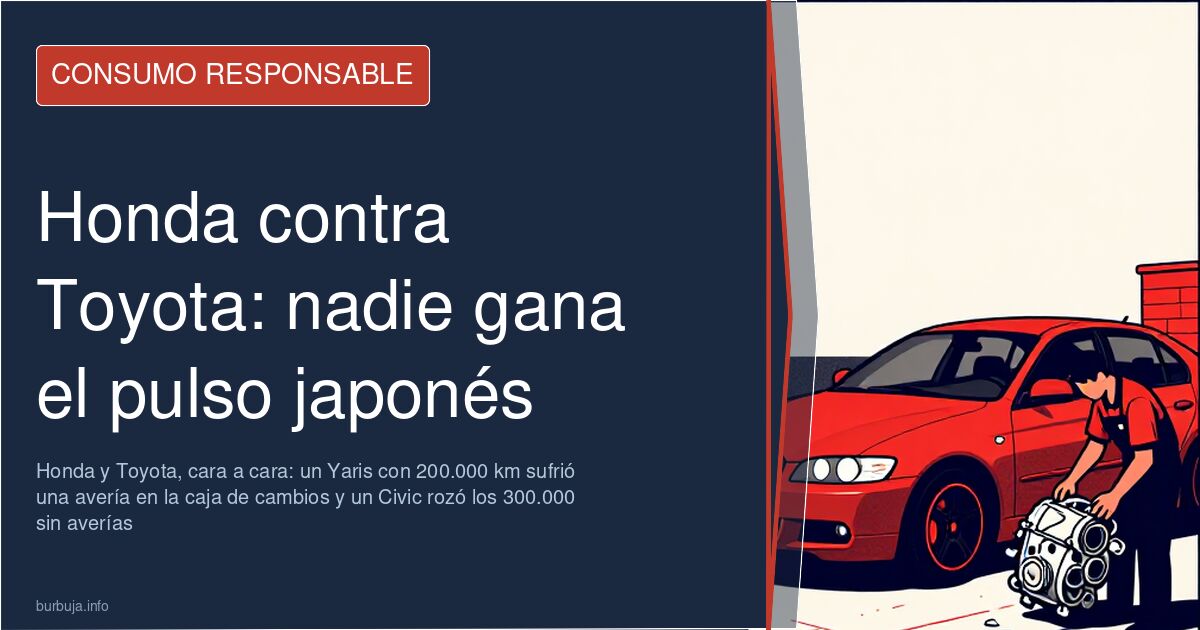
Toyota, Honda, or Lexus: Which Japanese Brand Lasts 400,000 km
The question might seem casual, but some answer it with 395 million vehicles as their basis. The cited study analyzes the US market and filters what percentage of cars exceed 250,000 miles, or about 400,000 kilometers. Mazda ranks sixth. And the fine print: the data is American, and cars here are stretched much further.
The mistake is confusing durability with a smart purchase. An engine that lasts 400,000 kilometers is useless if spare parts don't exist, the workshop charges exorbitant prices, or the used unit has been neglected for a decade.
What the Study on 395 Million Vehicles Says
The analysis, as reported, doesn't collect opinions: it measures survival. Based on this enormous pool of vehicles, it filters what percentage surpasses 250,000 miles. The simple conclusion: buying Japanese reduces the odds of bad luck, but doesn't eliminate it.
And there's a bias to keep in mind, according to those citing the study: in Spain, a car's lifespan is stretched much longer than in the United States. Translating the ranking without adjusting for this would be a statistical cheat.
Why Does an 18-Year-Old Yaris Lose Its Gearbox?
Because the failure exists, and so does the replacement part. A Toyota Yaris with 18 years and 200,000 kilometers lost its gearbox and had no replacement part available, according to a specific case reported: apparently, that model is prone to this failure. It's noted that Toyota offers a long warranty, up to 15 years, but no manufacturer will produce a new gearbox for a car two decades old.
This is where the myth of the indestructible car falls apart. Average reliability doesn't protect a specific owner of a specific failing model. And when a part is unavailable, the world's most reliable brand becomes an expensive paperweight.
Honda vs. Toyota: Engines vs. Spare Parts
Some argue that Honda wins on the mechanical side. The most repeated argument is that their engines last even longer than Toyota's, and in the motorcycle world, their dominance is almost absolute: 'there are only two motorcycle brands, Honda and all the others.' The counterargument comes with the bill. Honda is more expensive, parts are too, and when something breaks, the repair is costly.
Toyota wins in the boring aspects. Parts are plentiful, any neighborhood mechanic can fix it, and you pay the brand price regardless. The aesthetics, however, tend towards 'appliance.' Those seeking excitement aren't in the right dealership.
Lexus, Mazda, and Used Cars as a Gamble
If you only consider quality, the most common answer is Lexus, with an interesting nuance: if you look carefully, you can find 'used gems' at Toyota prices. According to one participant, the Mazda, Subaru, Suzuki, Mitsubishi, and Nissan block comes a step below. There's a gasoline Mazda 3 with 20 years and no breakdowns, and also those who shun Subaru like the plague.
The black spot is the used market. Honda has a fruta for attracting a profile that mistreats cars, so 'beaten-up' examples are abundant, while Toyota is associated with family drivers and is found in better condition. Curiously, the same argument that praises the engine hurts resale value.
With these factors, no brand dominates. The data that would settle the question—what percentage survives in Spain, not the United States—is not available. And that, precisely, is where the analysis gets stuck.
The question might seem casual, but some answer it with 395 million vehicles as their basis. The cited study analyzes the US market and filters what percentage of cars exceed 250,000 miles, or about 400,000 kilometers. Mazda ranks sixth. And the fine print: the data is American, and cars here are stretched much further.
The mistake is confusing durability with a smart purchase. An engine that lasts 400,000 kilometers is useless if spare parts don't exist, the workshop charges exorbitant prices, or the used unit has been neglected for a decade.
What the Study on 395 Million Vehicles Says
The analysis, as reported, doesn't collect opinions: it measures survival. Based on this enormous pool of vehicles, it filters what percentage surpasses 250,000 miles. The simple conclusion: buying Japanese reduces the odds of bad luck, but doesn't eliminate it.
And there's a bias to keep in mind, according to those citing the study: in Spain, a car's lifespan is stretched much longer than in the United States. Translating the ranking without adjusting for this would be a statistical cheat.
Why Does an 18-Year-Old Yaris Lose Its Gearbox?
Because the failure exists, and so does the replacement part. A Toyota Yaris with 18 years and 200,000 kilometers lost its gearbox and had no replacement part available, according to a specific case reported: apparently, that model is prone to this failure. It's noted that Toyota offers a long warranty, up to 15 years, but no manufacturer will produce a new gearbox for a car two decades old.
This is where the myth of the indestructible car falls apart. Average reliability doesn't protect a specific owner of a specific failing model. And when a part is unavailable, the world's most reliable brand becomes an expensive paperweight.
Honda vs. Toyota: Engines vs. Spare Parts
Some argue that Honda wins on the mechanical side. The most repeated argument is that their engines last even longer than Toyota's, and in the motorcycle world, their dominance is almost absolute: 'there are only two motorcycle brands, Honda and all the others.' The counterargument comes with the bill. Honda is more expensive, parts are too, and when something breaks, the repair is costly.
Toyota wins in the boring aspects. Parts are plentiful, any neighborhood mechanic can fix it, and you pay the brand price regardless. The aesthetics, however, tend towards 'appliance.' Those seeking excitement aren't in the right dealership.
Lexus, Mazda, and Used Cars as a Gamble
If you only consider quality, the most common answer is Lexus, with an interesting nuance: if you look carefully, you can find 'used gems' at Toyota prices. According to one participant, the Mazda, Subaru, Suzuki, Mitsubishi, and Nissan block comes a step below. There's a gasoline Mazda 3 with 20 years and no breakdowns, and also those who shun Subaru like the plague.
The black spot is the used market. Honda has a fruta for attracting a profile that mistreats cars, so 'beaten-up' examples are abundant, while Toyota is associated with family drivers and is found in better condition. Curiously, the same argument that praises the engine hurts resale value.
With these factors, no brand dominates. The data that would settle the question—what percentage survives in Spain, not the United States—is not available. And that, precisely, is where the analysis gets stuck.
Summary of a discussion on Burbuja.info - Foro de economía, actualidad y política., translated from Spanish and reviewed before publication. Read the full discussion (91 replies).
More summaries
-
Chinese vs European cars: the gap between equipment and finishes
Leapmotor B03x costs 17.500€ vs 25.000€ for the Skoda Epiq, but the Ebro 400's finishes and engine reignite the debate about its real quality.
-
1960s and 70s Cars in Spain: A Coca-Cola Can on Wheels
The cars of the 60s and 70s in Spain were low quality: doors that wouldn't latch, fragile bodies, and an industry that merely assembled Fiat designs...
-
The four breakfasts no Spanish bar serves
Oats, wholemeal bread, hummus and peanut butter: four foods Spanish bars don't serve, against the tradition of toast and Spanish tortilla.
-
Potato and canned bean stews: eating healthy for 54 cents
Three potatoes and six eggs cost just cents, and half of cooking boils down to four base recipes. Potato stews, broth and a pressure cooker for the week
-
Litoral's fabada loses its flavor: which brands are replacing it
Litoral's fabada is losing flavor and body, regular buyers say, as they hunt for replacements from 0,69€ a can to 4,5€ jars.
-
Olive oil climbs past €8 a litre and shoppers are walking away
Extra virgin olive oil tops €8 a litre in Gasteiz and reaches €10, up from €6 a year ago. More and more shoppers are taking it off their lists