
Total blackout on La Palma as emergency services declare general alert
A blackout leaves La Palma without power and emergency services declare a general alert. The island, with no electrical interconnection, suffers water cuts and disruptions to critical services.
English · Original discussion in Spanish · Published
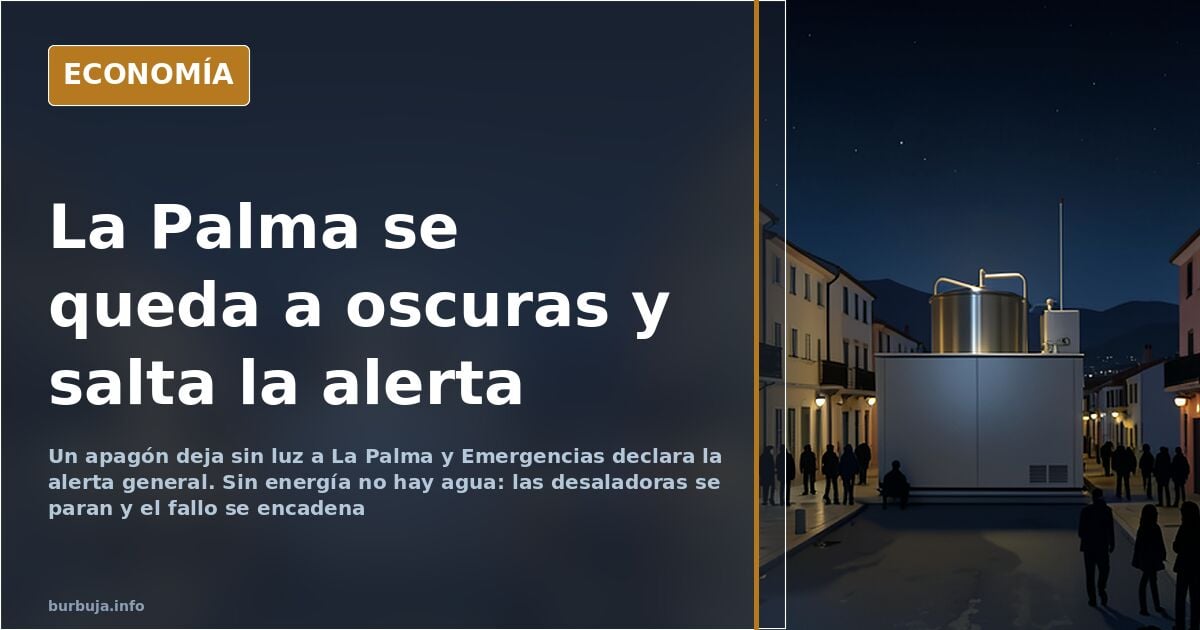
La Palma goes dark and its island power grid is back to square one
A blackout has left La Palma without electricity and emergency services have declared a general alert across the island. The outage is not an isolated incident involving a worn-out transformer: it is yet another bill from an electrical system that runs as an island, in every sense, with no interconnection to the rest of the archipelago. The news comes with the hospital, the desalination plants and everyday life hanging by a thread of aging copper.
The smallest of the large Canary Islands operates as an isolated system. There is no cable to save it if generation fails. And when it fails, it fails entirely.
Why a blackout on La Palma brings down the whole system
La Palma is not connected to any other island in the archipelago. Its power grid is a closed ecosystem where generation and demand must balance second by second. When that balance breaks, there is no neighbor to ask for power. The result is a textbook energy zero: a cascading collapse, plants shut down and municipalities in the dark.
On top of that fragile architecture, years of aging equipment and renewable experiments have piled up — experiments that, in the words circulating in the sector, were done on the cheap. Wind turbines and solar farms contribute, but they cannot hold the frequency when the system goes out of balance. The slightest failure brings the whole thing down.
The blackout dragged essential services down with it. The desalination plants came to a standstill, which led to drinking water cuts across much of the island's municipalities. No power means no pumping, and no pumping means no tap water. The general alert declared by emergency services is not an administrative formality: it is an acknowledgment that the island has lost two basic supplies at once.
The political bill for the energy zero
The outage hit in the middle of the hangover from other infrastructure crises, and the debate escalated quickly. Some read the blackout as proof of a broader decline: railways that fail, a power grid under strain, maintenance that keeps being postponed. The dominant thesis in part of the analysis is that Spain is falling into the Third World _at an accelerating pace_ after years of underinvestment.
On the other side, the technical argument: La Palma is a small, isolated system with an aging generation fleet. No government can fix in one budget what geography imposes. The real discussion is not who is to blame for the last blown fuse, but how much it costs to maintain an island grid that will never be cheap or robust.
The shadow of management also looms over the matter. There are suggestions that critical functions may have been delegated to automated control systems, and it is recalled that a general blackout already occurred months ago. These are suspicions without official verification, but they feed distrust of the institutional narrative.
The uncomfortable question remains: how many island blackouts are needed for maintenance to stop being an expense and become a priority? The answer, like the lights on La Palma, is still waiting for someone to close the circuit.
Summary of a discussion on Burbuja.info - Foro de economía, actualidad y política., translated from Spanish and reviewed before publication. Read the full discussion (68 replies).
More summaries
-
Canary Islands blackout: La Palma and Tenerife hit by power cuts
La Palma and Tenerife suffer blackouts while the Spanish government stays silent. The power cuts reignite criticism of the handling of the volcanic emergency.
-
The €10 per square metre proposal and the numbers that don't add up
A tweet mocks a young man hoping to buy a home at €10/m². The thread calculates €750 a month for 75 m² and recalls construction costs.
-
MAGA VoX ally who helped draft anti-antisemitism hoax laws caught abusing his grandson
A post on X claims that Israel supports people convicted of sexual abuse because they are easy to control. The message offers no evidence.
-
Urda: the shame of a rail crash no one will explain
A train rammed into another standing at Urda in Spain: the automatic braking system failed to act, and the line had already suffered another collision this year. The aftermath, under…
-
Barcelona's Colau blames far right for looting
Barcelona mayor Ada Colau blames the far right for the city's looting, as debate rages in Spain over whether the phenomenon even exists and who is really behind the riots.
-
Spanish men and South American women: the rivalry dividing men
A story about a bald man and a South American woman on a Spanish beach sparks 55 days of debate about relationships, status and money in Spain