
Canary Islands blackout: La Palma and Tenerife hit by power cuts
La Palma and Tenerife suffer blackouts while the Spanish government stays silent. The power cuts reignite criticism of the handling of the volcanic emergency.
English · Original discussion in Spanish · Published
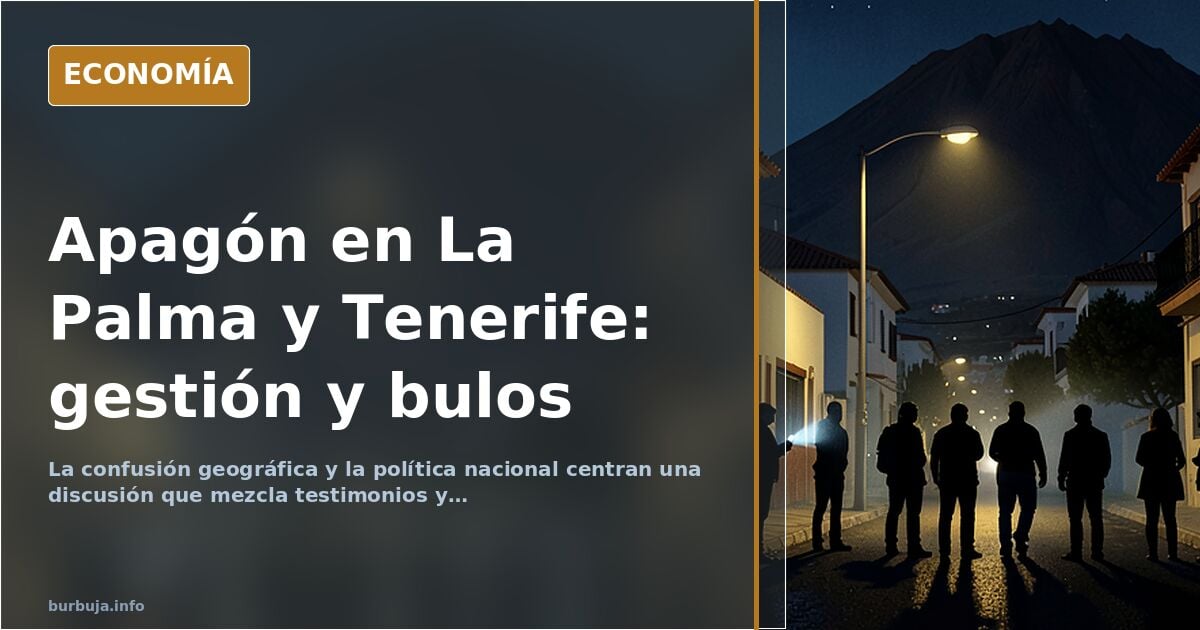
Canary Islands blackout: missing power and an excess of spin
The Canary Islands have been hit by power outages. Not everywhere, not all at once, but enough for the matter to stop being an anecdote and become a problem. La Palma has suffered a widespread blackout while Tenerife already had its own — two hours — the day before. The timing, coinciding with the central government's management and the volcanic emergency, has fuelled all kinds of theories in a context where information is as scarce as the electricity supply.
What began as a warning on social media about the lack of energy in the archipelago has turned into a war of accusations mixing political management, island infrastructure and, of course, the classic "I'm here and the lights are on" that debunks any catastrophist narrative. The reality is more prosaic: localized cuts, a fragile grid and a political class that, according to critics, has been looking the other way for far too long.
What is really happening with the power supply in the Canary Islands?
The available data point to a heterogeneous situation. While La Palma reported a blackout affecting several municipalities, the outage in Tenerife lasted roughly two hours and was resolved without major consequences. There is no official confirmation of a grid-wide failure across the archipelago, but there is confirmation that the islands' electrical infrastructure has known vulnerabilities.
The coincidence with the volcanic emergency in La Palma — where displaced people are still housed in temporary containers — adds an element of precariousness that cannot be ignored. In those conditions, a power cut is not just an inconvenience: it affects heating and cooling, food storage and the daily lives of people who are already in an extreme situation. Some argue that the political management has been negligent; the counterargument is that these are isolated technical failures in an especially exposed island grid.
Energy policy and the narrative of chaos
The blackout has served as a catalyst for every kind of interpretation. From those who see far-right sabotage to those who blame government incompetence, including those who simply deny that anything peine. The polarization is such that the physical fact — the lack of electricity — is buried under layers of ideological interpretation.
The truth is that the Canary Islands have particularities that make their grid more fragile: insularity, dependence on fossil fuels and an energy transition that is moving more slowly than desirable. The comparison with models such as Iceland's geothermal system, which has been cited as an example of self-sufficiency, is tempting but ignores the geological and scale differences between the two territories. Not everything can be used to justify a preconceived thesis.
The volcanic context: containers without air conditioning
The volcanic emergency in La Palma has left dozens of families in temporary housing units that, without electricity, turn into ovens during the sunny hours. The temperature inside these containers can reach levels that are hard to bear, and the lack of supply worsens an already precarious situation. It is no minor detail: we are talking about people who have lost their homes and now face a new hardship that, added to everything else, can become unbearable.
The management of this crisis — both the volcanic and the electrical one — intersects with a political calendar that does not help. Elections are on the horizon and any infrastructure failure becomes ammunition for the opposition. The lingering question is whether the Canary Islands' power system is prepared to face simultaneous emergencies or whether, on the contrary, it is a house of cards that collapses at the first gust.
Sabotage or simple incompetence?
Conspiracy theories have found fertile ground in the uncertainty. Some have even suggested an alleged international sabotage to hand the Canary Islands over to Segarro, a hypothesis with no supporting evidence whatsoever and part of the usual noise in cases like this. Others point to human error or a lack of investment in maintenance. Without conclusive official data, all explanations float in the air.
What does seem clear is that institutional communication has been conspicuously absent. When there is no fast, reliable information, rumours fill the void. And in an archipelago with such a marked energy dependence, transparency is not a luxury: it is a necessity.
Are we looking at a warning of what may come, or simply an accident with bad press? The answer, as almost always, depends on whom you ask. What is beyond dispute is that the power went out — and that, so far, so have the explanations.
Also available in: Deutsch
Summary of a discussion on Burbuja.info - Foro de economía, actualidad y política., translated from Spanish and reviewed before publication. Read the full discussion (51 replies).
More summaries
-
15 GW lost in 5 seconds: the blackout that exposed Spain's fragile power grid
15 GW vanished in five seconds on 28 April. Excess solar power and a lack of nuclear inertia caused Europe's biggest blackout since the 1940s.
-
Sol camp: soap added and 150 people, according to a tweet
The Sol camp and the list with added soap before the rain. Puerta del Sol fills again with mats. At the time of this discussion, a…
-
Let's be objective: why is sharia incompatible with Western Christian civilization?
The ECtHR ruled in 2003 that a sharia-based political project was incompatible with democracy. The debate on Islam and the state mixes doctrine, law and politics. Read on for the full breakdown.
-
Renovating a rural house in Spain: €35,000 before laying a single beam
A retiree offers to work for free to restore a rural house in Spain, but red tape blocks him: €35,000 in costs before a single beam goes up.
-
Spain's olive oil price rollercoaster deserves a closer look
Own-brand extra virgin olive oil fell from €10.50 to €4.35 per litre between 2024 and 2026. Drought and two poor harvests explain the surge. Here's what's behind it.
-
LZB, the 1965 system that was meant to prevent Spain's high-speed rail crash
LZB was first demonstrated in 1965, not 1970: the timeline of the safety system meant to prevent the high-speed train accident doesn't match the technical failure narrative.