
Torrejón: Drunk Officers Leave Man Dead in Street
Abderrahim died from asphyxiation in Torrejón de Ardoz after being pinned for over ten minutes by an off-duty drunk officer. Autopsy pending.
English · Original discussion in Spanish · Published
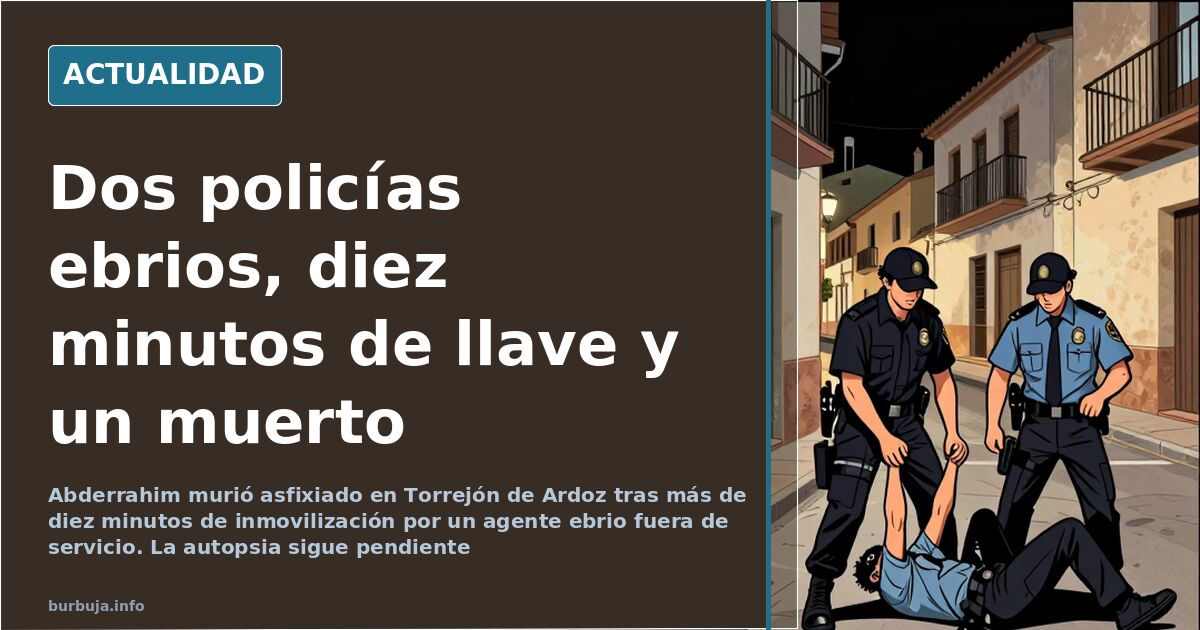
Torrejón de Ardoz: Two Drunk Officers and a Man Dead in the Street
Abderrahim, a 35-year-old man, died from asphyxiation on Tuesday night in a public street in Torrejón de Ardoz (Madrid). An off-duty Madrid Municipal Police officer kept his arm around the victim's neck with his full body weight on top of him for more than ten minutes, while a second man, a retired former officer, held his legs down. Neighbors filmed the scene and begged them to let go. No one did. Both officers tested positive for alcohol.
The judge at Court of Instruction No. 1 of Torrejón de Ardoz has released the officer under precautionary measures—passport seizure and weekly check-ins—and is investigating him for alleged negligent homicide. Both have been suspended without pay and face disciplinary proceedings. The case has moved to Court of Instruction No. 4, which handled the body removal.
What Witnesses Say and What Videos Reveal
Neighbors' recordings are the most disturbing evidence in the case. In them, a man warns the officer he is suffocating the detainee, a woman pleads for him to breathe, and the officer responds with contempt to those confronting him. "He's breathing... okay," he says at one point, when another neighbor alerts him that the man isn't moving.
Abderrahim's family rejects the framing of the incident as an arrest. His brothers, in tears, insist there was no attempt to move or restrain him: "This was murder, not an arrest," they told media outlets. They also raised a suspicion not confirmed by the court: that the action was motivated by racial prejudice. This is the family's accusation, not an established fact.
What Do We Know About the Autopsy and Charges?
The official cause of death remains undetermined. The preliminary forensic report had not been delivered at the time of this discussion, and it will be key to establishing whether mechanical asphyxia or another mechanism occurred. UFP police union spokesperson Carlos Quero summarized it thus: the autopsy will determine the causes of death.
JUPOL union confirmed both officers tested positive for alcohol. The provisional charge is negligent homicide, not murder, and this distinction—intent versus negligence—is what separates a high sentence from a low one. The officer also faces suspension without pay, which is an administrative measure, not a penalty.
The Narrative Competing with the Family's Account
A different version of events circulates in public debate: that the two officers were having dinner with colleagues, that two people stole their mobile phone, and that the pursuit led to a struggle. This sequence is supported by those defending the officers and has not been confirmed by any judicial ruling. The only proven facts so far are the positive alcohol tests, the open investigation, and the death.
Some argue that the deceased's history—previous arrests, according to that version—reduces the gravity of the case. This argument does not hold up legally: the victim's status does not alter the classification of the officer's conduct. And others, on the opposite side, assume murder is proven before the coroner signs a single line.
What Remains Unresolved in the Case
Comparisons with other international incidents of death during police restraint appear in discussions, but contextual differences are enormous and such comparisons clarify nothing about this specific case. What is clear is the sequence: two men with alcohol in their blood, prolonged restraint in a public street, several witnesses begging them to stop, and an irreversible outcome.
The forensic report is still pending. The investigation continues. And the question no one has answered yet is the simplest of all: why did no one release the arm when people were screaming for them to do so?
Abderrahim, a 35-year-old man, died from asphyxiation on Tuesday night in a public street in Torrejón de Ardoz (Madrid). An off-duty Madrid Municipal Police officer kept his arm around the victim's neck with his full body weight on top of him for more than ten minutes, while a second man, a retired former officer, held his legs down. Neighbors filmed the scene and begged them to let go. No one did. Both officers tested positive for alcohol.
The judge at Court of Instruction No. 1 of Torrejón de Ardoz has released the officer under precautionary measures—passport seizure and weekly check-ins—and is investigating him for alleged negligent homicide. Both have been suspended without pay and face disciplinary proceedings. The case has moved to Court of Instruction No. 4, which handled the body removal.
What Witnesses Say and What Videos Reveal
Neighbors' recordings are the most disturbing evidence in the case. In them, a man warns the officer he is suffocating the detainee, a woman pleads for him to breathe, and the officer responds with contempt to those confronting him. "He's breathing... okay," he says at one point, when another neighbor alerts him that the man isn't moving.
Abderrahim's family rejects the framing of the incident as an arrest. His brothers, in tears, insist there was no attempt to move or restrain him: "This was murder, not an arrest," they told media outlets. They also raised a suspicion not confirmed by the court: that the action was motivated by racial prejudice. This is the family's accusation, not an established fact.
What Do We Know About the Autopsy and Charges?
The official cause of death remains undetermined. The preliminary forensic report had not been delivered at the time of this discussion, and it will be key to establishing whether mechanical asphyxia or another mechanism occurred. UFP police union spokesperson Carlos Quero summarized it thus: the autopsy will determine the causes of death.
JUPOL union confirmed both officers tested positive for alcohol. The provisional charge is negligent homicide, not murder, and this distinction—intent versus negligence—is what separates a high sentence from a low one. The officer also faces suspension without pay, which is an administrative measure, not a penalty.
The Narrative Competing with the Family's Account
A different version of events circulates in public debate: that the two officers were having dinner with colleagues, that two people stole their mobile phone, and that the pursuit led to a struggle. This sequence is supported by those defending the officers and has not been confirmed by any judicial ruling. The only proven facts so far are the positive alcohol tests, the open investigation, and the death.
Some argue that the deceased's history—previous arrests, according to that version—reduces the gravity of the case. This argument does not hold up legally: the victim's status does not alter the classification of the officer's conduct. And others, on the opposite side, assume murder is proven before the coroner signs a single line.
What Remains Unresolved in the Case
Comparisons with other international incidents of death during police restraint appear in discussions, but contextual differences are enormous and such comparisons clarify nothing about this specific case. What is clear is the sequence: two men with alcohol in their blood, prolonged restraint in a public street, several witnesses begging them to stop, and an irreversible outcome.
The forensic report is still pending. The investigation continues. And the question no one has answered yet is the simplest of all: why did no one release the arm when people were screaming for them to do so?
Also available in: Deutsch
Summary of a discussion on Burbuja.info - Foro de economía, actualidad y política., translated from Spanish and reviewed before publication. Read the full discussion (125 replies).
More summaries
-
Torrejón Police Officer Arrested for Suffocating Thief
A off-duty municipal police officer in Torrejón, Spain, was arrested after suffocating a mobile phone thief. The investigation points to involuntary manslaughter.
-
Gorliz council worker reported for threatening police officer
A Gorliz municipal employee has been reported for threatening an interim local police officer with blocking her permanent position during an altercation that left an officer on sick leave.
-
Rui Pedro case and Wonderland Club network in Portugal
Analysis of the Rui Pedro case and the Wonderland Club network in Portugal, exposing the complexity of transnational criminal networks.
-
Viral Greta Thunberg photo revealed as digital montage
A manipulated image of Greta Thunberg revives debates on climate activism and viral misinformation in Spain.
-
Mouliaá First to Accuse Errejón of Harassment
Elisa Mouliaá, the first woman to accuse Íñigo Errejón of harassment, faces claims she sought personal gain. The case polarizes public opinion and disrupts Spanish politics.
-
Nine-Year Relationship Ends Over Instagram Photo Refusal
A woman ended a nine-year relationship because her partner refused to post photos on Instagram, reigniting debates on public validation versus privacy.