
Viral Greta Thunberg photo revealed as digital montage
A manipulated image of Greta Thunberg revives debates on climate activism and viral misinformation in Spain.
English · Original discussion in Spanish · Published
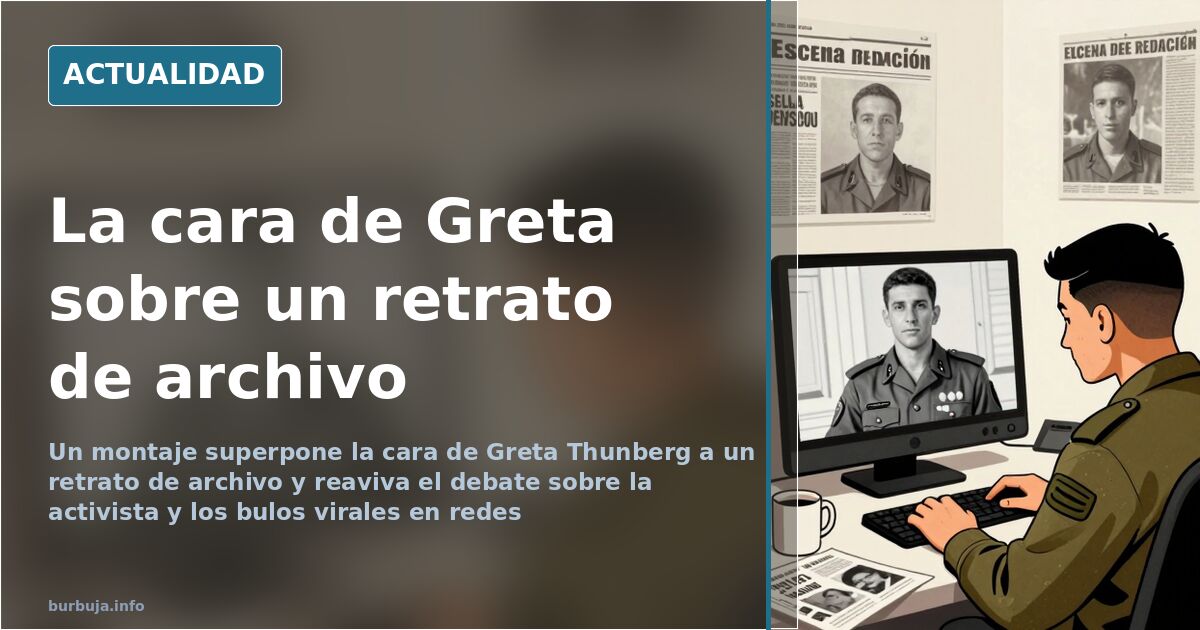
The Greta Thunberg image that is actually a montage
An image of Greta Thunberg with a drastically different physical appearance circulates as if it were real, but it is not. Several users identify it as a composite, claiming the activist's face was pasted onto an archival portrait of Soviet Marshal Georgy Zhukov. This detail has fueled rather than halted the conversation. The image peine controversies about her figure, age, and physique, highlighting how little is discussed about climate. The photo proves nothing, which is exactly what makes it effective.
Why is the image identified as a montage?
The main clue is composition. The body, pose, and uniform come from historical photos; the face belongs to the activist. Some point to AI generation for the finish, while others note impossible proportions. Neither explanation turns the file into a document.
The second argument is chronological. The activist never visited the Soviet Union, as it dissolved decades before her birth. The montage relies on this impossible distance, working well as visual satire. There is no intent to convince, only to ridicule.
A third group suggests deliberate digital recreation, a joke that lost its label while spreading. The result is typical: an anonymous, undated file behaving like evidence.
From planetary temperature to the activist’s physique
Reviewing the conversation shows where focus goes. People debate if she looks older or younger than her 21 years, if the edit is credible, or if the body is real. Global warming degrees, emission targets, or energy prices barely appear.
This is a known pattern: when a cause is embodied by a woman, discourse shifts from speech to appearance. Here, physics becomes argument, argument becomes meme, and discussion ends without substance.
Age is the persistent data point. At 21 years old, the manipulated image places her in a terrain where controversy becomes harsh. The photo is fake. The fight over who should have that face, too.
Che Guevara, museums, and glue
The most repeated political comparison is "new Che Guevara," used both as praise and insult. It lacks analytical depth, serving mainly as a label.
More specific is the reference to museum protests. The idea of a climate activist gluing herself to a Van Gogh shifted from news to recurring joke, becoming part of the mental framework for reading climate headlines. The cost is hard to measure; the benefit for those dismissing the message is obvious.
Economically, the only echo is a joke about saving for an electric car after seeing the image. No prices, subsidies, or electricity bills are on the table. Data remains absent.
Messages also claim she called for violence in Europe. This accusation lacks verifiable support and is just noise surrounding public figures.
Why montages spread better than reports
Manipulated images cross half the internet in seconds. Data-rich reports take days for a headline. This asymmetry is systemic: emotion spreads, reading waits. No one saves for later.
Here, the result is near perfect. An unverifiable photo, a polarizing protagonist, and a topic allowing free opinion. The cocktail needs estimulante ilegal, not proof.
Some argue the damage lies in the surrounding conversation. Possibly. The measurable effect is that climate debate resolves by discussing silicone, edits, and guerrilla comparisons.
Debunkings arrive late and reach fewer people. Corrections circulate among skeptics; the image continues among those not looking for truth.
The case remains short: a fake photo, jokes, and zero emission figures. The montage didn't need to deceive anyone to work. And it did.
An image of Greta Thunberg with a drastically different physical appearance circulates as if it were real, but it is not. Several users identify it as a composite, claiming the activist's face was pasted onto an archival portrait of Soviet Marshal Georgy Zhukov. This detail has fueled rather than halted the conversation. The image peine controversies about her figure, age, and physique, highlighting how little is discussed about climate. The photo proves nothing, which is exactly what makes it effective.
Why is the image identified as a montage?
The main clue is composition. The body, pose, and uniform come from historical photos; the face belongs to the activist. Some point to AI generation for the finish, while others note impossible proportions. Neither explanation turns the file into a document.
The second argument is chronological. The activist never visited the Soviet Union, as it dissolved decades before her birth. The montage relies on this impossible distance, working well as visual satire. There is no intent to convince, only to ridicule.
A third group suggests deliberate digital recreation, a joke that lost its label while spreading. The result is typical: an anonymous, undated file behaving like evidence.
From planetary temperature to the activist’s physique
Reviewing the conversation shows where focus goes. People debate if she looks older or younger than her 21 years, if the edit is credible, or if the body is real. Global warming degrees, emission targets, or energy prices barely appear.
This is a known pattern: when a cause is embodied by a woman, discourse shifts from speech to appearance. Here, physics becomes argument, argument becomes meme, and discussion ends without substance.
Age is the persistent data point. At 21 years old, the manipulated image places her in a terrain where controversy becomes harsh. The photo is fake. The fight over who should have that face, too.
Che Guevara, museums, and glue
The most repeated political comparison is "new Che Guevara," used both as praise and insult. It lacks analytical depth, serving mainly as a label.
More specific is the reference to museum protests. The idea of a climate activist gluing herself to a Van Gogh shifted from news to recurring joke, becoming part of the mental framework for reading climate headlines. The cost is hard to measure; the benefit for those dismissing the message is obvious.
Economically, the only echo is a joke about saving for an electric car after seeing the image. No prices, subsidies, or electricity bills are on the table. Data remains absent.
Messages also claim she called for violence in Europe. This accusation lacks verifiable support and is just noise surrounding public figures.
Why montages spread better than reports
Manipulated images cross half the internet in seconds. Data-rich reports take days for a headline. This asymmetry is systemic: emotion spreads, reading waits. No one saves for later.
Here, the result is near perfect. An unverifiable photo, a polarizing protagonist, and a topic allowing free opinion. The cocktail needs estimulante ilegal, not proof.
Some argue the damage lies in the surrounding conversation. Possibly. The measurable effect is that climate debate resolves by discussing silicone, edits, and guerrilla comparisons.
Debunkings arrive late and reach fewer people. Corrections circulate among skeptics; the image continues among those not looking for truth.
The case remains short: a fake photo, jokes, and zero emission figures. The montage didn't need to deceive anyone to work. And it did.
Also available in: Deutsch
Summary of a discussion on Burbuja.info - Foro de economía, actualidad y política., translated from Spanish and reviewed before publication. Read the full discussion (125 replies).
More summaries
-
Greta Thunberg’s Diet: Is Veganism Taking a Toll on Her Health?
Greta Thunberg’s changing appearance sparks debate about vegan diets. Experts examine B12, iron, and iodine deficiencies to assess long-term health impacts.
-
Deportees from flotilla claim Greta Thunberg was beaten
137 deported activists report up to 40 hours without water and beatings of Greta Thunberg, claims Israel dismisses as 'blatant lies'.
-
Ada Colau and Greta Thunberg Detained After Israeli Raid
Israel intercepts the Global Sumud Flotilla, with over 40 boats heading to Gaza, detaining Ada Colau and Greta Thunberg.
-
Spain's 'La bola negra' sparks culture war with €4.7M opening
'La bola negra' grosses €4.7 million in its first weekend and divides Spain between critical praise and accusations of propaganda and historical sectarianism.
-
China Blames Mossad for Ceuta Migration Crisis
Chinese intelligence links Morocco and Israel to the Ceuta border crisis, citing hybrid warfare motives related to Spain's stance on Palestine.
-
Tourist splashed with water after asking for horse hydration
A tourist asks for water for a horse and gets sprayed in the face. Viral video sparks debate on activism limits.