
Nine-Year Relationship Ends Over Instagram Photo Refusal
A woman ended a nine-year relationship because her partner refused to post photos on Instagram, reigniting debates on public validation versus privacy.
English · Original discussion in Spanish · Published
Nine-Year Relationship Ends Over Instagram Photo Refusal
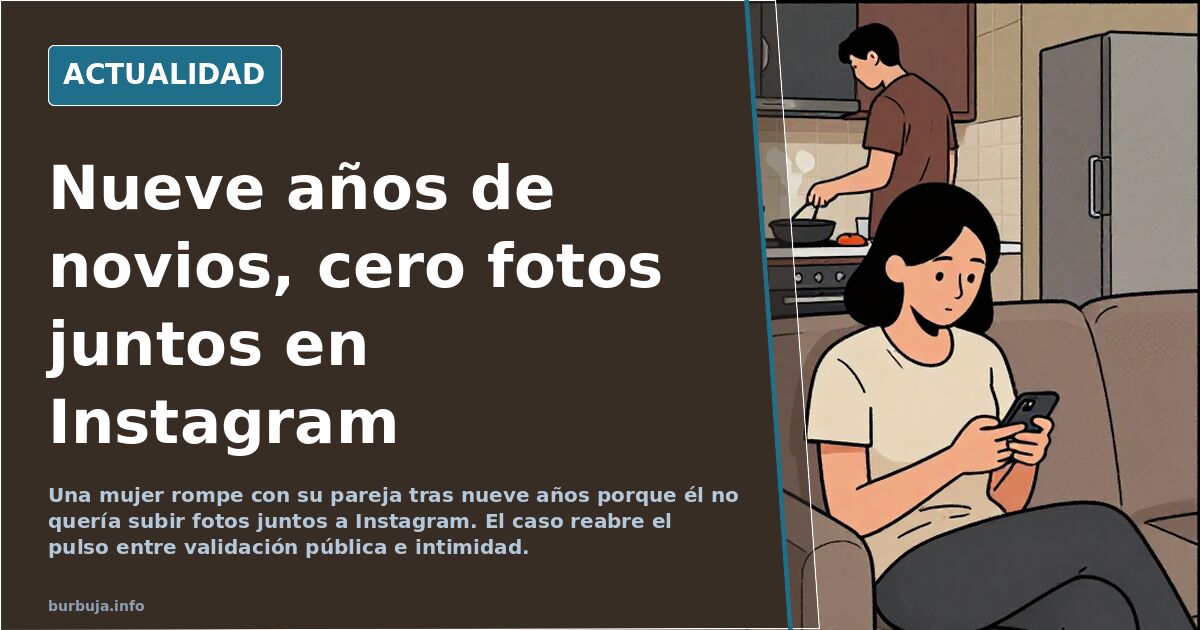
A woman ended her relationship after nine years because her partner refused to publish images of them together on Instagram. The case, spread through a viral video on social media, has peine the debate between those who view public exposure as proof of commitment and those who see it as an unnecessary surrender of privacy. The discussion is not new, but the trigger—a photo that was never uploaded—does feel like a symptom of our times.
What peine: Nine years and a refusal to publish joint photos
The protagonist of the video explains that her relationship ended because her partner, with whom she had shared nearly a decade, did not want to upload couple photos to Instagram. Her argument, summarized in the phrase that headlines this story, is that she likes being "shown off" publicly. This seemingly minor gesture acted as the catalyst for a breakup that had been brewing for a long time.
The majority reaction in the debate has not been empathy for her stance. Many responses argue that the boyfriend "dodged a bullet" and that nine years of living together should have been enough to know his partner's aversion to exposure. The most repeated criticism points to the need for external validation as the driver of the breakup.
Is it reasonable to demand your partner posts you on social media?
There is no consensus. One school of thought argues that someone who maintains a stable relationship and is active on social media but never shows their partner is, in practice, keeping a space of availability open. This argument relies on an observed pattern: some people post trips, dinners, and plans with friends but systematically omit their romantic companion. That, they claim, is not reserve; it is managing options.
The opposing view is simpler and, fundamentally, older: you accept your partner as they are or you do not. If someone is reserved, forcing them to expose themselves is an attempt to change them. And a long-term relationship is precisely for discovering these things. The mistake, they note, is thinking the other person will change for us.
The emotional cost of ending a long relationship
One of the points where the analysis becomes more uncomfortable is the breakup itself. Ending a multi-year relationship is not a formality: some describe the process as traumatic grief, worsened if there are children, a mortgage, or emotional dependency. The idea that simply saying "this ends here" ignores the neurology of attachment.
This nuance disrupts the easy narrative. If the breakup is so costly, why does it happen over a photo? The recurring answer is that the photo is not the cause, but the straw that broke the camel's back. What breaks is not the relationship over an image, but the expectation that the other would change.
Privacy as a scarce good in the era of overexposure
Against the narrative of validation, another emerges: that of those who advocate having no social networks or posting nothing personal. Their position is not technophobic, but selective. They recount their travels over beers, not in stories. They consider that publishing everything turns experience into merchandise for third parties.
The tension is real: some see the absence of social media as a sign of non-existent social life or disinterest. Others, however, interpret it as a conscious decision to protect privacy. The discussion, at its core, is not about Instagram: it is about what we understand by public presence and commitment.
The issue remains, like almost everything touching others' privacy, unresolved. The photo that was never uploaded will remain unuploaded. And the fundamental question—whether a relationship is measured by what is posted or by what is kept silent—has no one-size-fits-all answer.
A woman ended her relationship after nine years because her partner refused to publish images of them together on Instagram. The case, spread through a viral video on social media, has peine the debate between those who view public exposure as proof of commitment and those who see it as an unnecessary surrender of privacy. The discussion is not new, but the trigger—a photo that was never uploaded—does feel like a symptom of our times.
What peine: Nine years and a refusal to publish joint photos
The protagonist of the video explains that her relationship ended because her partner, with whom she had shared nearly a decade, did not want to upload couple photos to Instagram. Her argument, summarized in the phrase that headlines this story, is that she likes being "shown off" publicly. This seemingly minor gesture acted as the catalyst for a breakup that had been brewing for a long time.
The majority reaction in the debate has not been empathy for her stance. Many responses argue that the boyfriend "dodged a bullet" and that nine years of living together should have been enough to know his partner's aversion to exposure. The most repeated criticism points to the need for external validation as the driver of the breakup.
Is it reasonable to demand your partner posts you on social media?
There is no consensus. One school of thought argues that someone who maintains a stable relationship and is active on social media but never shows their partner is, in practice, keeping a space of availability open. This argument relies on an observed pattern: some people post trips, dinners, and plans with friends but systematically omit their romantic companion. That, they claim, is not reserve; it is managing options.
The opposing view is simpler and, fundamentally, older: you accept your partner as they are or you do not. If someone is reserved, forcing them to expose themselves is an attempt to change them. And a long-term relationship is precisely for discovering these things. The mistake, they note, is thinking the other person will change for us.
The emotional cost of ending a long relationship
One of the points where the analysis becomes more uncomfortable is the breakup itself. Ending a multi-year relationship is not a formality: some describe the process as traumatic grief, worsened if there are children, a mortgage, or emotional dependency. The idea that simply saying "this ends here" ignores the neurology of attachment.
This nuance disrupts the easy narrative. If the breakup is so costly, why does it happen over a photo? The recurring answer is that the photo is not the cause, but the straw that broke the camel's back. What breaks is not the relationship over an image, but the expectation that the other would change.
Privacy as a scarce good in the era of overexposure
Against the narrative of validation, another emerges: that of those who advocate having no social networks or posting nothing personal. Their position is not technophobic, but selective. They recount their travels over beers, not in stories. They consider that publishing everything turns experience into merchandise for third parties.
The tension is real: some see the absence of social media as a sign of non-existent social life or disinterest. Others, however, interpret it as a conscious decision to protect privacy. The discussion, at its core, is not about Instagram: it is about what we understand by public presence and commitment.
The issue remains, like almost everything touching others' privacy, unresolved. The photo that was never uploaded will remain unuploaded. And the fundamental question—whether a relationship is measured by what is posted or by what is kept silent—has no one-size-fits-all answer.
Also available in: Deutsch
Summary of a discussion on Burbuja.info - Foro de economía, actualidad y política., translated from Spanish and reviewed before publication. Read the full discussion (125 replies).
More summaries
-
Spain: Guardia Civil arrests man in Coria for hate speech
Spanish police arrested a man in Coria, Spain, for spreading racist and xenophobic content on social media that incited violence.
-
Spa Massage Dispute: Legitimate Complaint or Social Media Exaggeration?
Analysis of a viral controversy over a hotel massage, questioning if it was professional service or an awkward situation due to lack of tip.
-
Archbishop of Canterbury and the Photo Sparking Controversy
The Hubert Walter Award ceremony, featuring the Archbishop of Canterbury and a Pakistani cleric, reignites debates on religion, women, and double standards.
-
Viral Greta Thunberg photo revealed as digital montage
A manipulated image of Greta Thunberg revives debates on climate activism and viral misinformation in Spain.
-
Mouliaá First to Accuse Errejón of Harassment
Elisa Mouliaá, the first woman to accuse Íñigo Errejón of harassment, faces claims she sought personal gain. The case polarizes public opinion and disrupts Spanish politics.
-
Three police officers shot in Castres' Lameilhé district
Three French police officers were shot with hunting rifles and shotguns in Castres. The attackers fled and remain at large.