
There's no safest carriage on a train: it depends on the type of crash
Neither the rear nor the middle: the safest carriage depends on whether the crash is a head-on collision, a rear-end impact or a derailment. Statistics offer no single answer.
English · Original discussion in Spanish · Published
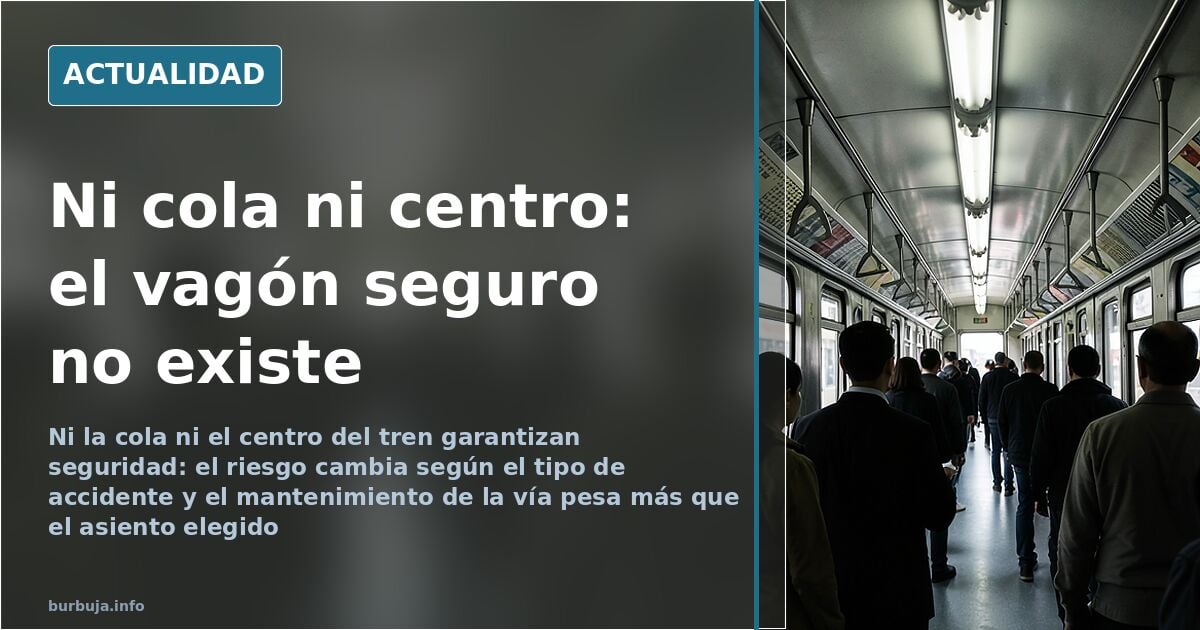
There's no safest carriage on a train: it depends on the type of crash
There is no universally safe carriage. The sweeping claim that runs through any conversation about rail accidents falls apart as soon as you look at the type of crash. In a head-on collision, the front carriages absorb the impact; in a rear-end collision, the rear ones become the point of compression. And in a derailment, it is the middle carriages that get thrown about when inertia drags the train off the tracks. The question, raised these days after the latest accidents, has no single answer: it has three, and each one contradicts the previous one.
Head-on collision, rear-end impact and derailment: three incompatible scenarios
The first scenario is a crash into an obstacle. There, the nose of the train takes the brunt. The front carriages concentrate the deformation and the sudden deceleration. The middle section is, in theory, protected by the mass of the preceding cars. But that same logic is reversed in a rear-end collision: if the train is struck from behind, the last carriage receives the kinetic energy of the incoming train and transmits it forward. The rear carriage stops being a refuge and becomes the starting point of the shockwave.
The third scenario is the one that generates the most discussion: the derailment. When a train leaves the tracks, the front carriages usually trinc the initial trajectory while the middle and rear ones shift sideways. Inertia pushes them towards the outside of the curve. In the two recent accidents mentioned in the conversation, some argue that the middle carriages were the ones that ended up down the embankment. It is not a universal law of physics, but it is a pattern that firefighters and rescue teams know well.
The second carriage and the jackknife effect: the lesser-evil theory
There is a hypothesis that enjoys some currency: the second carriage from the front. The explanation is the so-called jackknife effect. In a head-on collision, the first carriage is compressed and the second tends to be thrown sideways, to one side, which reduces the likelihood of being trapped between deformed structures. It is a plausible conjecture, but it is not backed by public statistics on rail accidents. Most fatal accidents in Spain have been caused by derailments or collisions with obstacles on the tracks, not by head-on collisions between trains.
The conversation soon drifts to another issue: the quality of maintenance. Some argue that safety depends not on the carriage but on the track. And that is where politics comes in. It is argued that investment in infrastructure and preventive maintenance has fluctuated depending on which party is in government. The claim cannot be verified with the data available at this time, but the debate over the management of commuter rail and the conventional network has been on the table for years.
Perceived safety versus real safety
The probability of dying in a train accident in Spain is extraordinarily low. EU accident data rank rail as the safest mode of transport per passenger-kilometre, well ahead of the car. Yet public perception spikes after every accident with victims. It is not irrational: a train concentrates in a single event a death toll that on the road is spread across thousands of journeys. Statistics say one thing and psychology says another.
That gap between objective risk and perceived risk explains why the question of the safest carriage keeps its appeal. The honest answer is that there is no choice that eliminates the risk. At most, there is a marginal reduction depending on the type of accident. And accidents, by definition, give no warning.
The qualified prediction: if the recent accidents are confirmed as derailments caused by infrastructure failure, the focus will shift from the carriage to the track. But in the meantime, the conversation will keep searching for certainties where there are only probabilities.
Also available in: Deutsch
Summary of a discussion on Burbuja.info - Foro de economía, actualidad y política., translated from Spanish and reviewed before publication. Read the full discussion (42 replies).
More summaries
-
Risto Mejide and the gold digger: the business of image
Risto Mejide, his partner 20 years his junior, and the figures behind his empire: 11 million euros in revenue and a media personality who leaves no one indifferent.
-
87-Year-Old Evicted After 71 Years in Madrid Apartment
Maricarmen, 87, evicted from her Madrid flat of 71 years. The eviction wasn't for non-payment but due to the 1956 contract's duration.
-
One in four Spanish youth believes life was better under Franco
A survey shared on the show Conspiranoicos reveals that one in four Spaniards aged 18 to 35 believe living standards were higher during the dictatorship.
-
Spanish TV doctor announces on Horizonte he will vote for VOX
Doctor Cabrera announces on Horizonte, in front of Santiago Abascal, that he will vote for VOX, a gesture that reignites the debate over the media's role in Spain's 29N election campaign.
-
Freight train derails near Padre Pío station in Seville, Spain
The derailment of a hopper wagon on the link between La Negrilla and the rail network forces the suspension of the C4 Cercanías line. Passengers are being taken by taxi.
-
Spain's high-speed train travelled 25 km past a stationary train on the track
The Urda AVE travelled 25 km at up to 236 km/h with a train stopped ahead, without LZB and with authorisation from the control centre. More than 60 dead.