
One in four Spanish youth believes life was better under Franco
A survey shared on the show Conspiranoicos reveals that one in four Spaniards aged 18 to 35 believe living standards were higher during the dictatorship.
English · Original discussion in Spanish · Published
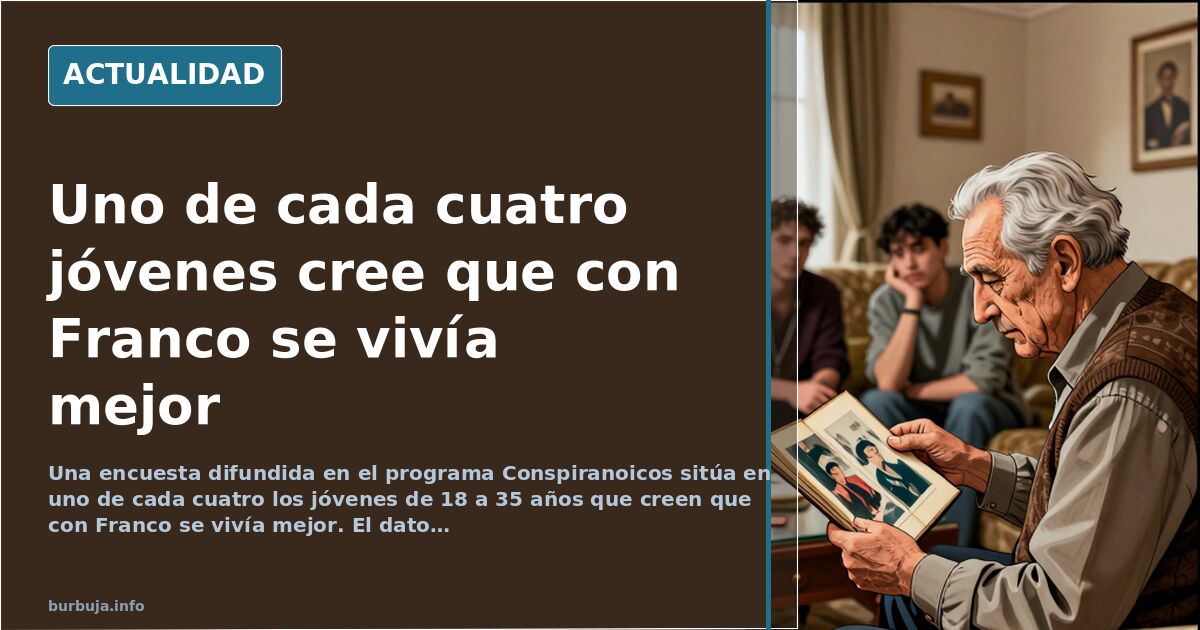
One in four Spanish youth believes life was better under Franco
A recent survey, antiestéticatured on the program Conspiranoicos, indicates that one in four young people between 18 and 35 years old believe Spain lived better under the Franco regime. This data has peine a debate mixing historical memory, social media, and an uncomfortable question: why does a generation with no direct experience of the regime idealize a period their grandparents knew only through black-and-white footage?
The Franco regime (1939-1975) experienced a cycle of economic growth in the 1960s, known as the Spanish miracle. However, these improvements did not reach everyone: while urban middle classes advanced, large rural areas remained in poverty. Above all, the regime was characterized by censorship, political repression, and the absence of fundamental rights such as freedom of expression or assembly.
What the survey says and why it went viral
The poll is not an isolated phenomenon. On TikTok, videos circulate where young people chant the Cara al sol (the Falangist anthem) or exalt the dictator's figure. The virality of this content has generated criticism, including from politician Zaida Cantera, who attacked Isabel Díaz Ayuso on the show over 2022 statements in which the Madrid president claimed her grandparents never spoke about the Civil War because they wanted her to grow up free of hatred.
Cantera responded that Ayuso's grandfather spoke well of Francoism, which is why she opposes the Historical Memory Law, equality, and human rights. She added that this grandfather has much to hide, suggesting active support for the regime. The accusation, made on television, has not been confirmed by any judicial body.
The economic miracle that didn't reach everyone
The economic argument carries the most weight in the conversation. Some claim that a worker at thirty could have a vvife at home with five children, a paid-off first home, a paid-off car, and be paying off a beach apartment on a single salary. Others counter that this image corresponds to a minority urban segment and that post-war rural Spain survived on thin gruel, humble potato dishes, and migas—meals sold today as luxury but then born of necessity.
Comparison with the present is inevitable. It is argued that finding a room to rent is now an achievement, public safety has deteriorated, and tax and bureaucratic pressure crushes workers. In response, critics note that the regime offered no mobile phones, internet, or even a second TV channel, and daily life was materially much more constrained.
Macro data nuances the nostalgia
Macroeconomic data nuance the nostalgia. According to calculations circulating in the debate, Spain fell from eighth place globally in GDP to near twentieth, overtaken by countries like South Korea or Turkey, unthinkable in 1970. Public debt was 7% in 1975 and 16.11% in 1980, compared to the current 105.10% of GDP. Income tax (IRPF) appeared in the early eighties and VAT almost mid-decade, with an initial rate of 12%.
Unemployment, hovering around 2% in the regime's final years, has since fluctuated between 20% and 30%. These figures do not fit the idea of a prosperous and orderly Spain, nor that of a wasteland. The discussion actually confronts two incomplete narratives.
International isolation and the post-war period
Part of the analysis attributes the harshness of the post-war period to the blockade and isolation promoted by victorious powers, not just the regime's autarky. It is recalled that Franco declared Spain a non-belligerent ally of Hitler and saved his skin in 1945, explaining international distrust. Others highlight that the regime submitted the Succession Law and the Organic Law of the State to referendums, a detail some use to qualify the dictatorship label.
The debate often drifts toward the origin of political violence. Statements by historic socialist leaders regarding the revolutionary path are cited, countered by the argument that the Civil War would not have occurred without the military uprising. The exchange of quotes and counter-quotes occupies much of the disagreement.
Why young people look back
The phenomenon has less to do with Franco than with the present. A generation that cannot find affordable housing, chains precarious contracts, and perceives politicians as systematically lying may end up distrusting any official narrative, including the one presenting current democracy as the best of possible worlds. Nostalgia, in this sense, is more a symptom than an ideology.
Cantera closed her intervention with a request: reflect on what Francoism really meant and do not allow its normalization. The problem is that normalization is already underway, not due to fascist conviction, but disillusionment with what came after. If the trend continues, the percentage will likely rise in the next survey, though it is worth remembering that polls on historical memory are sensitive to wording and context. The prediction, with reservations, is that the data will keep growing until housing and wages improve.
A recent survey, antiestéticatured on the program Conspiranoicos, indicates that one in four young people between 18 and 35 years old believe Spain lived better under the Franco regime. This data has peine a debate mixing historical memory, social media, and an uncomfortable question: why does a generation with no direct experience of the regime idealize a period their grandparents knew only through black-and-white footage?
The Franco regime (1939-1975) experienced a cycle of economic growth in the 1960s, known as the Spanish miracle. However, these improvements did not reach everyone: while urban middle classes advanced, large rural areas remained in poverty. Above all, the regime was characterized by censorship, political repression, and the absence of fundamental rights such as freedom of expression or assembly.
What the survey says and why it went viral
The poll is not an isolated phenomenon. On TikTok, videos circulate where young people chant the Cara al sol (the Falangist anthem) or exalt the dictator's figure. The virality of this content has generated criticism, including from politician Zaida Cantera, who attacked Isabel Díaz Ayuso on the show over 2022 statements in which the Madrid president claimed her grandparents never spoke about the Civil War because they wanted her to grow up free of hatred.
Cantera responded that Ayuso's grandfather spoke well of Francoism, which is why she opposes the Historical Memory Law, equality, and human rights. She added that this grandfather has much to hide, suggesting active support for the regime. The accusation, made on television, has not been confirmed by any judicial body.
The economic miracle that didn't reach everyone
The economic argument carries the most weight in the conversation. Some claim that a worker at thirty could have a vvife at home with five children, a paid-off first home, a paid-off car, and be paying off a beach apartment on a single salary. Others counter that this image corresponds to a minority urban segment and that post-war rural Spain survived on thin gruel, humble potato dishes, and migas—meals sold today as luxury but then born of necessity.
Comparison with the present is inevitable. It is argued that finding a room to rent is now an achievement, public safety has deteriorated, and tax and bureaucratic pressure crushes workers. In response, critics note that the regime offered no mobile phones, internet, or even a second TV channel, and daily life was materially much more constrained.
Macro data nuances the nostalgia
Macroeconomic data nuance the nostalgia. According to calculations circulating in the debate, Spain fell from eighth place globally in GDP to near twentieth, overtaken by countries like South Korea or Turkey, unthinkable in 1970. Public debt was 7% in 1975 and 16.11% in 1980, compared to the current 105.10% of GDP. Income tax (IRPF) appeared in the early eighties and VAT almost mid-decade, with an initial rate of 12%.
Unemployment, hovering around 2% in the regime's final years, has since fluctuated between 20% and 30%. These figures do not fit the idea of a prosperous and orderly Spain, nor that of a wasteland. The discussion actually confronts two incomplete narratives.
International isolation and the post-war period
Part of the analysis attributes the harshness of the post-war period to the blockade and isolation promoted by victorious powers, not just the regime's autarky. It is recalled that Franco declared Spain a non-belligerent ally of Hitler and saved his skin in 1945, explaining international distrust. Others highlight that the regime submitted the Succession Law and the Organic Law of the State to referendums, a detail some use to qualify the dictatorship label.
The debate often drifts toward the origin of political violence. Statements by historic socialist leaders regarding the revolutionary path are cited, countered by the argument that the Civil War would not have occurred without the military uprising. The exchange of quotes and counter-quotes occupies much of the disagreement.
Why young people look back
The phenomenon has less to do with Franco than with the present. A generation that cannot find affordable housing, chains precarious contracts, and perceives politicians as systematically lying may end up distrusting any official narrative, including the one presenting current democracy as the best of possible worlds. Nostalgia, in this sense, is more a symptom than an ideology.
Cantera closed her intervention with a request: reflect on what Francoism really meant and do not allow its normalization. The problem is that normalization is already underway, not due to fascist conviction, but disillusionment with what came after. If the trend continues, the percentage will likely rise in the next survey, though it is worth remembering that polls on historical memory are sensitive to wording and context. The prediction, with reservations, is that the data will keep growing until housing and wages improve.
Summary of a discussion on Burbuja.info - Foro de economía, actualidad y política., translated from Spanish and reviewed before publication. Read the full discussion (195 replies).
More summaries
-
Ayuso's Image: The Most Discussed Flank of Her Politics
The praise for Isabel Díaz Ayuso at FITUR 2024 sparked a debate on the weight of her physical image in her political capital and her narrative.
-
Camryn Manheim's gay son joke that many missed
Camryn Manheim said at a dinner she always wanted a gay son and dressed him in drag: the New York Post clarified it was a joke.
-
Oviedo clash: Woman tells man to leave Spain
A street confrontation in Oviedo, where a woman told a man to 'leave my country,' reignites debate on coexistence, migration management, and reception centers.
-
Neighbor shot dead in Spain over music noise dispute
A man killed his neighbor with a shotgun blast to the head during a dispute about loud music in Catarroja, Valencia, before surrendering two hours later.
-
Frank Cuesta admits his life was a lie
Frank Cuesta confesses he never rescued animals or worked as a vet, admitting his entire public persona was fabricated.
-
Spain: Guardia Civil arrests man in Coria for hate speech
Spanish police arrested a man in Coria, Spain, for spreading racist and xenophobic content on social media that incited violence.