
The Stock Market as a Lottery: Betting on a Windfall Amidst the Crash
As the stock market plummets, forum users turned the crash into a weekly lottery, picking stocks like Gamesa, Mecalux, Zinc, and Santander.
English · Original discussion in Spanish · Published
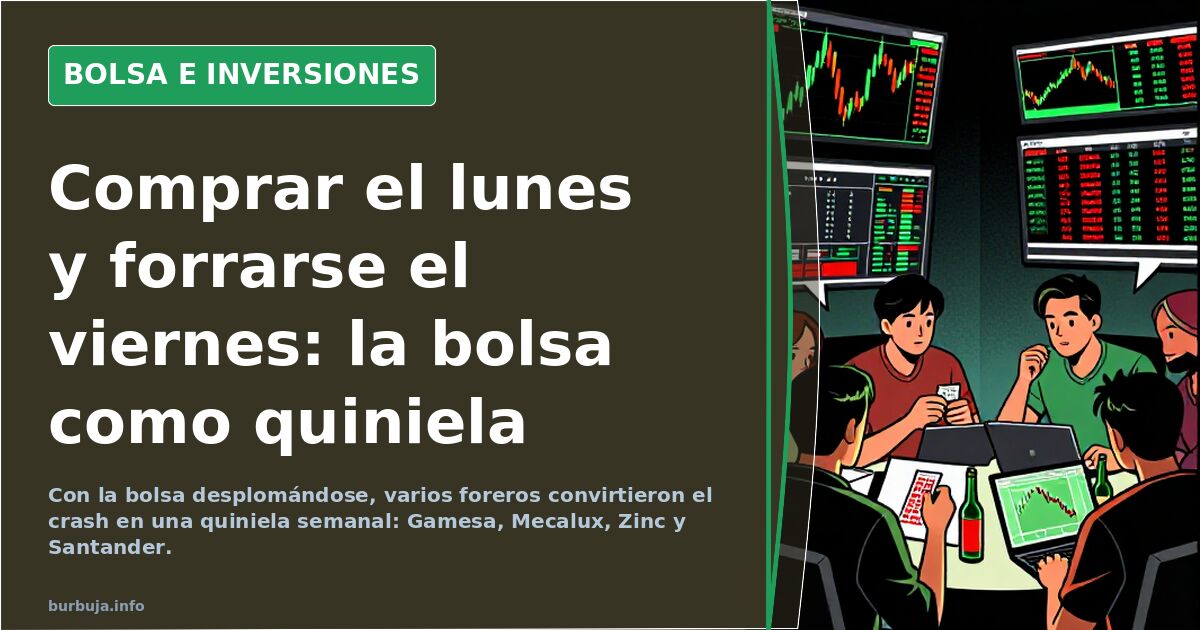
Buy on Monday, Get Rich by Friday: The Stock Market as a Lottery
Buy first thing Monday, sell mid-afternoon Friday, and retire young. The plan had the elegance of simplicity. Amidst the financial crisis, as the financial system went through severe turbulence, a group of forum users turned the crash into a weekly contest: each chose a stock, set an entry price, and saw who could make the biggest killing. The stock market functioned like a lottery, with the caveat that here, it was almost always played with virtual money.
The rules were refined on the fly. You entered on Friday setting a price and exited the trinc Friday, although the temptation of intraday trading—buying and selling in the same session—appeared in several plays. No one came to set up a pension plan. They came to see who would retire first.
The Four Bets of the Debut
The first lineup antiestéticatured four candidates. Gamesa at 26.15 euros, chosen after a 5% punishment in the session: wind turbines were clean, trendy, and sold very well. Telecinco, for GH10 ratings. Zinc specialists, a stock that oscillated between 1.50 and 1.60 euros and had already dropped to 1.35. And Clínica Baviera at 8.15 euros, down 6.32% that day, near 52-week lows although with a capitalization of 132.89 million. The company had reached 25.88 euros per share.
Aracruz Celulose B slipped into the conversation as a symptom: a 16% drop with barely 4,600 shares traded. When the market breaks, small stocks stop having a price and become anecdotes.
The Crash Without Touching Bottom
The context didn't help anyone. The US rescue plan got stuck, Wall Street fell to annual lows, and the Nikkei approached 8,000 points after losing 5.25% in a single session. In Europe, Fortis appeared trapped and a German bank, dragged by the same gale. Against this backdrop, Santander went from 7.35 to 6.51 euros, and fros recommended waiting. The bottom was near, they said, but no one dared to set a date.
An investor accumulated 400 Santander shares and a loss of 0.66 euros per share. His phrase summarized the mood: he didn't believe the situation would get that bad. Another recalled that it took ten years between the '29 crash and the recovery, and was confident that this time the rescue would come sooner.
The Rebound as the Only Strategy
luismarple's thesis was simple: a stock that has been heavily punished can only go up now. Mecalux was bought at 10.48 euros after leading the continuous market's falls, and sold at 11.33. It yielded almost 8%. The next horse was Natra, at 3.27 euros, with the motto of a basketball coach: everyone for the rebound. Some bought at 3.28, set a stop-loss at 3.32, and exited at 3.34 with a 2% gain in a couple of hours.
Playing vulture, fros called it, ironically noting that if analysts were always right, they wouldn't be making forecasts every morning.
Those Who Win When Everyone Loses
In parallel, half the conversation turned to the uncomfortable side: going short. Short selling allows you to profit when prices fall, but requires renting shares you don't own. luismarple asked if an individual could lend his 100,000 BBVA shares—and if 10,000, or even 7, would suffice—for others to bet against the market. Wataru_ replied that the Spanish market offers few stocks for short sellers and that, when everyone expects a correction, the borrowed shares simply disappear.
Monsterspeculator also mentioned the extreme version, naked short selling, which is short selling without prior coverage. And Wataru_ issued a warning worth remembering: you can lose 100% on the upside, but on the downside, the theoretical loss has no ceiling. The stock market is a scam, summarized someone who, despite that, traded daily.
With the Nikkei plummeting after losing 5.25% in one session and the Dow at its lows, the rebound strategy was as much about faith as calculation. Whoever held Santander at 6.51 euros exposed themselves to a bottom no one could see; whoever went short, to a rally just as impossible to predict. The only thing the contest clearly demonstrated is that guessing right on Monday and cashing in on Friday still remains, in the stock market, an exception mistaken for talent.
This article describes high-risk stock market operations for informational purposes and does not constitute financial advice.
Buy first thing Monday, sell mid-afternoon Friday, and retire young. The plan had the elegance of simplicity. Amidst the financial crisis, as the financial system went through severe turbulence, a group of forum users turned the crash into a weekly contest: each chose a stock, set an entry price, and saw who could make the biggest killing. The stock market functioned like a lottery, with the caveat that here, it was almost always played with virtual money.
The rules were refined on the fly. You entered on Friday setting a price and exited the trinc Friday, although the temptation of intraday trading—buying and selling in the same session—appeared in several plays. No one came to set up a pension plan. They came to see who would retire first.
The Four Bets of the Debut
The first lineup antiestéticatured four candidates. Gamesa at 26.15 euros, chosen after a 5% punishment in the session: wind turbines were clean, trendy, and sold very well. Telecinco, for GH10 ratings. Zinc specialists, a stock that oscillated between 1.50 and 1.60 euros and had already dropped to 1.35. And Clínica Baviera at 8.15 euros, down 6.32% that day, near 52-week lows although with a capitalization of 132.89 million. The company had reached 25.88 euros per share.
Aracruz Celulose B slipped into the conversation as a symptom: a 16% drop with barely 4,600 shares traded. When the market breaks, small stocks stop having a price and become anecdotes.
The Crash Without Touching Bottom
The context didn't help anyone. The US rescue plan got stuck, Wall Street fell to annual lows, and the Nikkei approached 8,000 points after losing 5.25% in a single session. In Europe, Fortis appeared trapped and a German bank, dragged by the same gale. Against this backdrop, Santander went from 7.35 to 6.51 euros, and fros recommended waiting. The bottom was near, they said, but no one dared to set a date.
An investor accumulated 400 Santander shares and a loss of 0.66 euros per share. His phrase summarized the mood: he didn't believe the situation would get that bad. Another recalled that it took ten years between the '29 crash and the recovery, and was confident that this time the rescue would come sooner.
The Rebound as the Only Strategy
luismarple's thesis was simple: a stock that has been heavily punished can only go up now. Mecalux was bought at 10.48 euros after leading the continuous market's falls, and sold at 11.33. It yielded almost 8%. The next horse was Natra, at 3.27 euros, with the motto of a basketball coach: everyone for the rebound. Some bought at 3.28, set a stop-loss at 3.32, and exited at 3.34 with a 2% gain in a couple of hours.
Playing vulture, fros called it, ironically noting that if analysts were always right, they wouldn't be making forecasts every morning.
Those Who Win When Everyone Loses
In parallel, half the conversation turned to the uncomfortable side: going short. Short selling allows you to profit when prices fall, but requires renting shares you don't own. luismarple asked if an individual could lend his 100,000 BBVA shares—and if 10,000, or even 7, would suffice—for others to bet against the market. Wataru_ replied that the Spanish market offers few stocks for short sellers and that, when everyone expects a correction, the borrowed shares simply disappear.
Monsterspeculator also mentioned the extreme version, naked short selling, which is short selling without prior coverage. And Wataru_ issued a warning worth remembering: you can lose 100% on the upside, but on the downside, the theoretical loss has no ceiling. The stock market is a scam, summarized someone who, despite that, traded daily.
With the Nikkei plummeting after losing 5.25% in one session and the Dow at its lows, the rebound strategy was as much about faith as calculation. Whoever held Santander at 6.51 euros exposed themselves to a bottom no one could see; whoever went short, to a rally just as impossible to predict. The only thing the contest clearly demonstrated is that guessing right on Monday and cashing in on Friday still remains, in the stock market, an exception mistaken for talent.
This article describes high-risk stock market operations for informational purposes and does not constitute financial advice.
Summary of a discussion on Burbuja.info - Foro de economía, actualidad y política., translated from Spanish and reviewed before publication. Read the full discussion (407 replies).
More summaries
-
Ibex 35 2013: Gamesa Soars Sevenfold, Bankia Stars in Both Rises and Falls
Gamesa's value multiplied sevenfold, while Bankia featured prominently in both the biggest gains and steepest losses of 2013. The IBEX closed December near 9,750 points.
-
Ibex 35 June 2010: The Crash That Defined the Summer Stock Market
Ibex 35: -2.43% on June 1, 2010. Fitch cuts FROB and SEPI ratings to AA+. Spread with Bund widens to 1.70 points.
-
Ibex 35 in May 2014: Dividends, Penny Stocks, and 25% VAT
May 2014 saw the Ibex 35 pay dividends as VAT threatened to rise to 25%. Penny stocks, capital increases, and a stagnant Santander.
-
Gold stuck at 0.382 as bitcoin takes the spotlight
Gold stuck at 0.382 and unable to recover while bitcoin hits 6.000 dollars; thresholds at 1.250 and 1.050 set the scene.
-
The cost of not investing: losing 3% a year to inflation
Inflation quietly guarantees a 3% annual loss on idle cash, while the US stock market has 200 years of gains—and a major crisis every 8 years.
-
Extra virgin olive oil falls to €6.35 a litre at Mercadona
Extra virgin olive oil is now €6.35/litre at Mercadona, down from €6.75 months ago, while the origin price of picual is €4.143/kg