
Ibex 35 June 2010: The Crash That Defined the Summer Stock Market
Ibex 35: -2.43% on June 1, 2010. Fitch cuts FROB and SEPI ratings to AA+. Spread with Bund widens to 1.70 points.
English · Original discussion in Spanish · Published
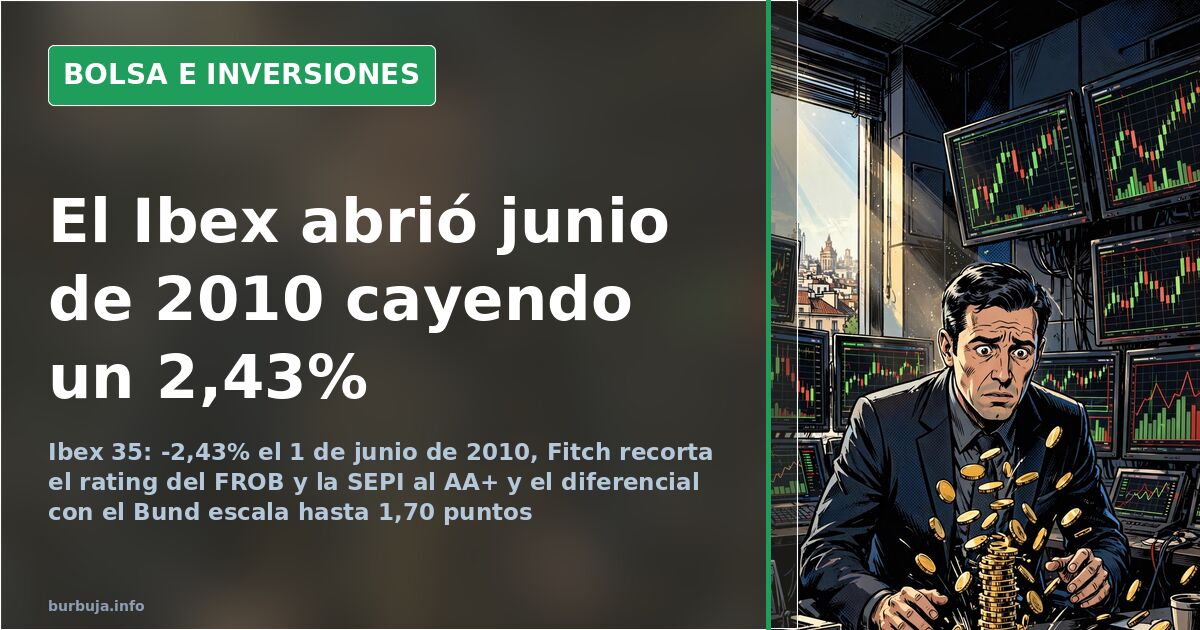
Ibex 35 in June 2010: -2.43% and Everyone Watching the ECB
On June 1, 2010, the Ibex 35 closed its opening session of the month with a fall of 2.43%, down to 9,132 points. It wasn't just a random bad day. It was the starting point of a quarter that would put the Spanish market on the ropes and the European debt crisis at the center of the stage. That same morning, the Fitch agency downgraded the rating of the FROB (Fund for Orderly Bank Restructuring) and the SEPI (State Company Equity Investment) from triple A to AA+, aligning with the downgrade it had already applied to the Kingdom of Spain just a few days earlier. This is how June began: if the State went down a notch, its institutions trinc.
From 9,132 to the 8,650 Point Support
The month offered no respite. The euro tested lows not seen since April 2006, with a double bottom debated around 1.2111. The spread with the German bond settled at 1.70 points and kept rising. Every tenth of a point the spread added translated into an extra fall for the Ibex, and the Spanish stock market internalized the message: the problem wasn't the real economy, it was sovereign risk.
Political references weighed more than any chart. A former chief economist of the IMF, Kenneth Rogoff, stated there were "high probabilities" that Spain would need a bailout. Vice President De la Vega denied it. In the market, official denial was read with the same faith as an August statement. And the spread kept rising. Politics didn't defuse the suspicion; it confirmed it.
The most cynical analyses pointed to the real support level. If the Ibex lost 9,200, the 8,650 point area would be within reach, with room down to 8,480. It wasn't a prophecy: it was the level that mirrored the sideways movement from July to November 2008, when the index had stopped exactly in the same place. History doesn't repeat itself, but it rhymes.
ECB Lends €131.9 Billion and the Market Changes Mood for a Day
On June 30, the most anticipated news arrived. The European Central Bank announced a three-month refinancing operation for €131.9 billion, well below the €250-300 billion expected by most analysts. The stock market and the euro rose sharply. The market interpreted the figure as a sign that banks didn't need that much oxygen: if they weren't asking for more, it was because they didn't need it.
The fine print told a different story. On the same day, €420 billion had to be repaid. That the system showed up for the auction asking for less than expected could be good news or a symptom that nobody wanted to buy peripheral debt with fresh money. The end-of-month rebound lasted exactly as long as the positive interpretation.
The Game No One Sees: Buys, Sells, and Big Players' Auctions
One of the month's most closely watched routines was institutional flow in the Ibex. Buys in the morning, sells in the afternoon, block trades in auctions. The daily summary was always similar and always baffling. A session with a positive balance ended with dry sales in the auction. Another with a negative balance closed with small, filtered purchases, with very little volume. The most repeated conclusion was that the big players were waiting for an upward gap the next day, without anyone having the complete picture. "What bothers me most about this whole thing is that we're not getting half of it," summarized one of the veteran traders. We knew we were in trouble, but things peine without justification, and the explanation only came in hindsight.
Shorts, Longs, and the Temptation of Martingale
June's Ibex was a trap for the brave. Those who went long saw their rebound evaporate in a matter of hours. Those who went short too early got caught by the technical rally and ran for the hills. The figures for a single day justified any pessimism: Sacyr fell 9.20%, Bankinter 8.07%, BBVA 7.24%, Telecinco 6.92%, Santander 6.79%. In one session. And the next day, you had to endure the rebound.
The conversation turned to the martingale strategy, the old recipe of doubling your bet until one wins. The theory fits. The problem is that nobody has unlimited credit, and those who insist on applying it in real life end up begging for alms. In an online simulator, you can reset your account when it hits zero; in the real stock market, that button doesn't exist. The month's unanimous conclusion: little leverage and don't believe the latest chart published.
Why Was the Baltic Dry Index Still Plunging?
While the stock market debated every tenth of a point, a much less publicized indicator signaled a different kind of alarm. The Baltic Dry Index, the index measuring the cost of shipping raw materials, continued to fall without pause. The circulating explanation pointed to the revaluation of the yuan: with the Chinese currency stronger, exports would lose competitiveness in the short term, and maritime traffic would notice. Nobody closed the debate with conclusive data. The BDI had already been a leading indicator in 2008, and now it was again. If the real economy hadn't hit bottom, why were the stock markets rebounding?
The Bearish Bet Paying 15 to 1
There was another window into market sentiment that didn't go through a professional terminal. On betting machines installed in the Basque Country, there was a bet on where the Ibex would end on December 31. The most bearish option, closing below 9,000 points, paid 15 to 1 at the beginning of June. Just a few weeks later, the odds had dropped to 5 to 1. The machine stopped accepting the bet and then peine it, more expensive. The betting market reproduced, in its own way, the same feeling as the professionals: the bearish scenario was the base case scenario.
On June 30, the Market Changed Tone, But Not Its Underlying Trend
The last week of the month was marked by the ECB auction and the quarterly derivatives expiry. The morning of the 30th was textbook: opening higher, a brief pullback to sweep stops, and aggressive buying of cheap paper. A rebound that, according to the most active traders, should last several days. The harvest was good for those who had held positions on the right side.
And yet, the dominant note at the close was different. A trader who had closed longs and peine shorts with the idea of holding them until November summarized the mood: the debt must be paid, even if our leaders are surprised. The problem wasn't a chart or an indicator. It was that nobody, neither inside nor outside, was fully saying out loud what was happening behind the scenes. The ECB had lent €131.9 billion, Fitch had downgraded the FROB's rating, and the Ibex closed the month without having decided whether the bottom was at 9,000, 8,650, or nowhere. That was the analysis based on the available material.
On June 1, 2010, the Ibex 35 closed its opening session of the month with a fall of 2.43%, down to 9,132 points. It wasn't just a random bad day. It was the starting point of a quarter that would put the Spanish market on the ropes and the European debt crisis at the center of the stage. That same morning, the Fitch agency downgraded the rating of the FROB (Fund for Orderly Bank Restructuring) and the SEPI (State Company Equity Investment) from triple A to AA+, aligning with the downgrade it had already applied to the Kingdom of Spain just a few days earlier. This is how June began: if the State went down a notch, its institutions trinc.
From 9,132 to the 8,650 Point Support
The month offered no respite. The euro tested lows not seen since April 2006, with a double bottom debated around 1.2111. The spread with the German bond settled at 1.70 points and kept rising. Every tenth of a point the spread added translated into an extra fall for the Ibex, and the Spanish stock market internalized the message: the problem wasn't the real economy, it was sovereign risk.
Political references weighed more than any chart. A former chief economist of the IMF, Kenneth Rogoff, stated there were "high probabilities" that Spain would need a bailout. Vice President De la Vega denied it. In the market, official denial was read with the same faith as an August statement. And the spread kept rising. Politics didn't defuse the suspicion; it confirmed it.
The most cynical analyses pointed to the real support level. If the Ibex lost 9,200, the 8,650 point area would be within reach, with room down to 8,480. It wasn't a prophecy: it was the level that mirrored the sideways movement from July to November 2008, when the index had stopped exactly in the same place. History doesn't repeat itself, but it rhymes.
ECB Lends €131.9 Billion and the Market Changes Mood for a Day
On June 30, the most anticipated news arrived. The European Central Bank announced a three-month refinancing operation for €131.9 billion, well below the €250-300 billion expected by most analysts. The stock market and the euro rose sharply. The market interpreted the figure as a sign that banks didn't need that much oxygen: if they weren't asking for more, it was because they didn't need it.
The fine print told a different story. On the same day, €420 billion had to be repaid. That the system showed up for the auction asking for less than expected could be good news or a symptom that nobody wanted to buy peripheral debt with fresh money. The end-of-month rebound lasted exactly as long as the positive interpretation.
The Game No One Sees: Buys, Sells, and Big Players' Auctions
One of the month's most closely watched routines was institutional flow in the Ibex. Buys in the morning, sells in the afternoon, block trades in auctions. The daily summary was always similar and always baffling. A session with a positive balance ended with dry sales in the auction. Another with a negative balance closed with small, filtered purchases, with very little volume. The most repeated conclusion was that the big players were waiting for an upward gap the next day, without anyone having the complete picture. "What bothers me most about this whole thing is that we're not getting half of it," summarized one of the veteran traders. We knew we were in trouble, but things peine without justification, and the explanation only came in hindsight.
Shorts, Longs, and the Temptation of Martingale
June's Ibex was a trap for the brave. Those who went long saw their rebound evaporate in a matter of hours. Those who went short too early got caught by the technical rally and ran for the hills. The figures for a single day justified any pessimism: Sacyr fell 9.20%, Bankinter 8.07%, BBVA 7.24%, Telecinco 6.92%, Santander 6.79%. In one session. And the next day, you had to endure the rebound.
The conversation turned to the martingale strategy, the old recipe of doubling your bet until one wins. The theory fits. The problem is that nobody has unlimited credit, and those who insist on applying it in real life end up begging for alms. In an online simulator, you can reset your account when it hits zero; in the real stock market, that button doesn't exist. The month's unanimous conclusion: little leverage and don't believe the latest chart published.
Why Was the Baltic Dry Index Still Plunging?
While the stock market debated every tenth of a point, a much less publicized indicator signaled a different kind of alarm. The Baltic Dry Index, the index measuring the cost of shipping raw materials, continued to fall without pause. The circulating explanation pointed to the revaluation of the yuan: with the Chinese currency stronger, exports would lose competitiveness in the short term, and maritime traffic would notice. Nobody closed the debate with conclusive data. The BDI had already been a leading indicator in 2008, and now it was again. If the real economy hadn't hit bottom, why were the stock markets rebounding?
The Bearish Bet Paying 15 to 1
There was another window into market sentiment that didn't go through a professional terminal. On betting machines installed in the Basque Country, there was a bet on where the Ibex would end on December 31. The most bearish option, closing below 9,000 points, paid 15 to 1 at the beginning of June. Just a few weeks later, the odds had dropped to 5 to 1. The machine stopped accepting the bet and then peine it, more expensive. The betting market reproduced, in its own way, the same feeling as the professionals: the bearish scenario was the base case scenario.
On June 30, the Market Changed Tone, But Not Its Underlying Trend
The last week of the month was marked by the ECB auction and the quarterly derivatives expiry. The morning of the 30th was textbook: opening higher, a brief pullback to sweep stops, and aggressive buying of cheap paper. A rebound that, according to the most active traders, should last several days. The harvest was good for those who had held positions on the right side.
And yet, the dominant note at the close was different. A trader who had closed longs and peine shorts with the idea of holding them until November summarized the mood: the debt must be paid, even if our leaders are surprised. The problem wasn't a chart or an indicator. It was that nobody, neither inside nor outside, was fully saying out loud what was happening behind the scenes. The ECB had lent €131.9 billion, Fitch had downgraded the FROB's rating, and the Ibex closed the month without having decided whether the bottom was at 9,000, 8,650, or nowhere. That was the analysis based on the available material.
Summary of a discussion on Burbuja.info - Foro de economía, actualidad y política., translated from Spanish and reviewed before publication. Read the full discussion (4430 replies).
More summaries
-
Indexed Funds: Tax Deferral Isn't What You Think
A calculator adapted for Spain reveals that tax deferral in indexed funds merely delays paying taxes, and inflation can eat away at the...
-
Gold stuck at 0.382 as bitcoin takes the spotlight
Gold stuck at 0.382 and unable to recover while bitcoin hits 6.000 dollars; thresholds at 1.250 and 1.050 set the scene.
-
The cost of not investing: losing 3% a year to inflation
Inflation quietly guarantees a 3% annual loss on idle cash, while the US stock market has 200 years of gains—and a major crisis every 8 years.
-
Extra virgin olive oil falls to €6.35 a litre at Mercadona
Extra virgin olive oil is now €6.35/litre at Mercadona, down from €6.75 months ago, while the origin price of picual is €4.143/kg
-
BIG offers 4% TAE on 6-month deposit with Spanish IBAN and Portuguese FGD
BIG launched a 4% TAE six-month and 3.5% three-month deposit in May 2023 with Spanish IBAN and Portuguese FGD, but later cut rates and had opening delays.
-
Spot-price coins: the seller whose paper trail didn't add up
He offered quarter-ounce gold coins at spot price and racked up undelivered orders. Buyers cross-checked his details and several got their money back.