
The Madrid-Paris-Berlin-Moscow axis that worries the Anglosphere
Nord Stream 2 and the Madrid-Paris-Berlin-Moscow axis are the focus of an analysis that places Germany, not Ukraine, at the heart of the conflict with the Anglosphere.
English · Original discussion in Spanish · Published
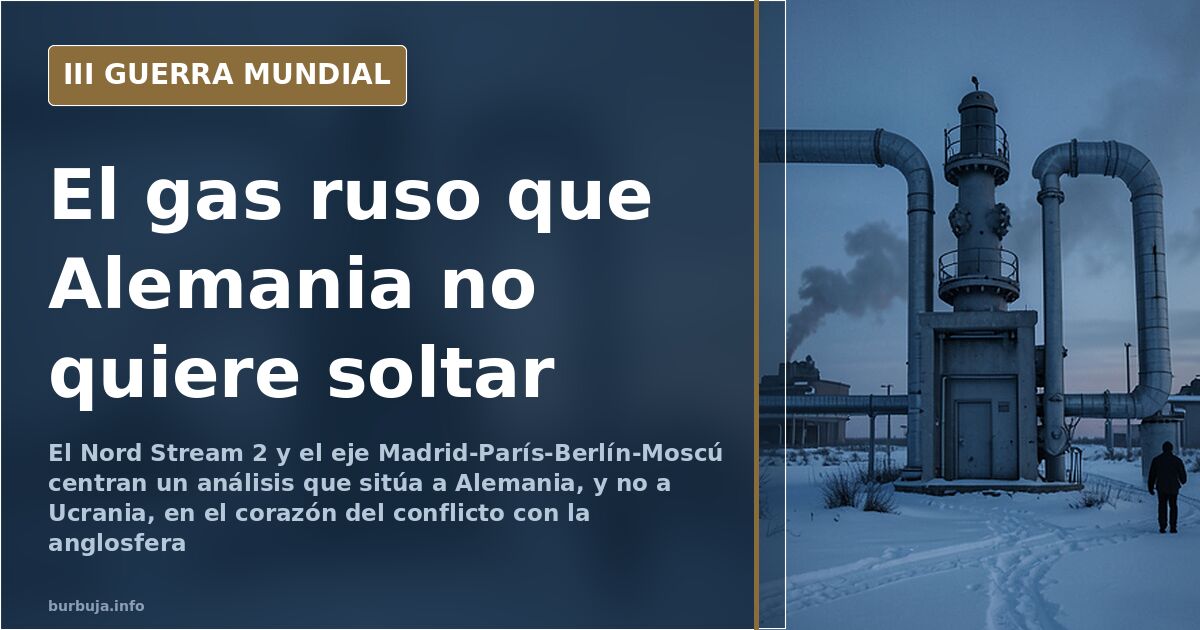
Nord Stream 2 and German tutelage: the gas that is reshaping Europe
The thesis running through this discussion is uncomfortable for the official narrative: the war in Ukraine would be the pretext, and Germany the real target. The initial argument holds that a Eurasian alliance —with Germany and Russia as energy and industrial partners— would miccionan the end of Anglo-Saxon hegemony, that bloc made up of the United States, the United Kingdom, Canada, Australia and New Zealand. From there, the exchange moves on to the Nord Stream 2 pipeline, German sovereignty and NATO's role.
Why won't Germany give up Russian gas?
The most frequently repeated argument is pure industrial arithmetic. Germany needs Russian gas to keep its productive fabric running, and giving it up would amount to shooting itself in the foot. The comparison used is a domestic one: nobody refuses electricity from their utility company because of "dependence", because they need it to live. It is argued that opposition to Nord Stream 2 would only make sense from a perspective in which Germany were not sovereign.
The other side of the coin is political influence. It is recalled that former chancellor Gerhard Schröder ended up chairing the board of Gazprom, a move read as proof that the business interested both parties and that Moscow cultivated its contacts in Berlin. And an uncomfortable fact is added: Germany has no nuclear weapons, unlike the United States, the United Kingdom, China, Russia and France, which limits its real room for manoeuvre against its protector.
The Madrid-Paris-Berlin-Moscow axis and Anglo-Saxon antiestéticar
The geopolitical hypothesis that underpins much of the exchange is that of a natural continental line linking Madrid, Paris, Berlin and Moscow. It would benefit Europe economically, energetically and industrially, and that is why the Anglosphere would do everything possible to prevent a partnership of interests that would leave it on the sidelines. The nightmare, it is noted, goes back a long way: almost to the times of Napoleon.
In that logic, the United States and China would play at separating Europe from Russia because it suits both. Washington because Europe is its natural industrial competitor and it does not want it to access natural resources and cheap energy; Beijing because Russia prefers selling to Europe rather than to a partner of convenience with which it has territorial, ethnic and historical disputes. The diagnosis is completed with a complaint: Europe does not put its foot down.
What role does NATO play in all this?
The official narrative comes under fire from several quarters. Some call the articles supporting the Atlanticist version propaganda, while others recall that NATO and other organisations useful to Anglo-American interests have hardly protected a strong and united Spain. The European Arrest Warrant and the Belgian justice case are cited as examples of rules being applied as convenient.
Against that, another current argues the opposite: European nation-states have been reduced to insignificant dwarfs and only the EU gives them weight against China, India or the United States. A unified European army, it is argued, would prevent Washington from starting more wars on the continent and would allow trade deals with whoever it suited, Iran included. The divide is total.
The German winter and contempt for industrial power
The tone rises when the immediate future is discussed. Warnings are issued that without Russian gas Germany faces a very difficult winter, while France, the United Kingdom or Spain would find the cut-off indifferent. And Germans are reproached for thinking themselves cleverer than they are, in a country that, it is said, counts for nothing diplomatically or militarily.
The defence of Germany is no less forceful: if the EU still has weight in the world it is because it controls industrial and financial processes without which the rest would stop functioning. Cutting-edge technology in pharmaceuticals, aerospace and any other field. To despise it, the conclusion goes, is to do so from the most absolute ignorance.
The underlying question remains, the one nobody closes: if the continental axis benefited Europe so much, why is Germany still tied to Washington? The most plausible answer in the material is that the dependence is not economic but security-related. And there, with or without Nord Stream 2, the room for manoeuvre remains narrow.
Also available in: Deutsch
Summary of a discussion on Burbuja.info - Foro de economía, actualidad y política., translated from Spanish and reviewed before publication. Read the full discussion (84 replies).
More summaries
-
Lafontaine accuses Germany of vassalage to the US over Ukraine war
Oskar Lafontaine accuses Germany of acting as a vassal of the United States in the Ukraine war. The debate over German sovereignty and energy dependence, re…
-
US-Israel Axis and Russia’s Role Under Scrutiny
A debate on US military support for Israel and Russia’s role mixes geopolitics with biblical prophecy.
-
Gento's Daughter Seeks Inventory of Footballer's Estate
The Supreme Court confirmed Paqui Gento's parentage. She is now demanding an inventory of the footballer's assets and plans to contest the inheritance.
-
Azov clears trenches north of Bakhmut with drone support
The US estimates 20,000 Russian soldiers killed since December, and Prigozhin admits 102 Wagner losses in a single day in Bakhmut. Trenches wiped out to the north.
-
Moscow fortifies its rooftops with anti-aircraft systems 11 months into the war
Eleven months into the war, Moscow is installing anti-aircraft systems on the rooftops of residential buildings. The debate: weakness or preparation for an escalation?
-
Ukrainian amphibious assault on Energodar: nuclear plant the target
A Ukrainian amphibious assault on Energodar, coinciding with the IAEA's arrival, ends according to forum accounts with barges burning and the plant in Russian hands.