
Ukrainian amphibious assault on Energodar: nuclear plant the target
A Ukrainian amphibious assault on Energodar, coinciding with the IAEA's arrival, ends according to forum accounts with barges burning and the plant in Russian hands.
English · Original discussion in Spanish · Published
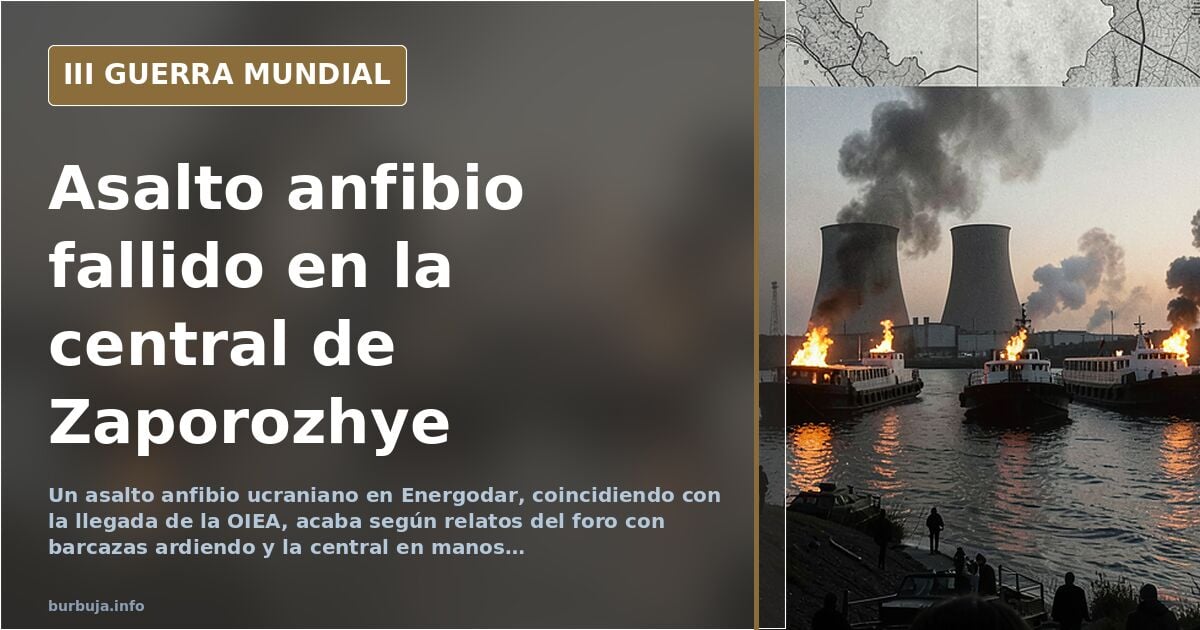
Amphibious assault on Energodar: the nuclear plant as the prize
In the context of the IAEA mission's arrival at the Zaporizhzhia nuclear power plant, a Ukrainian attempt to land on the southern shore of the Kakhovka reservoir ended, according to circulating accounts, with assault barges burning on the shore and an undetermined number of casualties. The operation, described as a quick strike to secure a beachhead in Energodar, ran into a defense that seemed to be expecting the move. The result, as of this discussion, is a tactical failure that leaves the plant in Russian hands and the international delegation as an uncomfortable witness.
The initial plan was ambitious: **between 80 and 100 men** in a first wave, with the idea of seizing the plant and, from there, pressuring the visiting "atomic" delegation and the international community with a policy of faits accompli. The timing with the inspection was no coincidence. As the argument goes, the operation sought to present Ukraine as the victim of a Russian bombing of the plant, a narrative that the presence of IAEA journalists and experts would make hard to sustain. The problem was that **the Russians did not withdraw** as a gesture of goodwill, as had peine on other occasions, and the assault force was met by Ka-52 helicopters and Su-25 aircraft flying over the landing zone.
How many barges and men took part in the assault?
The figures circulating in forum accounts are disparate and unverified. Some speak of **42 vessels** and more than **250 fighters** in two groups of boats and motor launches, with a result of 20 barges destroyed and 250 casualties. Other versions reduce the first wave to 60 men in a single barge that managed to reach the shore before being hit. What does seem confirmed by the images is that **one barge was left burning on the shore**, a detail that fits the version of a failed landing rather than an orderly withdrawal.
The discrepancy in the figures matters because it shapes the interpretation. If there were 250 men in 42 vessels, the Ukrainian command bet on a large-scale operation, not a commando raid. If there were 60 in a single barge, the failure is less costly in lives but just as decisive in strategic terms. In both cases, the question is the same: why launch an amphibious assault against a defended shore with Russian air superiority?
The nuclear plant as shield and target
The interest in controlling the Zaporizhzhia plant, the largest in Eurasia, is not only military. Whoever controls the plant controls the energy supply of a significant part of Ukraine and holds a lever of pressure over the international community. The IAEA's presence added a layer of complexity: any incident at the plant, with inspectors inside, would have had immediate media impact. Hence the hypothesis that the assault sought **to use the delegation as a human shield** or, failing that, as a witness to an alleged Russian bombing.
The story that the Russians were bombing the plant to provoke a nuclear disaster has been a constant in Western media. The arrival of the inspectors and the presence of journalists, it is argued, would make it difficult to maintain that narrative if the images showed an intact plant and the Russians controlling the area without incident. The operation, therefore, was not only military: it was a piece in the information war.
The surprise factor that wasn't
The Russian defense seemed prepared. Attack helicopters prowled the landing zone and Su-25s flew over the area with no documented Ukrainian air response. For some analysts, this is only explainable if **the Russians had prior intelligence** about the movement. The timing with the IAEA's arrival, which had suffered delays and cancellations, suggests the operation was planned well in advance and that someone leaked the details.
The tip-off hypothesis fits the pattern of other Ukrainian operations in the area, where Russian intelligence superiority has been a recurring factor. It also fits the absence of media coverage of the assault by Russian channels, which limited themselves to commenting on the falsity of some videos attributed to the fighting. If the operation had been a success, Ukrainian propaganda would have had material for days. The subsequent silence is, in itself, telling.
The staged video and the disinformation war
Amid the failure, a video appeared purporting to show Russian casualties: a watch with Russian inscriptions at the start, several bodies with no visible wounds and no trace of the river or the plant. The conclusion of those who analyzed it was that it was a staging, filmed somewhere else entirely for propaganda purposes. **The absence of shell casings, impact marks and geographic references** gave it away.
This episode illustrates the difficulty of establishing a verifiable account of events in a conflict where both sides have incentives to exaggerate or invent. The difference, in this case, is that the side that lost the operation is the one with the greater need to fabricate evidence. And the evidence, to date, has not appeared.
The Energodar amphibious assault leaves several questions open. The first, the real number of casualties and vessels destroyed. The second, the degree of IAEA involvement in planning the visit and whether its initial delay was a maneuver to buy time for the operation. The third, the impact this failure will have on the sarracena of Ukrainian forces and on the international perception of their military capability. With the plant in Russian hands and the inspectors inside, the story of a Russian bombing of the plant is, for now, unsupported. What is unknown is what would have peine if the landing had succeeded.
Also available in: Deutsch
Summary of a discussion on Burbuja.info - Foro de economía, actualidad y política., translated from Spanish and reviewed before publication. Read the full discussion (87 replies).
More summaries
-
Nuclear balance and the standoff over Ukraine: fear of atomic war
Fear of a nuclear conflict over Ukraine is spreading: NATO expansion and bases five minutes from Moscow are at the heart of concerns about atomic escalation.
-
Russia's Nuclear Threats Face Skepticism Even Among Allies
After a key ship sank, Moscow raises nuclear stakes while NATO arms Ukraine. The conflict's end remains unclear.
-
Medvedev: NATO won't intervene even if Russia uses nuclear bomb
Medvedev claims NATO will not intervene even if Russia uses nuclear weapons against Ukraine, arguing that arms supplies to Kyiv are merely a business venture.
-
Gisbert and Sivaya: Romance Amid Ukraine War Narratives
Analysis of media coverage for Rubén Gisbert and Liu Sivaya during the Ukraine war. Is this digital propaganda or reality?
-
Hiroshima denial theory collides with 6.2 kg of plutonium
The thesis denying the atomic bomb clashes with the 1.4% of uranium fissioned in Little Boy and the 16% of plutonium in Fat Man. Data versus narrative.
-
US trade deficit with Russia grew 41% after the invasion
US imports from Russia rose 6.5% in March and its trade deficit 41%, while the EU keeps buying Russian energy via India