
Azov clears trenches north of Bakhmut with drone support
The US estimates 20,000 Russian soldiers killed since December, and Prigozhin admits 102 Wagner losses in a single day in Bakhmut. Trenches wiped out to the north.
English · Original discussion in Spanish · Published
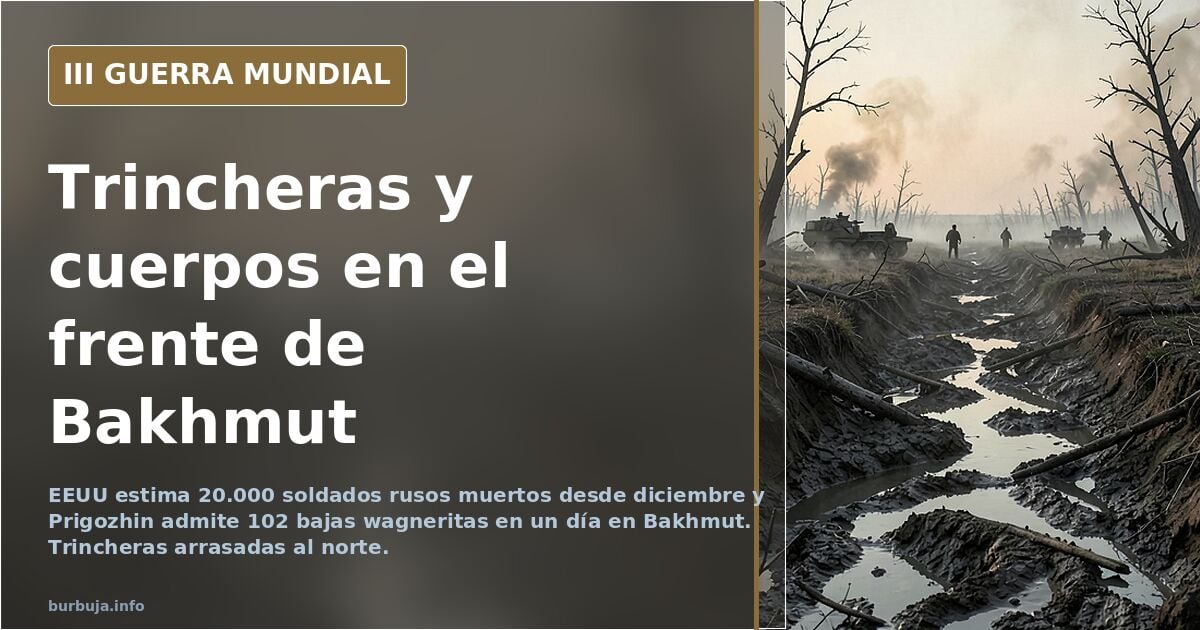
Trench assaults and drones: the war of attrition north of Bakhmut
The figure that puts everything else in order: the United States estimates that 20,000 Russian soldiers have died in Ukraine since December, and at least half of them would be mercenaries from the Wagner group. Against that backdrop of attrition, the drone footage circulating from north of Bakhmut makes sense: Russian trenches packed with bodies, assaults by Ukrainian units — the 92nd Mechanized Brigade, Azov, the Kraken unit and the Georgian legion are mentioned — and positions changing hands after several days of clearing operations.
The casualty figure is not an isolated leak. Wagner's own chief, Yevgeny Prigozhin, has spoken about the number of dead his ranks have accumulated and has put it at 102 Wagner losses in a single day to "liberate" a few lampposts in Bakhmut, according to Russian media. The extrapolation used in the most aggressive analyses puts the total number of Russians killed since the start of the invasion at around 60,000.
The method: trench assault, drone and finishing off
The descriptions accompanying the videos read almost like a manual. A Ukrainian soldier spots a Russian soldier who had been missed at the position and is hiding a grenade; he shoots him dead before he can throw it. In another case, the fighter is hit next to a corpse and then finished off with grenades, all filmed from the air. The sequence repeats itself: approach, assault, clearing of the trench and a drone circling overhead to hunt down anyone hiding in a hole.
Some dispute exactly who carried out each recording — there is debate over whether it was Kraken, Azov or the 92nd Brigade — and some flatly deny the scenario: "There are no Wagner troops in Bakhmut. The video must be from when the Ukrainians lost Bakhmut." The controversy over which unit killed whom and on what date takes up more space than it deserves.
What is being debated when propaganda is debated?
The core of the disagreement is not whether there are dead. It is why the videos are published. One camp holds that these videos add nothing new — "we've seen hundreds of them" — and that the same half-dozen recordings could be published with the sides reversed without changing the analysis one bit. The other side replies that the aim is to dismantle the Russian narrative: that those trenches were under Russian control, it is claimed, is simply false.
Where the discussion turns harshest is over sources. It is pointed out that Russian propaganda is mass-produced and has loudspeakers in major media outlets, and Colonel Baños is mentioned as an example of that echo in the so-called free press. On the other side, the retort is that Ukrainian propaganda "debunks itself." Nobody here offers an independent measurement of audiences; it is a battle of perceptions.
Bakhmut, Avdiivka and the 23% of the territory
The most frequently repeated counterpoint comes in the form of a percentage: Russia occupies 23% of Ukrainian territory. It is the argument of those who believe that a handful of retaken trenches does not move the needle of the war. The response from the other side is that the capture of Bakhmut is announced over and over and never quite happens, and that the road they have been trying to cut for months remains uncut.
Added to that is the logistical detail that even the accounts most favourable to Moscow admit: the shortage of ammunition. Prigozhin has said it plainly — Russians are dying needlessly in Bakhmut for that reason — which turns the internal complaint into a datum more eloquent than any video. When the man doing the recruiting admits his men are falling because of supply shortages, the argument about propaganda loses steam.
The question neither of the two verbal trenches answers remains: if the casualty figures are true and the attrition is on this scale, how long can the side that recruits without training and sends its men into assault pumped up on amphetamines, as described, sustain such a war? And if they are not true, why does the mercenaries' own chief confirm them?
Also available in: Deutsch
Summary of a discussion on Burbuja.info - Foro de economía, actualidad y política., translated from Spanish and reviewed before publication. Read the full discussion (77 replies).
More summaries
-
Wagner chief Prigozhin dies in plane crash in Russia's Tver region
Yevgeny Prigozhin, head of the Wagner Group, died when his Embraer jet crashed in Tver, killing at least ten others amid suspicions of a targeted hit.
-
Prigozhin says Russian desertion opens 2 km gap in Bakhmut
Prigozhin claims a Russian unit abandoned its positions in Bakhmut, leaving 2 km of front exposed, and threatens Wagner with charges of «treason against the State» if it withdraws.
-
Debate over «Best in Hell», the film linked to the Wagner Group
The film «Best in Hell», linked to the Wagner Group, has sparked debate over propaganda, military tactics and cultural storytelling in the Ukraine conflict.
-
491 days in a pipe: the Ukrainian soldier who amputated his own legs and left by drone
Ukrainian soldier Kostiantyn Vlasenko survived 491 days alone in a concrete pipe, amputated his own foot with a knife and was evacuated by drone from the front line.
-
Moscow fortifies its rooftops with anti-aircraft systems 11 months into the war
Eleven months into the war, Moscow is installing anti-aircraft systems on the rooftops of residential buildings. The debate: weakness or preparation for an escalation?
-
Ukrainian amphibious assault on Energodar: nuclear plant the target
A Ukrainian amphibious assault on Energodar, coinciding with the IAEA's arrival, ends according to forum accounts with barges burning and the plant in Russian hands.