
Fears of a mass exodus of French people to Spain
A forum user argues that the crisis in France will push workers towards Spain, fuelling the housing debate; rents in Valencia average around €1,776
English · Original discussion in Spanish · Published
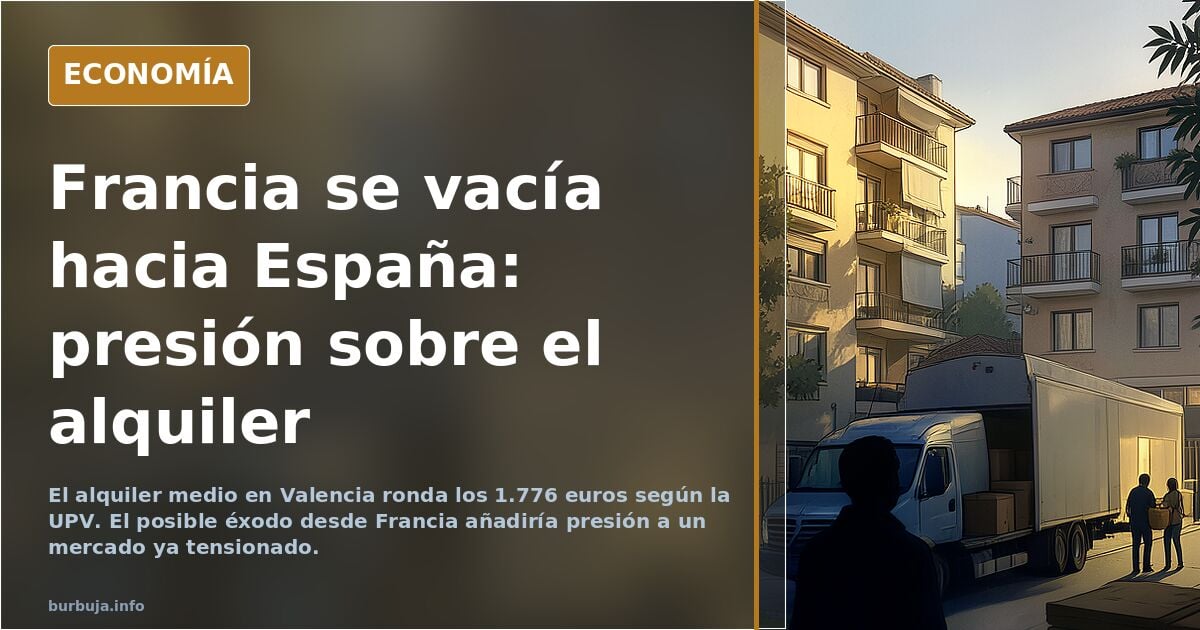
France bleeds out while Spain eyes its neighbour warily
The thesis is gaining traction in economic forums: if France goes under, hundreds of thousands of its citizens will cross the Pyrenees. The argument rests on a premise repeated in every conversation about France's decline: its skilled professionals have already left for London, Quebec, the United States or Switzerland, and now it is the average worker's turn. Geographic and cultural proximity makes Spain the natural destination. And that is where the alarm bells ring: an already strained housing market would take an additional hit.
The discussion quickly splits in two. One camp holds that the native French person who emigrates is hard-working and calm, and that their arrival could even balance out migratory pressure from other origins. The other camp responds with scepticism: those who flee are not coming to fight, and anyone arriving in search of benefits contributes nothing. Mutual distrust sets the tone.
Rents in Valencia as the thermometer
The most concrete figure in the exchange comes from the Valencia property market. Average monthly rent in the city of Valencia stands at around €1,776 according to the Housing Observatory of the Universitat Politècnica de València, while other portals put it lower at €1,637 (about €16.6/m²). By size, a studio starts at €1,358, a one-bedroom flat at €1,482, a two-bedroom at €1,672 and a three-bedroom at €1,875.
With that escalation, the warning is clear: if a new wave of foreign demand is added, the €2,000-a-month average barrier will stop being a hypothesis. Valencia already absorbs Italians from the south and Anglo expats; adding the French would be the final straw for local tenants.
Why would the French leave France?
The diagnosis being floated points to growing social and racial tension in France's big cities, with episodes of street violence and looting that have produced highly striking images. A climate close to racial civil war is described which, on this reading, most people fail to see. The comparison with Argentina in Europe keeps coming up: a rich country that is impoverishing itself and driving out its middle class.
Against that, some point out that beyond the ghettos there is a white France with a standard of living still light years above Spain's. For that profile, Spain is not a desirable destination but a pigsty. The argument has its logic: those with assets and qualifications do not move down a category if they can avoid it.
The political factor: who will the newcomers vote for?
Political suspicion runs through much of the exchange. There are antiestéticars that the new French residents will end up voting for the same parties as in their country of origin, perpetuating the cycle that, on this view, has brought France to its current situation. The phrase that sums up the unease: import the French, and you get France. The corollary is that the receiving country would end up replicating the sender's problems.
The opposite reading also appears: if France falls, the whole of Europe falls with it. The catastrophic scenario would not be the arrival of refugees, but the collapse of the neighbour, which would leave Spain in a far worse position. Seen through that lens, praying that France holds up is more rational than celebrating its fall.
Housing as the bottleneck
The property market is the point where almost all positions converge. The most repeated conclusion is that there is no housing available: the newcomers would have to sleep under bridges. Supply is not growing at the pace of demand, and any additional flow pushes prices up.
The paradox is that the same diagnosis defuses the alarm: if there is no housing, there will be no mass arrival either. The French person considering emigrating compares conditions and, unless fleeing something serious, does not choose a market where rent already competes with their salary. Migratory pressure regulates itself through the wallet.
The scenario nobody rules out
The prediction that closes the exchange is twofold. First, that the flow will be not hundreds of thousands but millions if the French situation deteriorates. Second, that the profile of the newcomer will not be the skilled professional but the average citizen who can no longer cope. If that combination materialises, the impact on Spain's labour and housing markets will be hard to exaggerate.
The caveat is obvious: nobody knows when, or even whether, France will cross that threshold. The decline has been announced for years and the country is still standing. The warning, though, has been issued: he who warns is no traitor.
Also available in: Deutsch
Summary of a discussion on Burbuja.info - Foro de economía, actualidad y política., translated from Spanish and reviewed before publication. Read the full discussion (63 replies).
More summaries
-
Red-flag march through Madrid returns to Puerta del Sol
A march with red flags through Madrid returns to Puerta del Sol amid debate over who is behind it
-
Vulnerable family: €1,000 a month per child for migrants
An analysis of the welfare debate in Spain: housing, the Minimum Vital Income and the vulnerability threshold that leaves Spanish workers out while migrants qualify.
-
SCANDAL: Plus Ultra airline under investigation for drug trafficking
Plus Ultra is under investigation for flights carrying up to 10 tonnes of excess weight, and the Guardia Civil unit tracking the Spanish airline has been disbanded.
-
Living the dream: can you live off welfare in Spain?
Analysis of the 'living the dream' thread: is it possible to live off benefits in Spain? Data, controversy and the immigration debate.
-
World's third-largest gas storage facility destroyed in the UAE
The world's third-largest gas storage facility, located in the United Arab Emirates, has been destroyed. Qatari LNG output reportedly falls to zero. Who benefits from the energy chaos?
-
TVE journalist confronted live in Paris during unrest
A TVE journalist was confronted live on air from Paris and the broadcast was cut after a throat-slitting gesture was made at the camera.