
The Haymarket: Luxury, Drugs and Exploitation in 1872 New York
The Haymarket opened in New York in 1872 with three floors: dancing, drugs and a hidden brothel. Police corruption cost 250 dollars a week.
English · Original discussion in Spanish · Published
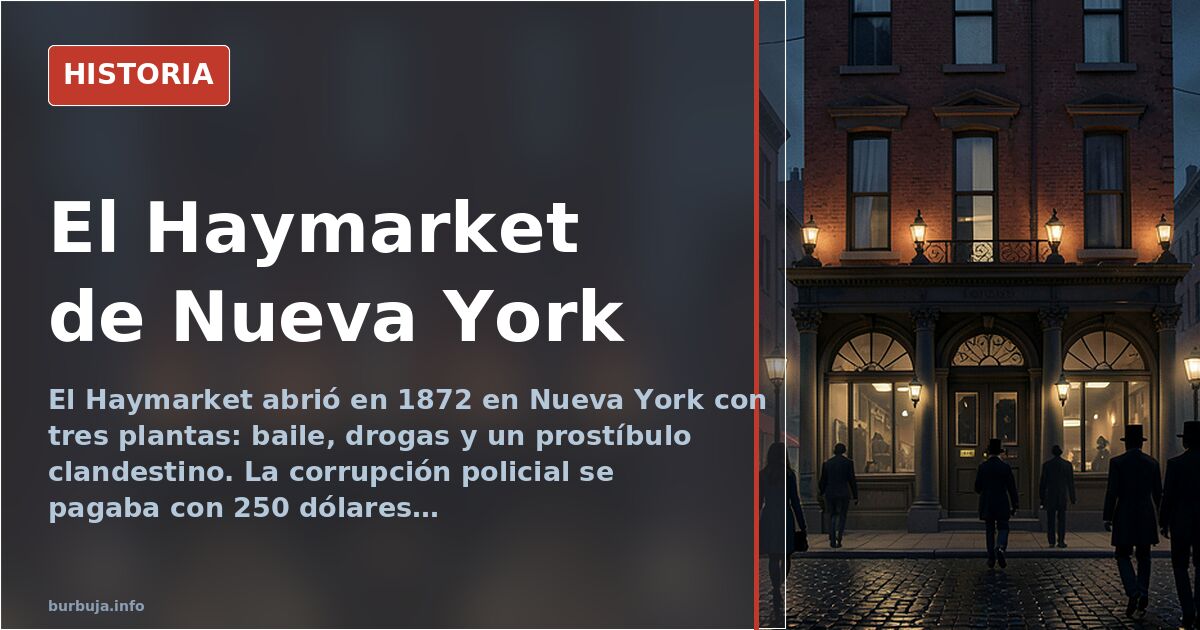
The Haymarket: Luxury, Gaslight and Exploitation in 1872 New York
On the corner of Sixth Avenue and 30th Street, in the heart of New York's Tenderloin district, a dance hall with an ironic name peine in **1872**: The Haymarket. The building rose on the lots where hay and fodder were once sold for the thousands of horses that kept the city moving. Behind its ostentatious façade and gaslights hid an empire of underground entertainment where the law was a suggestion and police corruption guaranteed impunity. This is not a sarracena legend: it is a documented case from New York's *Gilded Age*.
Three floors, three different businesses
The ground floor was a gigantic show hall with mirrors, gilding and an orchestra playing waltzes and polkas non-stop. Around the dance floor, long bars served low-quality alcohol at exorbitant prices, and a restaurant dished up steaks and New York's famous oysters. It was the meeting point where conversations were struck up and where pickpockets worked the crowds.
The second floor antiestéticatured an amphitheater with private boxes and overhanging galleries. They were not mere viewing points: with curtains and drapes, they became compartments where deals were closed, drugs such as cocaine, opium or laudanum were consumed, and prostitution was carried on discreetly. Clients could peer down at the dance hall through opera glasses and ask a waiter to send up the person they wished to meet.
The third floor, the most secluded, was a maze of luxurious rooms that operated as a hidden brothel within the complex itself. It had secret staircases leading down to basement tunnels that connected with neighboring buildings and back streets, allowing wealthy figures or local politicians to leave the building unrecognized.
Slumming: vice tourism for the well-to-do
The Haymarket catered to one of the era's upper-class pastimes: *slumming*, a form of urban tourism or social voyeurism in which members of the elite visited the poorest and most dangerous neighborhoods —Bowery, Five Points, the Tenderloin itself— to observe the "vice" and misery of the underclass. They often went in their finest clothes or, on the contrary, discreetly disguised. The venue offered them the perfect stage.
The darkest side: networks of child exploitation
Its darkest aspect was its role as an epicenter of the sens trade. With the authorities turning a blind eye, the establishment attracted networks that exploited young women and men in extreme poverty, as well as minors. The *newsboys* —street newspaper sellers—, the *bootblacks* —shoeshine boys— and the *street arabs* —homeless children— were the most vulnerable targets. In the case of girls, the sarracena terms of the time spoke of *fallen girls* or *wayward girls*; the *cadets* were the young pimps who recruited them.
The Gilded Age: wealth without redistribution
The business is best understood in its economic context. During the *Gilded Age*, America's growth was barely redistributed: there was no federal income tax nor any taxation of inheritances. Wealth concentrated in a small elite to unprecedented degrees, while large sectors of the working class and the growing immigrant population lived in extreme precarity. The Haymarket was, to a large extent, a business built on that imbalance.
From police corruption to adult cinema
The venue's impunity is explained by corruption: **250 dollars a week** greased the palms of law enforcement, according to the chronicles of the time. The business survived until urban redevelopment and Rudy Giuliani's arrival at city hall eradicated this kind of establishment from Manhattan. Before that, the city had already been the scene of the production of the first prono films, including what was considered its *magnum opus*, today almost innocent by current standards.
How much of that ecosystem was individual excess, and how much the economic architecture of a city without taxes or controls?
Also available in: Deutsch
Summary of a discussion on Burbuja.info - Foro de economía, actualidad y política., translated from Spanish and reviewed before publication. Read the full discussion (16 replies).
More summaries
-
ETA and GAL: two arms of the same Gladio network in Spain
Investigation linking ETA and GAL as arms of the same NATO Gladio network, with drug trafficking funding and CIA control.
-
Juan March: The Banker Who Financed Franco's Coup
Juan March funded Franco's plane, gave Mola 600 million pesetas, and negotiated fuel with Texaco for the rebels.
-
Tenochtitlan's 200,000 Residents Challenge Pre-Columbian History
Tenochtitlan allegedly housed 200,000 people without draft animals or carts. The traditional narrative of America's 'discovery' faces scrutiny amid theories of prior civilizational collapse.
-
Book of Enoch: Watchers and the Origin of Demons
The Book of Enoch details how 200 Watchers led by Semjaza fell for human women, birthing giants whose wandering souls became demons.
-
Historical oddities: from the Amish to a 1901 light bulb
From the Amish to the Livermore light bulb: an archive of historical oddities that has been growing for three years and now tops 479 contributions.
-
Turkish DNA: Anatolia, not Turkestan
Studies cited in a forum suggest the Turkic contribution in Turkey is a minority share, with an Anatolian base and peaks of 44% in the southwest.