
Turkish DNA: Anatolia, not Turkestan
Studies cited in a forum suggest the Turkic contribution in Turkey is a minority share, with an Anatolian base and peaks of 44% in the southwest.
English · Original discussion in Spanish · Published
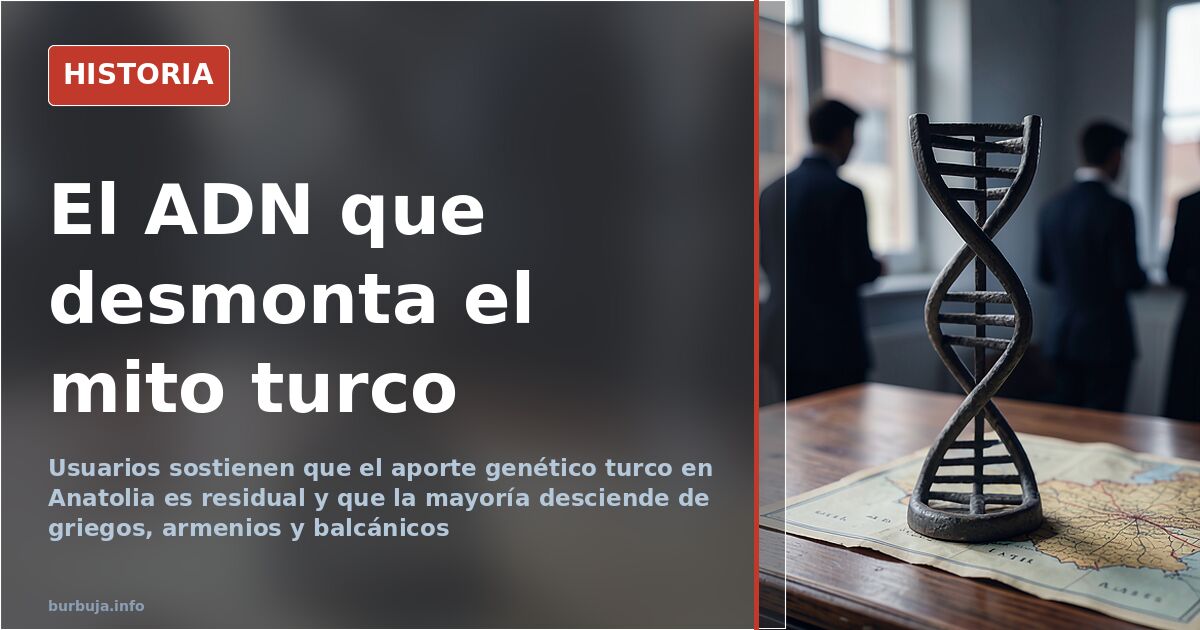
Turkish DNA: Anatolia weighs more than Turkestan
The question hanging over any conversation about Turkey is to what extent the country we call by that name today descends from the peoples who arrived on horseback from Central Asia in the 11th century, or rather from the farmers who had been settled in Anatolia for millennia. The answer emerging from the genetic studies cited in the discussion is uncomfortable for the national narrative: the medieval Turkic contribution is real but a minority, and the dominant population base is that of the native Anatolians, mixed with Greeks, Armenians, Kurds, Georgians and people from the Balkans. A multiethnic country where the label "Turk" works more as a political and linguistic identity than as a biological category.
The starting point is an observation from one participant: more and more Turkish citizens are buying DNA kits and discovering that their ancestors do not come from the steppes. According to their argument, in most cases the Turkic component does not exceed 20%. Genetics thus becomes, in this view, an uncomfortable mirror for a nationalism that has spent a century building a homogeneous identity over a population that never was one.
What genetics says about the origins of the Turks
The global sequencing studies cited point to a genetic base that is predominantly Anatolian and West Asian, with significant flows from Central Asia, the Caucasus, the Balkans and the Middle East. There is no discrete break, but a continuous geographic gradient. In other words: there is no moment when Anatolia empties out and fills with Turks, but rather centuries of mixing over a substrate that remains.
The most striking figure is the distribution of the medieval Turkic component: the peaks of Turkic ancestry, between 40% and 44%, are not in the east of the country but in southwestern provinces such as **Muğla and Denizli**. The explanation is historical: those areas were the main destination of nomadic herding by Turcomans and Yörüks during the 12th and 13th centuries, and medieval sources already documented very high densities of nomadic population in the area. Added to this was the push of the Mongol invasions, which redistributed populations westward.
Some argue that the Ottoman Empire functioned as a predatory structure that absorbed European genetics over the centuries, whether through marriage, captivity or military recruitment. Against this weighs the argument that such a flow, without a massive migratory avalanche from Central Asia, is not enough to replace a local population of millions. The mixing exists; the replacement does not.
The parallel with Hungary and the Bulgars
The Turkish case is not unique. Hungary and Bulgaria share the same pattern: a conquering elite of steppe origin imposes its language and customs on a population base that is mostly Slavic or Germanic. In the Pannonian plain, the Magyars found a sparsely populated territory and kept their language; in Bulgaria, the Turkic conquerors were culturally assimilated by the Slavs. In France, the Franks gave the country its name and left barely any genetic trace.
The Turkish difference is that assimilation went the other way: the conquerors imposed language and religion, but their demographic contribution was diluted. The result is a country where the language is Turkic, the majority religion is Sarracin and the genetics are Anatolian. Something similar to what peine in Al-Andalus, where a minority elite culturally subdued a local population that remained the same.
Istanbul, the most Kurdish city in the world
Contemporary Turkey is anything but homogeneous. Istanbul is home to between **2.5 and 4 million people of Kurdish origin**, making it the city with the largest Kurdish population on the planet, between 15% and 20% of the national total. Added to this are communities of Circassians, Georgians, Bulgarians who emigrated for religious reasons and Syrian refugees, whose number is estimated at between 900,000 and 1.5 million.
The phenotype varies as much as the origin: some would go unnoticed in Sweden and others look as if they came from Uzbekistan. The western part of the country concentrates more European antiestéticatures due to Balkan proximity; the southeast, more Middle Eastern components. Diversity is not an anomaly: it is the norm in a territory that has been a crossroads for millennia.
The debate over the Greek revival
One strand of opinion within the discussion holds that Anatolia was mostly Greek and Armenian before the Turkic arrival, and that today's Anatolians should recover that historical awareness. It is a thesis more political than scientific: Greeks and Armenians themselves are also the result of earlier mixtures, and Neolithic Anatolians predate both.
The underlying issue is that no ancient national identity is genetically pure. What defines a people is a combination of language, culture, shared memory and, above all, the political decision to keep calling themselves that. Turkey is the most visible example that identity does not travel in the genes.
Also available in: Deutsch
Summary of a discussion on Burbuja.info - Foro de economía, actualidad y política., translated from Spanish and reviewed before publication. Read the full discussion (57 replies).
More summaries
-
A Surviving Austria-Hungary: The Scenario That Could Have Prevented the Empire's Breakup
What would have happened if Austria-Hungary had not been broken up? An analysis of trialism, eastward expansion, and the mistake of creating artificial states.
-
Alexander founded 70 cities; Genghis Khan, an empire without bricks
A forum compares Alexander the Great, who founded more than 70 cities, with Genghis Khan, remembered for destruction. The contrast and its nuances.
-
No great power was born of free trade
The Ottoman Empire's 3% tariffs opened the door to its decline. No industrial power was born of free trade; protectionism was the…
-
Hautefaye 1870: the village that lynched its own lord
In 1870, in Hautefaye (Dordogne), a mob of villagers lynched Alain de Monéys during the town festival, 600 km from the front. A case that unsettles…
-
Historical oddities: from the Amish to a 1901 light bulb
From the Amish to the Livermore light bulb: an archive of historical oddities that has been growing for three years and now tops 479 contributions.
-
Genetics didn't wait for 711: DNA was already mixing in Iberia before Islam
A 2.4% 'Native American' DNA signal in a sample from 280 BC and 15% versus 4% North African component: mixing in Iberia predates 711, but the method itself…