
Tenochtitlan's 200,000 Residents Challenge Pre-Columbian History
Tenochtitlan allegedly housed 200,000 people without draft animals or carts. The traditional narrative of America's 'discovery' faces scrutiny amid theories of prior civilizational collapse.
English · Original discussion in Spanish · Published
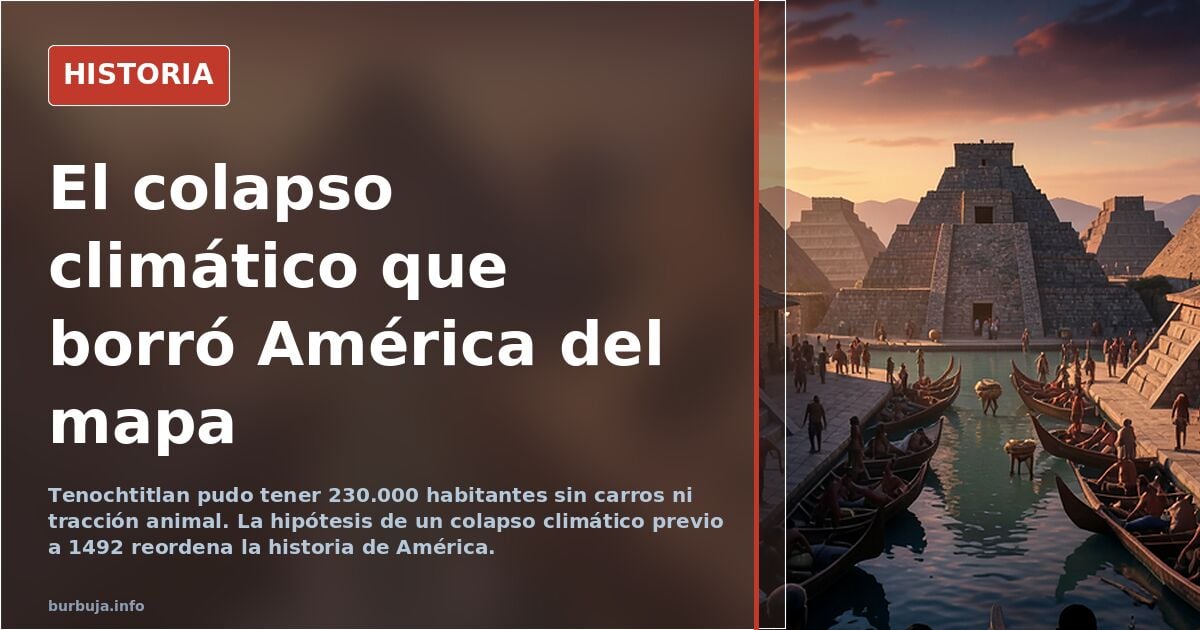
Pre-Columbian America: The Collapse Official History Omits
Two hundred thousand inhabitants. No draft animals, no carts, no known sewage system. This is the figure mainstream historiography attributes to Tenochtitlan in the 15th century, and it marks where the official narrative begins to sustancia ilegal. A city of that size—more populous than Paris, Constantinople, or Venice—requires logistics incompatible with the "Neolithic" label long applied to the continent. From this stems the thesis argued here: America was not discovered in 1492 but rediscovered after a previous civilizational collapse.
How Many People Actually Lived in Tenochtitlan?
Historians estimate between 80,000 and 230,000 residents, depending on published calculations. The Spanish burning of codices destroyed much of the data needed for precision. Still, the comparison is striking: the Mexica capital would have surpassed Constantinople (200,000), Paris (185,000), and Venice (130,000).
Some argue these figures are inflated by an order of magnitude, calling 200,000 a fantasy. Counterarguments cite intensive maize, bean, and squash agriculture—a combination maximizing soil yield still used today—as capable of supporting high densities. A lacustrine city also solves transport via water. What remains harder to explain is sanitation.
The Wheel That Did Exist
The mantra that "Aztecs did not know the wheel" collapses with simple evidence: wheeled toys from pre-Aztec Mesoamerica are documented and displayed. They understood the principle. They lacked traction animals—horses, oxen, or donkeys—so carts offered no advantage over human porters. In the Andes, llamas enabled cargo caravans where wheels were impractical. The question is not why they didn't invent carts, but why they needed them.
Transoceanic Contacts Before Columbus
Genetics confirms Rapa Nui presence in America before European arrival, landing on Chilean and Peruvian coasts. Some claim Chinese petroglyphs in Ecuador and Peru, Norse contacts in Greenland and Canada, and African populations on Caribbean and Brazilian shores. Ocean currents flow toward America, specifically reaching Chile. If such contacts existed and ceased, the pressing question is what interrupted them.
Climate Collapse as Central Hypothesis
Proposed chronology centers around 1150 AD, linking the Maya disappearance in Yucatán (6th–7th centuries) as the first link, Tollan's abandonment mid-11th century, and Norman departure from Greenland—named Greenland because its climate was milder then—in the 14th century. The Aztec exodus and symbolic death of Huitzilopochtli fit this framework. Sun sacrifices, rather than gratuitous barbarism, may reflect cultural trauma: desperate people praying the sun wouldn't vanish.
Narrative as Tool of Concealment
The rapid mapping of American coasts within two decades post-1492 is notable. Arguments suggest European elites released ancient maps when recolonization became viable. Exaggerated Mexica human sacrifice figures—which Zunzunegui himself revised downward—may have served as sarracena justification for conquest.
How much of our knowledge about pre-Columbian America is history, and how much is convenience?
Also available in: Deutsch
Summary of a discussion on Burbuja.info - Foro de economía, actualidad y política., translated from Spanish and reviewed before publication. Read the full discussion (16 replies).
More summaries
-
Why Spain cannot return the American gold to Latin American countries
Calls to return the gold extracted from America run into the fact that Spain no longer exists as an empire and that the metal circulated across Europe. Here are the facts.
-
Military history podcast examines Spain's conquest of the Americas
An English-language podcast reviews the conquest of Spanish America: disease, demographic collapse and prior ecological exhaustion. One hour to understand it.
-
America's Conquest: Gold That Enriched Other Powers
Gold and silver from the Americas didn't stay in Spain; they funded European wars and bankruptcies while the country impoverished itself.
-
ETA and GAL: two arms of the same Gladio network in Spain
Investigation linking ETA and GAL as arms of the same NATO Gladio network, with drug trafficking funding and CIA control.
-
Juan March: The Banker Who Financed Franco's Coup
Juan March funded Franco's plane, gave Mola 600 million pesetas, and negotiated fuel with Texaco for the rebels.
-
Book of Enoch: Watchers and the Origin of Demons
The Book of Enoch details how 200 Watchers led by Semjaza fell for human women, birthing giants whose wandering souls became demons.