
The future disappoints: the feeling that nothing good can happen
The sense that nothing good can happen runs through the conversation: from the debt Ponzi scheme to nostalgia for 1690. The future expires after ten years.
English · Original discussion in Spanish · Published
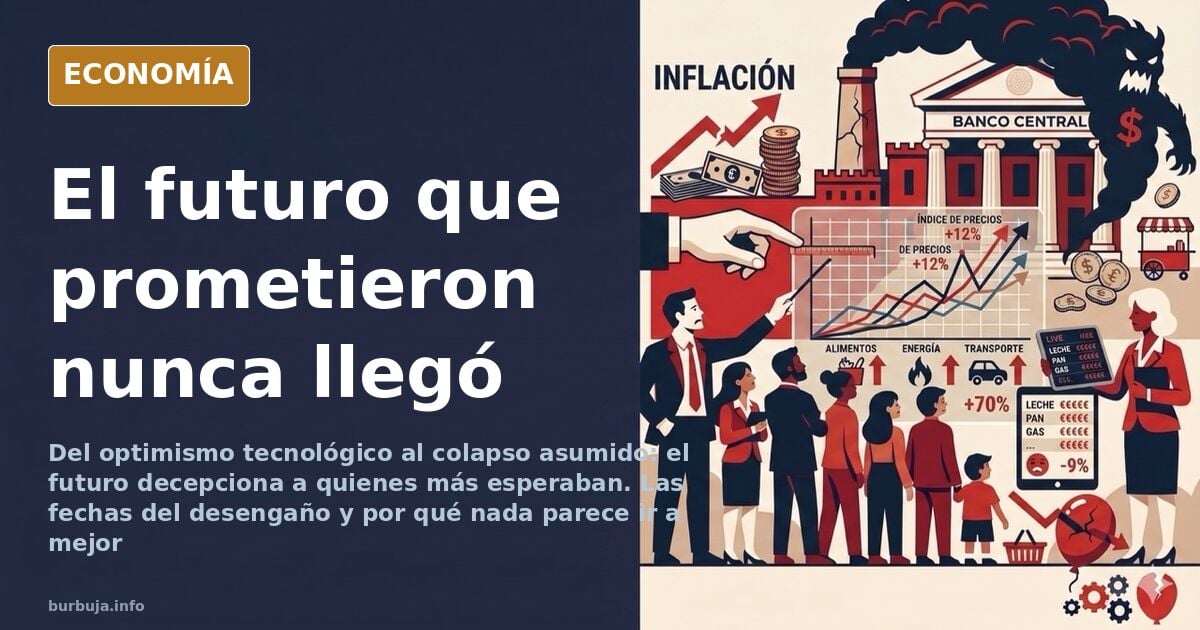
The future disappoints: the feeling that nothing can get better anymore
There is a scene that repeats itself in any dinner-table conversation: someone recalls what they expected from the year 2000 and someone lets out a bitter laugh. Disappointment with the future is no longer a generational pose; it is a commonplace that cuts across classes and ages. What began as a personal confession —"I've always been an optimist, but I have to admit I was wrong"— ended up becoming a chorus: the older you get, the more negative and disillusioned you become.
The conversation starts with an intimate confession and drifts toward a collective diagnosis. The dominant idea is that civilization does not move in a straight line. History is not pogre, argues a school of thought that makes people uncomfortable: living more comfortably is not a sign of pogre. And some put a date on the turning point: 2007 as the year things started to go wrong, 2015 as the moment it became evident, and 2018 as the point when it was already too late to react.
Why do people feel the future has gotten worse?
The unease does not come from technology; it comes from the perception that the decisions being made make life worse instead of better. The most repeated complaint is not strictly economic: it is the feeling that nothing good can happen because part of society is programmed to destroy anything that shines. That distrust of others —"people who go through life wearing masks"— weighs more than any GDP figure.
Pessimism becomes more concrete when money comes up. A calculation circulating in the thread holds that the system is a debt-based Ponzi scheme: it needs more people joining in than it feeds off, and the low birth rate in the first world breaks the equation. Immigration, in that narrative, would not come to sustain the system but to extract from it. It is a debatable and debated thesis, but it explains why so many people feel they are paying for a party they were never invited to.
The present disappoints too: aesthetics and everyday life
Not all the disenchantment is macroeconomic. Part of the malaise is purely aesthetic and social: the feeling that the street has become more shabby. It is the classic complaint of someone who looks around and no longer recognizes the neighborhood. Behind it lies a deeper idea: decline is not measured only in euros; it is measured in how people dress, how they speak, and how they treat their neighbor.
Against that narrative, there is one objection that cannot be ignored: the best era in history for access to goods and services. Three small old apartments in a big city have been enough for part of society to move up in class without working. It depends on which side of the changes you peine to be on. And some add that money is not everything: better poor with people around you than rich surrounded by masks.
The future as an omen: from dystopian cinema to AI
Popular culture has been warning us for decades. The dystopian films that seemed like fiction have fallen short. And technology, which was supposed to save us, is increasingly perceived as a threat: artificial intelligence appears in the conversation not as a tool but as a possible executioner. The question hanging in the air is uncomfortable: what if technical pogre only serves to let a few control everyone else?
The result is a mix of nostalgia and dark humor. Some joke about going back to 1690, some recall an acquaintance who predicted the end of the world in 2012 and has lived every day since as a gift, and some have simply stopped thinking about the future: "I think about surviving." This is not salon nihilism; it is expectation management.
The generational divide: even the old days weren't that good
The temptation to blame the previous generation runs into an uncomfortable testimony: someone born in 1970 remembers sinister teachers, the industrial restructuring of the eighties, and pitched battles between workers and police in Asturias. There was no golden age. At most, there was a time when decline was better disguised.
The conclusion that imposes itself is that the future has an expiration date. After ten years, any promise becomes obsolete. And while some position themselves to watch the show from a remote estate in the mountains, others keep hoping something brilliant will appear. The unsettling fact: the generation that has consumed the most in history is also the one that trusts the future the least. The future is no longer what it used to be, Paul Valéry wrote. And he is still right.
Also available in: Deutsch
Summary of a discussion on Burbuja.info - Foro de economía, actualidad y política., translated from Spanish and reviewed before publication. Read the full discussion (100 replies).
More summaries
-
The right and the pensions elephant: promises without numbers
An analysis argues that Spain's pension system is already being propped up by debt and that the right promises to pay pensions without saying how. The electoral dilemma nobody wants to face.
-
Spain's Government pays Christmas bonus before elections
Spain disburses the Christmas bonus for civil servants and pensioners just hours before voting, according to forum calculations.
-
VOTE HERE AND NOW: Do we need an economic crisis?
Is an economic crisis necessary? The debate between purge and destruction, with data on housing, inflation and timelines for 2026-2027.
-
Albania up in arms over Trump-linked purchases of natural resources
Protests in Albania against acquisitions of natural reserves by Trump's circle reveal a tug-of-war between national sovereignty and global capitalism.
-
Two evictions suspended after protests in Mataró, Spain
Eight arrests, seven of them minors, and two evictions suspended in Mataró after protests. Housing tensions escalate and landlords threaten to withdraw their properties.
-
Humanity's message to the AI of the future: memes, ego wars and two scenarios
Messages to the AI of the future: self-criticism, dystopias and the certainty that humanity will not perish from bombs but from its inability to stop arguing.