
Spain's Government pays Christmas bonus before elections
Spain disburses the Christmas bonus for civil servants and pensioners just hours before voting, according to forum calculations.
English · Original discussion in Spanish · Published
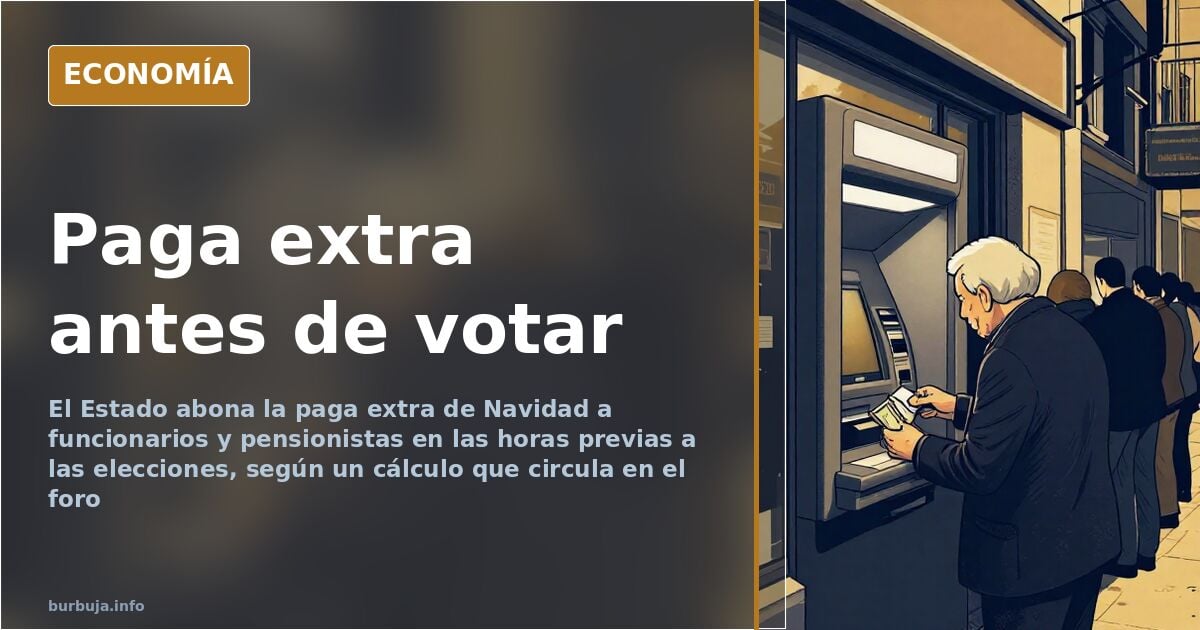
Spain's Government pays Christmas bonus before elections
Can a vote be bought with a paycheck? The question sounds like a joke, but has an uncomfortable answer: it depends on when the money arrives. According to calculations circulating in forums, the payment of the Christmas extra pay for civil servants and pensioners—usually paid between November 21 and 25—coincides with the hours leading up to the election. The amount moving during those days is around €16.7 billion, according to the same calculation. A liquidity injection arriving exactly as polling stations open.
The operation is not new in its mechanics, but its timing is. The Executive maintains this is simply an administrative adjustment. Some speak of buying votes with public money. In the middle, a fact no one disputes: the recipients are mostly elderly voters, a group with historically high turnout.
Why is the bonus paid in November and not December?
The November extra pay is not a recent invention. It has been paid that month for years, arguing that it gives recipients liquidity before Christmas shopping. What has changed is not the date, but the context: this time, the electoral calendar and payment schedule overlap in a way that makes it hard not to see political intent.
The circulating calculation speaks of more than €16.7 billion leaving public coffers in just a few days. To put it in perspective, that figure equals a significant part of monthly spending on contributory benefits. It is not pocket change. And it comes after weeks of interested leaks about a supposed lack of liquidity to cover the bonus.
Some argue the advance responds to prudent management. Against this weighs the argument that the State does not advance payments out of generosity, but calculation. The coincidence with the campaign is, at least, striking.
The empty box narrative and the plot twist
For weeks, versions circulated suggesting there would be no money for the extra pay. These versions, attributed to unidentified sources, fueled uncertainty among pensioners and public employees. The Government debunked them with facts: the salary is paid, and paid before anyone votes.
The political effect is double. On one hand, it defuses the antiestéticar of non-payment that the opposition tried to capitalize on. On the other, it places recipients in a position of forced gratitude just as they cast their ballot. You don't need to be a genius to understand that a voter who has just received an extraordinary transfer from the State rarely punishes the giver at the polls.
Meanwhile, the right watches with a mix of indignation and clumsiness. Its criticisms of the "electoralist use" of bonuses sound hollow when it has failed to articulate a credible alternative to the pension system. The result is that the Government sets the pace and the opposition reacts.
Who gets paid and who benefits electorally
The direct beneficiaries are two groups with specific electoral weight: pensioners and civil servants. Both have above-average turnout rates and both are sensitive to any threat to their income. The November bonus is not a gift, it is a right, but receiving it at key dates can tip the balance.
The underlying debate is not whether the bonus should be paid—no one disputes that—but whether the schedule was manipulated to maximize political return. The official answer is no. The unofficial answer, heard in corridors, is that everything was calculated to the millimeter.
The truth is the State does not improvise these things. Payments are planned months in advance. That the date coincides with the campaign is not a weather accident.
The precedent no one wants to remember
This is not the first time a Government uses the payment schedule as an electoral tool. Recent history is full of announcements of investments, pension increases, or tax rebates landing on suspiciously convenient dates. What changes is the scale and the blatant coincidence.
The question many ask is not if this is legal—it is—but if it is decent. Economic policy has become a succession of gestures designed for short-term electoral gain, not system sustainability. Meanwhile, the deficit remains, waiting for someone to have the courage to face it.
In the end, the move is so simple it causes vicarious embarrassment: pay before voting and let the adversary get tangled in explanations. The dog is invincible, some say. Others, more sober, just check their account balance and smile.
Can a vote be bought with a paycheck? The question sounds like a joke, but has an uncomfortable answer: it depends on when the money arrives. According to calculations circulating in forums, the payment of the Christmas extra pay for civil servants and pensioners—usually paid between November 21 and 25—coincides with the hours leading up to the election. The amount moving during those days is around €16.7 billion, according to the same calculation. A liquidity injection arriving exactly as polling stations open.
The operation is not new in its mechanics, but its timing is. The Executive maintains this is simply an administrative adjustment. Some speak of buying votes with public money. In the middle, a fact no one disputes: the recipients are mostly elderly voters, a group with historically high turnout.
Why is the bonus paid in November and not December?
The November extra pay is not a recent invention. It has been paid that month for years, arguing that it gives recipients liquidity before Christmas shopping. What has changed is not the date, but the context: this time, the electoral calendar and payment schedule overlap in a way that makes it hard not to see political intent.
The circulating calculation speaks of more than €16.7 billion leaving public coffers in just a few days. To put it in perspective, that figure equals a significant part of monthly spending on contributory benefits. It is not pocket change. And it comes after weeks of interested leaks about a supposed lack of liquidity to cover the bonus.
Some argue the advance responds to prudent management. Against this weighs the argument that the State does not advance payments out of generosity, but calculation. The coincidence with the campaign is, at least, striking.
The empty box narrative and the plot twist
For weeks, versions circulated suggesting there would be no money for the extra pay. These versions, attributed to unidentified sources, fueled uncertainty among pensioners and public employees. The Government debunked them with facts: the salary is paid, and paid before anyone votes.
The political effect is double. On one hand, it defuses the antiestéticar of non-payment that the opposition tried to capitalize on. On the other, it places recipients in a position of forced gratitude just as they cast their ballot. You don't need to be a genius to understand that a voter who has just received an extraordinary transfer from the State rarely punishes the giver at the polls.
Meanwhile, the right watches with a mix of indignation and clumsiness. Its criticisms of the "electoralist use" of bonuses sound hollow when it has failed to articulate a credible alternative to the pension system. The result is that the Government sets the pace and the opposition reacts.
Who gets paid and who benefits electorally
The direct beneficiaries are two groups with specific electoral weight: pensioners and civil servants. Both have above-average turnout rates and both are sensitive to any threat to their income. The November bonus is not a gift, it is a right, but receiving it at key dates can tip the balance.
The underlying debate is not whether the bonus should be paid—no one disputes that—but whether the schedule was manipulated to maximize political return. The official answer is no. The unofficial answer, heard in corridors, is that everything was calculated to the millimeter.
The truth is the State does not improvise these things. Payments are planned months in advance. That the date coincides with the campaign is not a weather accident.
The precedent no one wants to remember
This is not the first time a Government uses the payment schedule as an electoral tool. Recent history is full of announcements of investments, pension increases, or tax rebates landing on suspiciously convenient dates. What changes is the scale and the blatant coincidence.
The question many ask is not if this is legal—it is—but if it is decent. Economic policy has become a succession of gestures designed for short-term electoral gain, not system sustainability. Meanwhile, the deficit remains, waiting for someone to have the courage to face it.
In the end, the move is so simple it causes vicarious embarrassment: pay before voting and let the adversary get tangled in explanations. The dog is invincible, some say. Others, more sober, just check their account balance and smile.
Also available in: Deutsch
Summary of a discussion on Burbuja.info - Foro de economía, actualidad y política., translated from Spanish and reviewed before publication. Read the full discussion (23 replies).
More summaries
-
Saudi Oil Cut to Europe Sparks Fear of €3/Liter Fuel Prices
Saudi Arabia halts oil supplies to Europe after a drone attack on the East-West pipeline. Barrel prices surge, raising fears of €3 per liter fuel costs.
-
Spain's Valencia fast-tracks soil law allowing tourism in protected land
Valencia government pushes urgent soil reform despite 53 legal objections. Community Interest Declarations become permanent.
-
Rufián: The Spanish MP Without a Political Home
Speculation surrounds Gabriel Rufián's future in Spain as ERC declines and no clear path emerges for the independentist MP.
-
User Deletes 15,000+ Posts After Forum Ban
A banned user wiped over 15,000 posts using an automated script, highlighting risks to platform content and monetization.
-
Cost of Living in Spain's Pre-Digital Era
In the 1970s, a modest apartment cost between 200,000 and 900,000 pesetas, while a Seat 600 was around 60,000. Here is how people bought with monthly salaries of 8,000.
-
Mistral pivots to resell Chinese AI with European safety filters
French startup Mistral will offer Chinese AI models with EU compliance layers at a 10% premium, leveraging Shieldstral.