
The dying process: what science reveals about the end
The body shuts down in a recognizable order. Palliative care research shows that visible signs of distress often differ from internal experience.
English · Original discussion in Spanish · Published
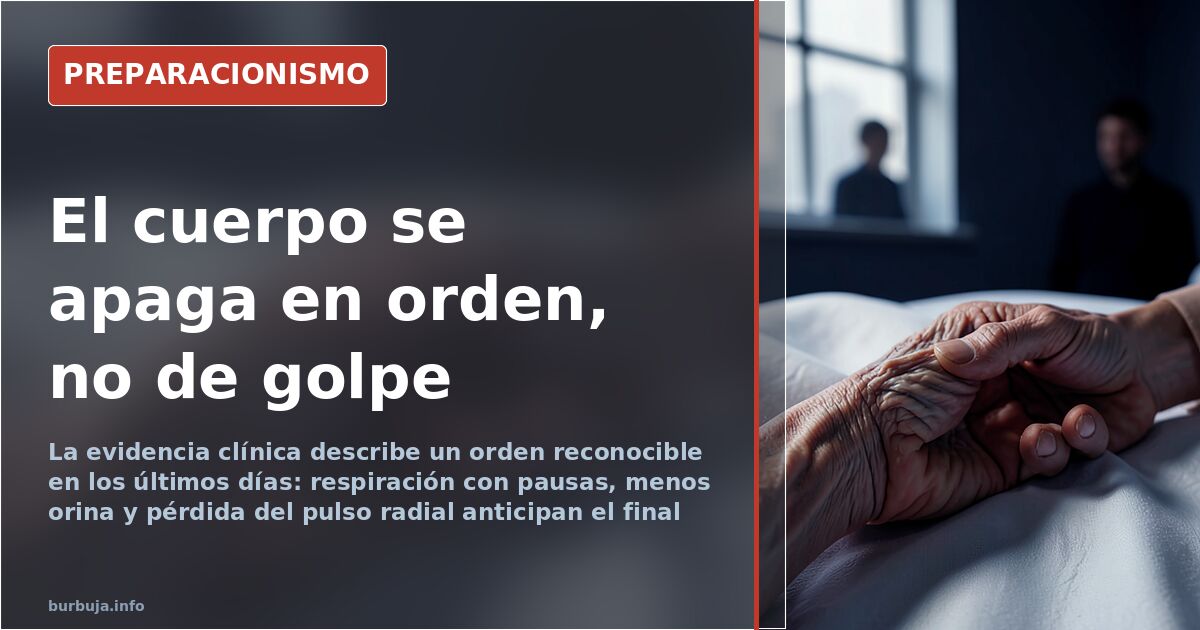
How death unfolds step by step: the science of the end
The body does not switch off abruptly. It shuts down in an orderly fashion. According to accumulated evidence, this sequence repeats with surprising regularity among individuals. Breathing pauses, skin mottling, decreased urine output, and loss of radial pulse are signs that tend to appear in a recognizable pattern during the final days, allowing medical teams to estimate that hours remain.
David Hui’s study on imminent death signs, published in The Oncologist in 2014, tracked advanced cancer patients during their last weeks to record which physical signals emerged and how close they were to death. The practical conclusion challenges common perceptions: much of what appears as suffering to observers is experienced quite differently internally, according to the evidence.
Stopping eating: hunger or physiological process?
Few things distress families more than seeing a loved one refuse food. It is often interpreted as abandonment, leading to insistence. A 1994 article by McCann, Hall, and Groth-Juncker in JAMA asked conscious terminal patients directly if they felt hunger or thirst. Most reported no hunger at all, or only initially. Thirst and dry mouth improved with simple care: ice chips, small amounts of liquid, and oral hygiene. Forced feeding provides no comfort at the end of life.
Death rattle: sounds like agony, but isn’t
This is likely the hardest moment to bear during a farewell. The wet sound with each breath suggests drowning. A Cochrane review on noisy breathing analyzed available treatments and found no solid evidence that drugs used to reduce it are effective. The noise occurs because the person can no longer swallow or cough up secretions. Those in this state, usually unconscious, likely do not suffer from the sound. It disturbs listeners far more.
Hearing: the last sense to fade
When someone stops responding, it is easy to conclude they are gone. Research suggests hearing may persist in some cases. A 2020 study by Elizabeth Blundon and Lawrence Ward from the University of British Columbia recorded brain activity in palliative care patients listening to sound sequences with unexpected elements. Several who no longer responded to external stimuli showed brain responses to unexpected sounds. Authors note the small sample size and unknown conscious perception, but support continuing to speak to them.
Terminal lucidity and the final surge
Some people with advanced dementia, who had not recognized family for years, suddenly regain clarity shortly before death. A 2012 review by Michael Nahm and Bruce Greyson compiled dozens of documented cases since the 19th century of patients with severe neurological diseases briefly regaining lucidity. They concluded the phenomenon exists, lacks accepted explanation, and warrants further study. The U.S. National Institute on Aging subsequently convened specialists to establish a research agenda.
In 2022, Raúl Vicente, Ajmal Zemmar, and colleagues published the first recording of brain activity in a living person as their heart stopped: an 87-year-old epilepsy patient connected to an EEG suffered cardiac arrest. They observed increased gamma waves, associated with memory and concentration, in the thirty seconds around the last heartbeat. The authors caution: a single case, a damaged brain, no healthy comparison. A clue, not proof.
Knowing what happens does not remove sadness. It removes some antiestéticar of the unknown. And leaves a practical lesson in one sentence: the last thing someone receives from this world may be the voice of those who stay. While possible, it is worth using.
Also available in: Deutsch
Summary of a discussion on Burbuja.info - Foro de economía, actualidad y política., translated from Spanish and reviewed before publication. Read the full discussion (17 replies).
More summaries
-
PDF Book: "Drugs, Pharmaceuticals, and Poisons" by David Sucunza
David Sucunza's "Drugs, Pharmaceuticals and Poisons" is available for free download. Explore the human use of natural substances.
-
Stab or slash? The dilemma of stopping an attacker
A blade rarely stops an aggressor instantly. Here is the technical debate between stabbing and slashing for self-defense.
-
Rural Land as a Low-Cost Survival Retreat in Spain
Rural land avoids monthly urban housing costs. Spanish rules may allow building shelters for poultry, but legal advice is essential before construction.
-
Spain's gun laws: from .50 BMG to Stg 44
From the Stg 44 to the .950 JDJ, Spain’s regulations exclude many weapons. This article details the actual limits of the F license for collectors and shooters.
-
Sheep Wool Desalination: Cornell Study Achieves 2.43 L/m²/h
Cornell University researchers use polydopamine-treated wool to achieve solar evaporation rates of 2.43 liters per square meter per hour, producing freshwater without electricity.
-
Spain’s preppers stockpile six months of food amid grid fears
While official EU guidelines recommend a 72-hour supply, some households in Spain are storing six months of rice and water.