
Spain’s preppers stockpile six months of food amid grid fears
While official EU guidelines recommend a 72-hour supply, some households in Spain are storing six months of rice and water.
English · Original discussion in Spanish · Published
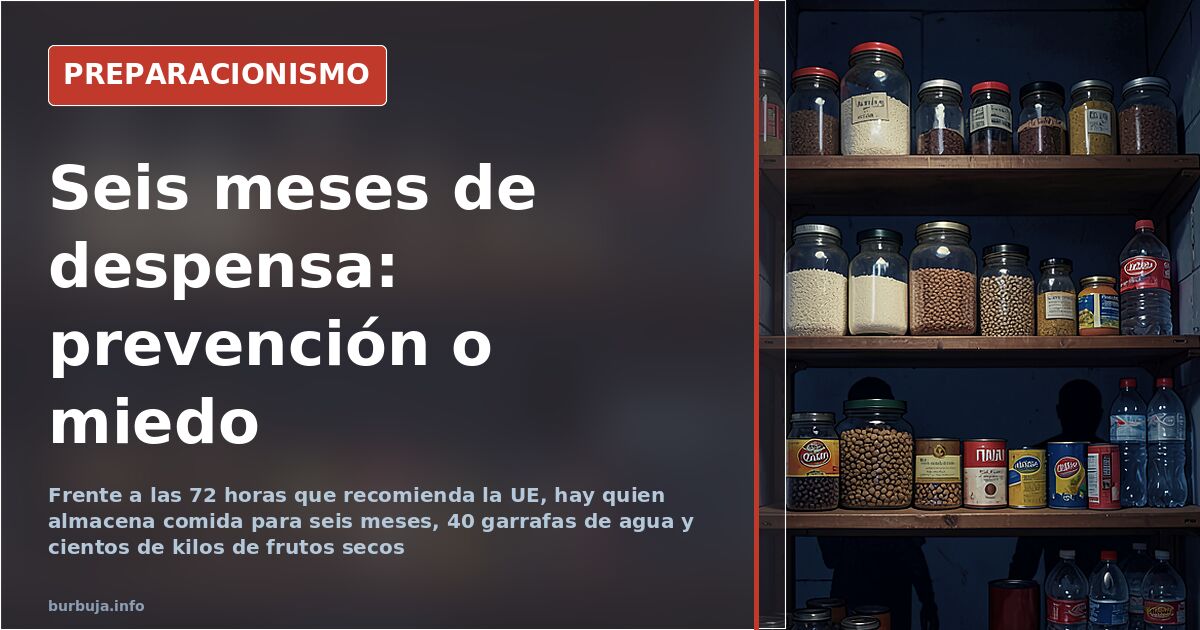
Six months of rice, 40 water jugs, and a remote garden
What is the cost of peace of mind? For a growing segment of the population, it is no longer a financial cushion but a pantry: rice, legumes, canned goods, honey, unshelled nuts, and eight-liter water containers. The premise driving this discussion is a household that has decided to move from weekly shopping to a six-month stockpile, with an eye on a secluded plot of land where they can start a garden when everything else fails.
The figure is not arbitrary. According to calculations circulating online, the EU has recommended since 2025 having provisions for about 72 hours, and Civil Protection works with three-day margins. In other words, the official standard covers a long weekend. Anyone storing for half a year is multiplying that reference by sixty. This is where the real debate begins: is this prudence or an expensive way to buy anxiety?
What is stored and how long it lasts
The typical inventory mentioned in conversations is humble and sensible: non-perishables, legumes, canned goods, honey—which practically never expires—and unshelled nuts, which last years at stable temperatures. Around hundreds of kilograms are stored, according to the initial plan, plus between 30 and 40 eight-liter water jugs.
The first technical problem is not space, but rotation. A pantry that is not consumed ends up expired and turned into very expensive waste. The rule imposed is first-in, first-out, with visible dates on each batch and a logistical line for restocking that requires periodic trips to the stash. Buying for six months and not touching it is throwing money away with extra steps.
Water deserves its own chapter. It stores well, but should be kept in the dark, away from concrete floors and chemicals. And the consumption calculation—three or four liters per person per day—turns any domestic planning into an uncomfortable arithmetic exercise.
Purifying river water: filters, UV, and the ash mistake
When the conversation gets into details, the dependency nobody wants to look at appears: water. Those living in apartments must go to the river, and here the purification kit comes in. A 0.1-0.2 micron membrane filter removes bacteria and parasites but not all bicho; boiling for one to three minutes or adding drops of bleach suitable for drinking does cover that gap. Ultraviolet light inactivates pathogens, but only in clear water and with available batteries or power.
Order matters: let it settle, pre-filter with cloth, and only then use membrane and UV. If the water is turbid, the filter clogs and radiation does not peine.
Here arises one of the most useful moments in the discussion. It is suggested to make homemade bleach with chimney ash and water. The chemical correction is sharp: what comes out of ash is an alkaline solution of potassium carbonate and hydroxide, the old lye for washing clothes, not hypochlorite. Ash has no chlorine. Adding it to drinking water makes it corrosive, not potable. Commercial hypochlorite is manufactured by electrolysis of saltwater. Confusing both terms is not a nuance: it is a health risk.
The remote plot and the problem of defending it
The complete plan includes a modest owned house with discreet solar panels, gas cooking, accumulated cylinders, battery-powered tools, and a nearby stream already used for irrigation. The logic is invisibility: the less visible, the less likely an unwanted visit.
The objection arrives quickly and with history behind it. In the post-war period, in farmhouses with gardens attached to the house, people had to sleep with loaded shotguns during harvest because few nights passed without someone prowling for cabbage or pumpkins, according to stories told online. A productive garden without a community around it is an invitation, not a fortress. And the nuance pointed out is that the most exposed reserve is not that of the one who stores cans, but that of the one who has worked and visible land.
Weapons, neighbors, and mutual aid not seen in movies
The proposal to buy a weapon and ammunition to defend the stock appears early. The institutional response is clear: in Spain, a gun license requires an exam, psychological report, and Guardia Civil control, and the scenario of going out for more is no longer defense, it is robbery. In real emergencies—blackouts, snowstorms, floods—what has worked has been the opposite: getting along with neighbors, sharing, and organizing.
The consensus forming in the second half of the conversation is that individual self-sufficiency is a delusion. Stockpiling is not a solution, it is bought time. Appendicitis is not solved with tuna cans. Documented history of collapses points more to cooperating communities than to lone wolves looting.
The antiestéticared scenario: solar pulse, blackout, and cities with no return
The underlying diagnosis handled is a cascade of failures: a solar electromagnetic pulse that leaves without light, a crisis in the Sahara, riots in the streets. The harshest prediction holds that with an electromagnetic pulse, cities would take at least ten years to recover something resembling normality, and that most of the population would not manage to reach rural areas without cars. Those who stayed in the city, according to that calculation, would gain fifteen days.
Against this, the experience of the war in Ukraine is used as a counterweight: years of conflict with apparently normal life except for recruitment and specific episodes. Degradation is not a switch, it is a slope one adapts to.
Knowledge as a pantry that does not expire
Among the most valued resources appear manuals for identifying edible wild plants, vacuum sealers for legumes and flours—which extend shelf life to decades—the bread maker, water distiller, and powdered mashed potatoes as a low-budget option. The repeated idea: you can accumulate a single product and survive a year.
It is also noted that unshelled nuts are hardly found in supermarkets, except walnuts. And an uncomfortable question: rice must be cooked. Without gas, firewood, or pot, the largest pantry is an expensive piece of furniture.
In the end, the conclusion that imposes itself is not whether collapse comes, but how much of this effort is foresight and how much is a sophisticated way of not looking at the real problem: nobody saves themselves alone. Fine irony for a country that continues buying the 72-hour kit like someone buying insurance they never read.
Also available in: Deutsch
Summary of a discussion on Burbuja.info - Foro de economía, actualidad y política., translated from Spanish and reviewed before publication. Read the full discussion (111 replies).
More summaries
-
Prepper pre-buying: months of normal food without spending extra
The prepper pre-buying strategy suggests stockpiling months of regular food without extra spending. Data, debate, and lockdown lessons in a no-holds-barred analysis.
-
Kubotans and tactical pens: legality in Spain
Spain's Weapons Regulation does not explicitly mention kubotans. Possession of a tactical pen depends on police discretion and intended use.
-
Heat pumps lose efficiency in cold weather, users report
Forum users report heat pump performance drops below 5°C, suggesting alternatives like €20 electric blankets or wood.
-
Edible Oil Selection Becomes Strategic for Indian Food Makers
Vyansa Intelligence predicts palm oil will account for 27% of India's edible oil consumption in 2026. Oil choice impacts frying, packaging, and supply.
-
Portable Heat Pump: The 39-Euro Annual Cost That Doesn't Add Up
A user claims €39/year heating with a portable heat pump. COP of 3.2 and constant outlet temperature fail to prove this.
-
Emergency Radio: Frequencies to Save When Internet and TV Fail
No secret government frequency exists, but specific bands and protocols work when networks fail. A guide to essential emergency radio equipment.