
Spain's gun laws: from .50 BMG to Stg 44
From the Stg 44 to the .950 JDJ, Spain’s regulations exclude many weapons. This article details the actual limits of the F license for collectors and shooters.
English · Original discussion in Spanish · Published
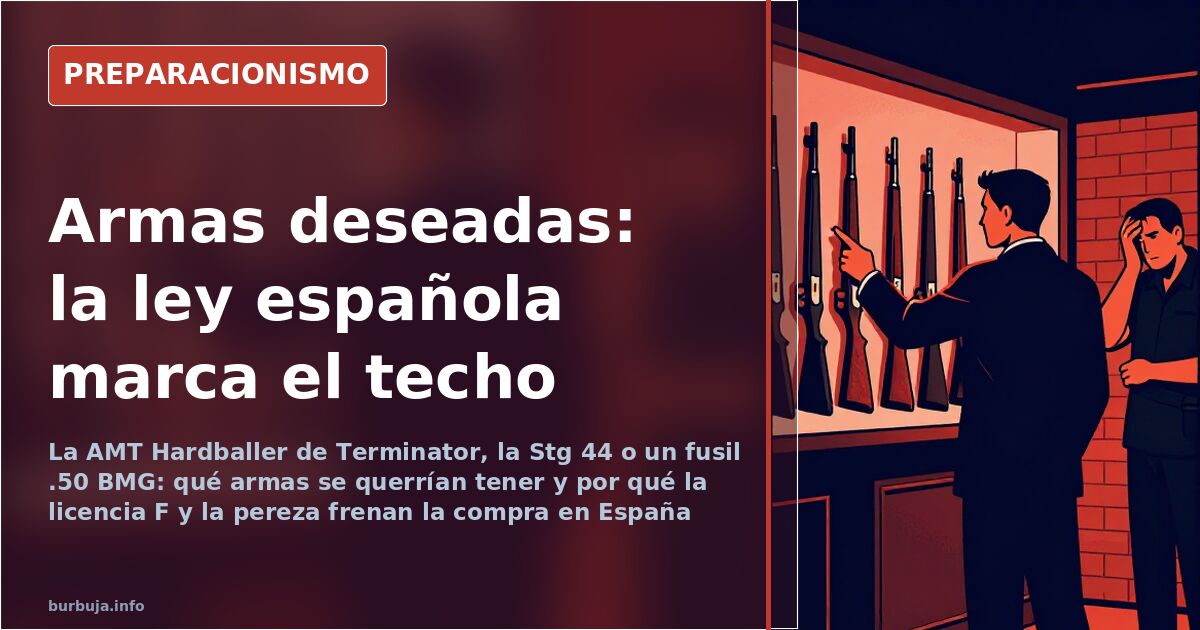
From the Stg 44 to the .50 BMG: The arsenal Spanish law leaves out of reach
A German WWII assault rifle, a light machine gun in .338 caliber, a Soviet anti-materiel rifle, or even a nuclear warhead. The list of firearms that enthusiasts would like to try at least once, but which are prohibited by Spanish regulations—or simply common sense—spans hundreds of messages. It reveals something more interesting than just a catalog: how high is the legal ceiling for Spanish collectors and shooters, and why it isn’t where many assume.
The discussion begins with a specific pistol, the AMT Hardballer antiestéticatured in the first Terminator movie. It is an elongated 1911-style handgun also seen in Resident Evil and Hitman, firing .45 ACP ammunition with full metal jacket bullets. The start is aesthetic, almost cinematic. But within a few replies, the focus shifts to the real question: what can be legally owned in Spain and what cannot?
What guns can you own in Spain with an F license?
The answer circulating in the thread is broader than common perception suggests. According to the debate, holding a third-category license (F) and using a certified safe opens up a range that includes 9mm carbines, bolt-action rifles, and historical replicas. The recurring argument is that in Spain, few things are outright banned except certain calibers and automatic mechanisms. The ceiling exists, but it is high.
The contrast with the United States appears immediately, though nuanced: there, laws vary by state, and some jurisdictions are actually more restrictive than Spain in certain aspects. The easy comparison breaks down when looking at the details. It is not a lawless paradise versus a regulatory desert.
.22 LR or 9mm: The beginner’s dilemma
A practical question hovers over much of the conversation: those obtaining their license often hesitate between a .22 LR carbine and a 9mm one. The majority opinion favors the 9mm due to ammunition availability, as it is the most common and easiest to obtain. The .22 LR is defended for its economy and because it is the cartridge where one truly learns marksmanship.
Regarding 9mm carbines, there is an administrative detail many overlook: according to the thread, they are used by private hunting guards under a C license. Since these guards can operate as self-employed individuals, they may hold ownership of such firearms. Bureaucracy draws paths that the standard catalog does not show.
Historical rifles and the issue of open sights
The central part of the exchange fills with relics: the Stg 44, the Degtyarev PTRD, the WWI artillery Luger—noting that the last units were manufactured by Mauser between 1930 and 1934, about a thousand pieces, for the civilian market in the US and Iran—the short Mosin Nagant, or the Enfield with peep sights.
Here arises a technical discussion worth its weight in gold for enthusiasts: the real utility of open sights and diopters. The aperture of a diopter eats up light; it is not optics, and at 200 meters, appreciating small targets requires an act of faith. The proposed solution is to enlarge the hole, although this lets in too much light for fine shooting. Everything is a compromise. And on whether video games teach anything useful for real life, the answer is blunt: no.
The .950 JDJ and the 50-kilo rifle
The tone changes when the FatMac rifle and its .950 JDJ cartridge appear, the thickest on its chart. It weighs about 50 kilos, and its recoil would be equivalent to dropping a 30-kilo cement bag from a first-floor window. The muzzle flash and shockwave would temporarily deafen and blind the shooter. Pure ballistic fantasy exercise, with no hunting pretension.
Halfway between joke and fact is the .22 bolt-action rifle for long-range target shooting at 300 meters or more, the modest option for those who prefer cheap precision over power. And the Sharps with a 0.8 mm diopter, which was previously 0.5 mm, allowing barely any light through.
The conclusion of a lifelong shooter
The reflective closing comes from someone with years of experience across different calibers and weapons: ultimately, shooting feels the same with all of them. Some are very precise for competition, others very powerful for hunting, and some comfortable and enjoyable due to economy. What generates intense dopamine is the combination of the chosen weapon and cartridge.
With this framework, the list of impossible wishes—the .50 BMG, the Stg 44, the .338 machine gun, the Star Trek disruptor, even a Zeppelin type X—stops being a whim and becomes something else: a map of a legal ceiling that each shooter measures in their own way. Where is the limit between what the law forbids and what only laziness prevents?
Also available in: Deutsch
Summary of a discussion on Burbuja.info - Foro de economía, actualidad y política., translated from Spanish and reviewed before publication. Read the full discussion (434 replies).
More summaries
-
Spain's legal route to owning a pistol: the F licence explained
The F licence allows pistol ownership in Spain for sport shooting only, not self-defence. The 24-joule limit and an octogenarian's case fuel the debate.
-
Earthbag houses: cheap, well-insulated and stuck without a clear permit in Spain
Superadobe builds cheap, insulating, impact-resistant houses using soil from the plot itself. In Spain the obstacle isn't the material: it's the building permit.
-
EU survival kit debate: water, radios and firearms
The EU's 72-hour emergency kit recommendation sparks debate over supplies, from basic water to Swiss Lugers.
-
How to Get a Gun License in Spain: Costs and Procedures
Obtaining a legal firearm in Spain requires a license, exams, and a gunsmith. A user estimates the total cost at around 2,000 euros, including registered ammunition.
-
Sheep Wool Desalination: Cornell Study Achieves 2.43 L/m²/h
Cornell University researchers use polydopamine-treated wool to achieve solar evaporation rates of 2.43 liters per square meter per hour, producing freshwater without electricity.
-
Spain’s preppers stockpile six months of food amid grid fears
While official EU guidelines recommend a 72-hour supply, some households in Spain are storing six months of rice and water.