
Stab or slash? The dilemma of stopping an attacker
A blade rarely stops an aggressor instantly. Here is the technical debate between stabbing and slashing for self-defense.
English · Original discussion in Spanish · Published
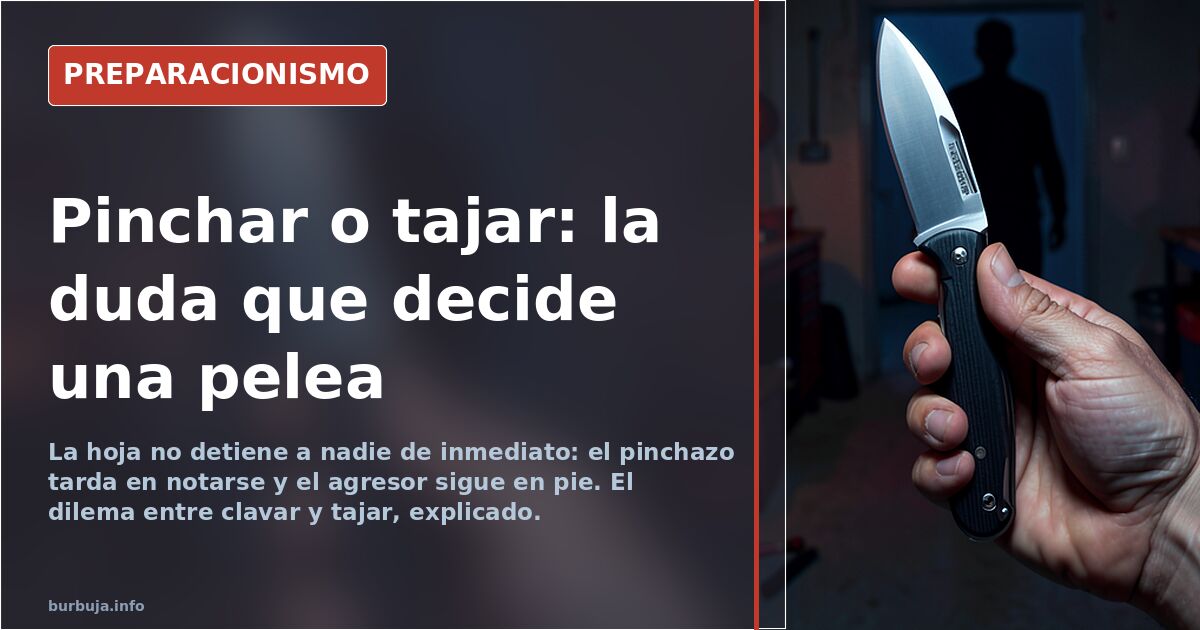
Stab or slash: The doubt that decides a knife fight
The scene comes from a video: a large man hits a woman. Someone asks if a pocketknife would stop him. The uncomfortable answer emerging from the discussion is that the blade does not stop anyone immediately. Blood takes time, pain deceives, and the aggressor remains standing for several seconds longer than movies promise.
The starting point is a confession of ignorance: the person opening the topic admits they could use a blunt object but not a knife, intuiting that multiple stabs would be needed. According to several participants, this intuition is exactly the problem. The knife is not a switch.
Where must you stab to incapacitate an aggressor?
The most repeated viewpoint points to areas with rapid hemorrhage: the neck, the chest, the area below the sternum. One participant details the angle below the sternum toward the center of the chest as the fastest route to near-immediate collapse. Others add the femoral artery and jugular vein as accessible targets if attacking by surprise.
Against this, a second line defends the opposite: slash before stabbing, targeting tendons and arteries in the inner arm, the back of the knee, or the wrist. The argument is that this reduces mobility and attack capability without touching vital organs, and that a well-placed cut on a tendon disables faster than a torso thrust. The discrepancy is significant: some talk about killing, others about stopping.
The grip and the myth of the chain knife
Here the disagreement becomes almost physical. One sector defends the grip with the thumb over the handle and the edge facing out, shoulders raised, crouched posture, because it gives more force to the stab and protects the arm from being grabbed. Another sector considers it a direct amateur error, arguing that in real combat, whoever holds it this way loses. The discussion drifts into historical fencing and old knife manuals, referencing the "baratero" art (traditional Spanish knife fighting) and knife defense treatises.
If there is consensus, it is this: the blade enters without resistance and the victim doesn't notice the puncture. One testimony compares it to a weak punch. Another recalls recorded fights where the injured party keeps hitting until they look at their hand.
The pencil, the pen, and the cheap alternative
One of the most concrete contributions in the exchange involves everyday objects. It is argued that a pencil stabbed into a thigh hurts more than a steel cut, because the body severs cleanly with an edge but reacts worse to an object that perforates and breaks inside. It is also noted that carrying a knife under eleven centimeters with a single edge is not a crime in itself in Spain, but unjustified possession can lead to legal problems.
The practical conclusion repeated throughout: the best defense is not being close. And if you must be close, surprise and cold blood weigh more than technique.
So, does a pocketknife work to stop an aggressor? The answer left by the exchange is that it works for many things, but not for what most people imagine.
Also available in: Deutsch
Summary of a discussion on Burbuja.info - Foro de economía, actualidad y política., translated from Spanish and reviewed before publication. Read the full discussion (57 replies).
More summaries
-
Legal Home Defense Weapons in Spain: Axe vs Katana
In Spain, small axes and kitchen knives offer better legal protection than katanas due to space constraints and judicial scrutiny.
-
Legal Gray Area Self-Defense: From Box Cutters to Pepper Spray
Box cutters, 250ml sprays, and steel-toe boots: gray-area self-defense balances avoiding confrontation with explaining actions in court.
-
Urban Self-Defense: Flee Before Fighting
Effective urban self-defense teaches running, not fighting. Participants argue that current laws exclude practical means of protection.
-
Sabre Red MK-3 gel: the spray that only works if you practice drawing it
The Sabre Red gel MK-3 50 ml spray wins on brand and pepper, but the consensus is clear: without practice or aim, the best canister is useless
-
Rural Land as a Low-Cost Survival Retreat in Spain
Rural land avoids monthly urban housing costs. Spanish rules may allow building shelters for poultry, but legal advice is essential before construction.
-
The dying process: what science reveals about the end
The body shuts down in a recognizable order. Palliative care research shows that visible signs of distress often differ from internal experience.