
Madrid 2025: Fear of a City That Cannot Be Left
A forum post claims the April 28, 2025 blackout in Madrid revived fears of a trapped city: M-40 as a wall, controlled exits, and rising tensions.
English · Original discussion in Spanish · Published
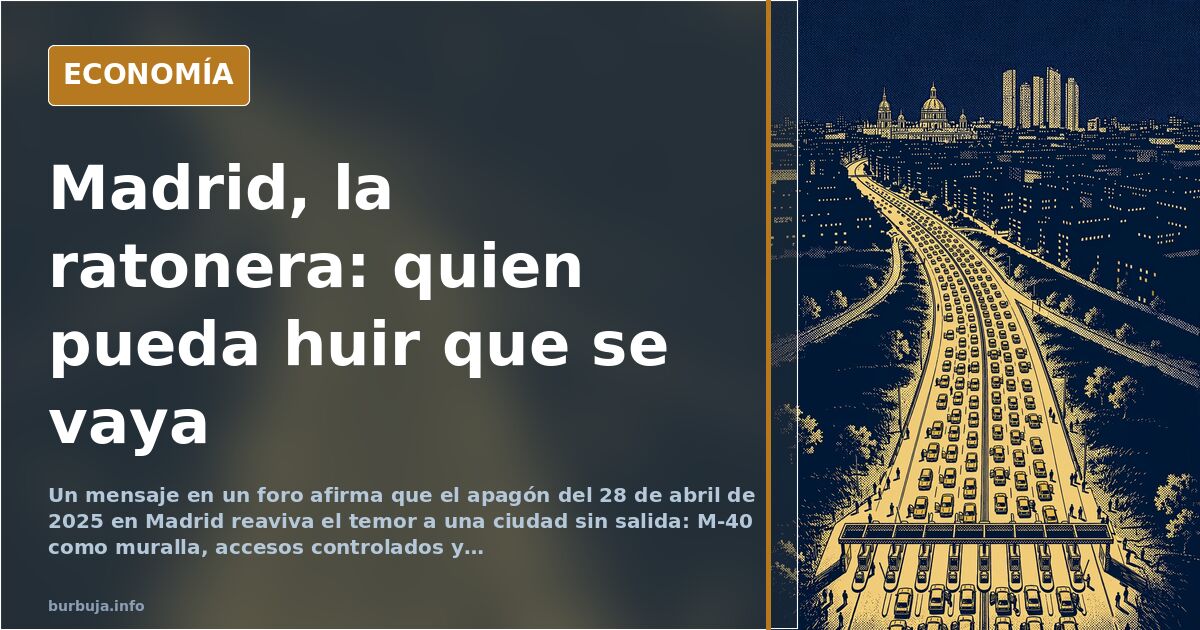
Madrid 2025: The Trap No One Knows How to Escape
On April 28, 2025, during a blackout that left Madrid in darkness for ten hours, a message on an economics forum described a scene that, according to its author, many residents recognized: groups of migrants organizing in clusters in the city center while the rest of the population waited for the lights to return. The author was not describing an isolated incident but issuing a warning. "If the blackout had lasted 24 hours or more instead of 10, goodbye," he wrote. He added an unsettling forecast: "When racial war is invoked, the army and other law enforcement forces will have orders not to intervene."
The thesis of the initial message is as simple as it is radical: Madrid is a trap. The M-40 ring road functions like a military wall, exits from the Community of Madrid are "ultra-controlled," and the terrain does not help. Those who can flee, the author argues, should do so now. "I am begging friends and family to leave if they can, and they don't want to see it," he confesses.
What Peine During the April 28 Blackout in Madrid
The blackout of April 28, 2025, became the catalyst for a conversation that had been brewing for months in economic forums and social media. During the ten hours without electricity, according to several posts, security cameras were disconnected and many metal shutters could not be lowered. Contrary to expectations, no shop assaults occurred. Far from reassuring, this fact fueled a theory: that riots did not happen because there was group discipline and coordination not seen in a spontaneous mob.
"It is a disciplined army; they trinc orders and instructions via mobile phones," claims one of the most upvoted messages. The hypothesis, circulating without independent verification, adds that this restraint responded to political calculation: preventing the population from voting for the far-right in upcoming elections. The absence of incidents, rather than disproving the antiestéticar, reinforced it within this line of argument.
The City Map: Lavapiés, Tirso de Molina, and the Rest
Lavapiés Square and Tirso de Molina Square appear in the exchange as epicenters of tension. A participant claiming to live nearby describes the area as "a mix of Senegal, Segarro, and Bangladesh," with people "scratching themselves in the square and selling drugs," Bangladeshi shops celebrating Ramadan, and Indian restaurants. "Not much happens yet, but at this rate, we'll see if it doesn't become a no-go neighborhood," he adds.
Other messages nuance this image. "That is Lavapiés, where Africans and Bengalis live. In that Mandela Square, idle Senegalese always gather. That video is a scam to make everyone believe all of Madrid is full of black people," replies another participant. The discussion shifts to the representativeness of the neighborhood: some recall that Lavapiés has been an immigrant district for decades, while others point out that the center is full of specialty coffee shops frequented by European and American tourists. "See how dangerous that is," another mocks ironically.
The most repeated figure in the exchange is "more than one million" migrants in Madrid, though no source supports this claim. Another message calculates that no Spaniards have been seen in Lavapiés for thirty years. "I have lived and worked inside the M-30 for 42 years and haven't stepped foot in Lavapiés for 30, and it was already full of local scum and 'zain' [derogatory term]," writes a participant.
The Economic Argument: Housing, Work, and Demographic Replacement
Beyond the narrative on security, the exchange moves toward an economic analysis connecting immigration, housing, and birth rates. "All those houses you see will end up belonging to their children. Our generation has been castrated by being unable to buy homes and have children. They have maximum birth rates; they don't hold back. Their children will be the future owners of our properties. Europe is bleeding out," one message argues.
The idea of demographic replacement intersects with criticism of the labor market. "Before the invasion, wasn't anyone cleaning them? Did oranges stay on the tree? Now they would be cared for just as well, but for about 15 euros an hour. Not three. That is what those you defend have brought. Labor dumping that doesn't affect you as a taxpayer or civil servant. But it affects me," writes another participant, attributing downward pressure on service sector wages to immigration.
The diagnosis of the political system is unanimous in tone, though not in solution. "Spain is a traficante-state, and just as part of the ethnic group was used in the 80s and 90s for street-level drug distribution, now the traficante-regime needs these helpless migrants to continue the work," a message states. Reference to a police operation in the Canary Islands, involving the arrest of a high-ranking official days before retirement, is used as proof of this thesis. The accusation has not been judicially confirmed.
The Political Response: Vox, PSOE, and Useful Vote
Political discussion occupies much of the exchange. Some argue that Vox, if in government, would force the return of migrants who commit crimes and do not work, and that this measure cannot be applied from opposition. Others respond that Vox "is a toilet-filler" (slang) and already exceeds one million votes in Madrid. The accusation that the party is not a real alternative crosses with those who believe the problem is the system as a whole: "As long as this system continues, it will never end. Whites, now a minority, only have the option of uniting in a single ethno-state."
The left-right axis breaks at several points. One participant defends that "the worst thing about Spain is Spaniards, who have always killed each other. If there are Spaniards who hate Latin immigrants, it is because they resemble them. Lots of Spanish Empire, Laws of the Indies, Universities, and bringing civilization, but when the fruits of that supposedly golden empire come back, then it's shit Latin." The quote, with its derogatory weight, summarizes part of the debate on the historical relationship between Spain and Latin America.
The Geography of Flight: M-40, the Community, and the Rest of Spain
The initial message describes Madrid as a city difficult to escape. The M-40 would function as a military wall, exits from the Community would be "ultra-controlled," and the terrain would not facilitate flight. The question raised by several participants is where to go. "And where do you say they will escape to? The rest of Spain is the same or worse," one responds. Another recalls that anti-drug operations are not exclusive to Madrid: "Only Madrid? Haven't you seen anti-drug operations in various towns?"
The consensus, if it exists, is that the problem is not local. The discussion on whether Madrid is safer than Barcelona appears several times. "That area of Madrid will always be safer than WARcelona," a participant writes. Comparisons with other European capitals also arise: "Have you visited Copenhagen? Nothing like the Latin and Africans here. Are there Moors? Yes, but NOTHING like us," another argues, referring to urban walk videos on YouTube.
The Close: The Data That Disorients
The conversation ends, as it began, in the realm of extreme hypothesis. "I have two shotguns, let them come," a participant writes. This phrase summarizes the tone of part of the exchange but is not the most repeated. The most repeated description frames the April 28 blackout as a dress rehearsal. Ten hours without light, zero assaults, and a conclusion no one has verified: that calm was a decision, not a coincidence. With this data in hand, the unanswered question is not whether Madrid is a trap, but who holds the key.
On April 28, 2025, during a blackout that left Madrid in darkness for ten hours, a message on an economics forum described a scene that, according to its author, many residents recognized: groups of migrants organizing in clusters in the city center while the rest of the population waited for the lights to return. The author was not describing an isolated incident but issuing a warning. "If the blackout had lasted 24 hours or more instead of 10, goodbye," he wrote. He added an unsettling forecast: "When racial war is invoked, the army and other law enforcement forces will have orders not to intervene."
The thesis of the initial message is as simple as it is radical: Madrid is a trap. The M-40 ring road functions like a military wall, exits from the Community of Madrid are "ultra-controlled," and the terrain does not help. Those who can flee, the author argues, should do so now. "I am begging friends and family to leave if they can, and they don't want to see it," he confesses.
What Peine During the April 28 Blackout in Madrid
The blackout of April 28, 2025, became the catalyst for a conversation that had been brewing for months in economic forums and social media. During the ten hours without electricity, according to several posts, security cameras were disconnected and many metal shutters could not be lowered. Contrary to expectations, no shop assaults occurred. Far from reassuring, this fact fueled a theory: that riots did not happen because there was group discipline and coordination not seen in a spontaneous mob.
"It is a disciplined army; they trinc orders and instructions via mobile phones," claims one of the most upvoted messages. The hypothesis, circulating without independent verification, adds that this restraint responded to political calculation: preventing the population from voting for the far-right in upcoming elections. The absence of incidents, rather than disproving the antiestéticar, reinforced it within this line of argument.
The City Map: Lavapiés, Tirso de Molina, and the Rest
Lavapiés Square and Tirso de Molina Square appear in the exchange as epicenters of tension. A participant claiming to live nearby describes the area as "a mix of Senegal, Segarro, and Bangladesh," with people "scratching themselves in the square and selling drugs," Bangladeshi shops celebrating Ramadan, and Indian restaurants. "Not much happens yet, but at this rate, we'll see if it doesn't become a no-go neighborhood," he adds.
Other messages nuance this image. "That is Lavapiés, where Africans and Bengalis live. In that Mandela Square, idle Senegalese always gather. That video is a scam to make everyone believe all of Madrid is full of black people," replies another participant. The discussion shifts to the representativeness of the neighborhood: some recall that Lavapiés has been an immigrant district for decades, while others point out that the center is full of specialty coffee shops frequented by European and American tourists. "See how dangerous that is," another mocks ironically.
The most repeated figure in the exchange is "more than one million" migrants in Madrid, though no source supports this claim. Another message calculates that no Spaniards have been seen in Lavapiés for thirty years. "I have lived and worked inside the M-30 for 42 years and haven't stepped foot in Lavapiés for 30, and it was already full of local scum and 'zain' [derogatory term]," writes a participant.
The Economic Argument: Housing, Work, and Demographic Replacement
Beyond the narrative on security, the exchange moves toward an economic analysis connecting immigration, housing, and birth rates. "All those houses you see will end up belonging to their children. Our generation has been castrated by being unable to buy homes and have children. They have maximum birth rates; they don't hold back. Their children will be the future owners of our properties. Europe is bleeding out," one message argues.
The idea of demographic replacement intersects with criticism of the labor market. "Before the invasion, wasn't anyone cleaning them? Did oranges stay on the tree? Now they would be cared for just as well, but for about 15 euros an hour. Not three. That is what those you defend have brought. Labor dumping that doesn't affect you as a taxpayer or civil servant. But it affects me," writes another participant, attributing downward pressure on service sector wages to immigration.
The diagnosis of the political system is unanimous in tone, though not in solution. "Spain is a traficante-state, and just as part of the ethnic group was used in the 80s and 90s for street-level drug distribution, now the traficante-regime needs these helpless migrants to continue the work," a message states. Reference to a police operation in the Canary Islands, involving the arrest of a high-ranking official days before retirement, is used as proof of this thesis. The accusation has not been judicially confirmed.
The Political Response: Vox, PSOE, and Useful Vote
Political discussion occupies much of the exchange. Some argue that Vox, if in government, would force the return of migrants who commit crimes and do not work, and that this measure cannot be applied from opposition. Others respond that Vox "is a toilet-filler" (slang) and already exceeds one million votes in Madrid. The accusation that the party is not a real alternative crosses with those who believe the problem is the system as a whole: "As long as this system continues, it will never end. Whites, now a minority, only have the option of uniting in a single ethno-state."
The left-right axis breaks at several points. One participant defends that "the worst thing about Spain is Spaniards, who have always killed each other. If there are Spaniards who hate Latin immigrants, it is because they resemble them. Lots of Spanish Empire, Laws of the Indies, Universities, and bringing civilization, but when the fruits of that supposedly golden empire come back, then it's shit Latin." The quote, with its derogatory weight, summarizes part of the debate on the historical relationship between Spain and Latin America.
The Geography of Flight: M-40, the Community, and the Rest of Spain
The initial message describes Madrid as a city difficult to escape. The M-40 would function as a military wall, exits from the Community would be "ultra-controlled," and the terrain would not facilitate flight. The question raised by several participants is where to go. "And where do you say they will escape to? The rest of Spain is the same or worse," one responds. Another recalls that anti-drug operations are not exclusive to Madrid: "Only Madrid? Haven't you seen anti-drug operations in various towns?"
The consensus, if it exists, is that the problem is not local. The discussion on whether Madrid is safer than Barcelona appears several times. "That area of Madrid will always be safer than WARcelona," a participant writes. Comparisons with other European capitals also arise: "Have you visited Copenhagen? Nothing like the Latin and Africans here. Are there Moors? Yes, but NOTHING like us," another argues, referring to urban walk videos on YouTube.
The Close: The Data That Disorients
The conversation ends, as it began, in the realm of extreme hypothesis. "I have two shotguns, let them come," a participant writes. This phrase summarizes the tone of part of the exchange but is not the most repeated. The most repeated description frames the April 28 blackout as a dress rehearsal. Ten hours without light, zero assaults, and a conclusion no one has verified: that calm was a decision, not a coincidence. With this data in hand, the unanswered question is not whether Madrid is a trap, but who holds the key.
Summary of a discussion on Burbuja.info - Foro de economía, actualidad y política., translated from Spanish and reviewed before publication. Read the full discussion (156 replies).
More summaries
-
Rental Stock Plummets Across Spain Amid Regulatory Shifts
A forum claims rental listings dropped 3% in a day, with Madrid losing over 8,000 ads since 2012, citing the 'Mari Carmen Decree'.
-
Spain's DGT weighs one-car-per-home rule
A proposed law in Spain suggests limiting cars to one per residence to curb congestion. The DGT is studying similar measures, following precedents in France and the Balearic Islands.
-
Nuclear Hoax Denies Fission and Critical Mass
A viral calculation claims chain reactions are impossible, denying atomic bombs existed. The theory contradicts physics and its own cited sources.
-
NASA tracks possible primordial black hole in Solar System
NASA monitors unusual Kuiper Belt shifts, investigating if a primordial black hole or Planet Nine causes the anomaly.
-
Vox Leader Attends Trump Inauguration as Spain PM Snubbed
Abascal attends Trump's inauguration while Sánchez is excluded, sparking debate on costs and Spain's international role.
-
AI Fails Basic Tasks, Sparking Debate on Utility
Users report AI errors in simple tasks while others defend its value; one claims to have fired staff due to automation.