
YouTuber and bodyguards clash with street vendors in Barcelona
A YouTuber and his security team confront street vendors on La Rambla, reigniting debate over illegal vending and public order.
English · Original discussion in Spanish · Published
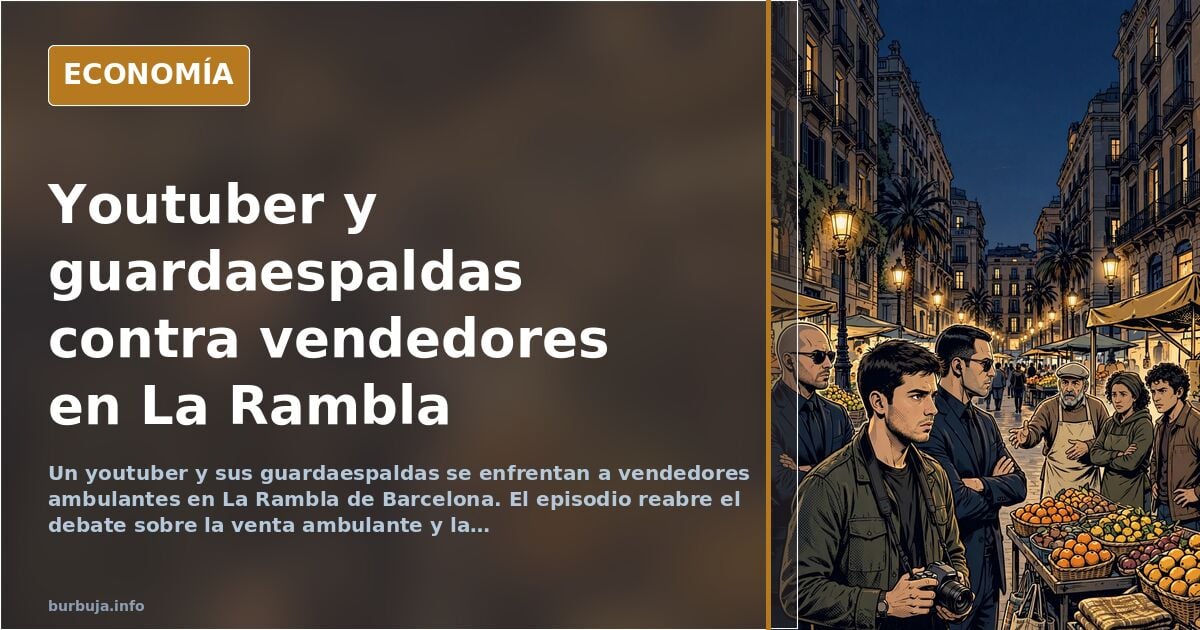
YouTuber and bodyguards clash with street vendors in Barcelona
What happens when a content creator decides to film a confrontation with the street vendors operating on La Rambla in Barcelona? According to circulating footage, the result is a daylight brawl involving his bodyguards. The incident has peine discussions about coexistence in the city’s tourist center, police passivity, and the role of those who record such situations for visibility.
What peine on La Rambla
The starting point is a video where a YouTuber’s team confronts a group of street vendors on La Rambla. Reports suggest the creator’s bodyguards struck several of them. The scene unfolded in broad daylight on one of Barcelona’s most touristy streets, amplifying its viral spread.
Some claim the YouTuber sought to provoke the vendors to gain subscribers and likes. Others argue he simply did what authorities fail to do: harass those operating illegally in public spaces. The debate over the creator’s intent remains open.
The business of bracelets and tuk-tuks
The modus operandi described by locals is always the same: they offer you a free bracelet, put it on you, then demand payment. If you refuse, they persist. In Madrid, near the San Miguel Market, they coexist with tuk-tuk drivers, creating an environment some describe as hellish. In Barcelona, the stage is La Rambla.
The underlying economic calculation is simple: if the product offers no value, the business relies on persistence and pity. Those who haggle with street sellers, according to some comments, fail to understand there is no margin here: it is either survival or fraud, depending on perspective.
Police passivity and legal framework
One of the most repeated questions is why the police do not intervene. Several comments suggest agents are busy with minor issues, like monitoring double parking or mask usage. A police station is just meters from La Rambla, but accounts convey a sense of impunity.
The mentioned legal framework concerns unauthorized street vending, an activity theoretically prosecuted but practically tolerated, according to these reports. Some recall that forty years ago, the area also had shell game operators, pickpockets, and other activities, noting the problem is not new: what has changed is the origin of those involved.
The role of bodyguards and private security
The intervention of bodyguards sparked its own debate. Some consider their actions disappointing because they failed to resolve the situation. Others warn that without them, the YouTuber might have fared worse. Private security, in any case, does not replace the police.
The episode leaves an uncomfortable question: why is a content creator filming a street fight? For some, it highlights a real problem. For others, it exploits it. The line between denunciation and spectacle is blurred.
Migration background and social tension
The incident surfaced conflicting views on immigration and crime. Some link street vending to irregular immigration and demand deportations. Others remind us that most migrants work and pay taxes, arguing generalization is unfair.
The discussion shifts toward coexistence models in tourist neighborhoods, the shadow economy, and lack of job alternatives. There is no consensus. What appears in several comments is the feeling that central Barcelona has become a territory where rules are applied unevenly.
The fight is already forgotten. So is the bracelet. What remains is the perennial question: who restores order on La Rambla?
What happens when a content creator decides to film a confrontation with the street vendors operating on La Rambla in Barcelona? According to circulating footage, the result is a daylight brawl involving his bodyguards. The incident has peine discussions about coexistence in the city’s tourist center, police passivity, and the role of those who record such situations for visibility.
What peine on La Rambla
The starting point is a video where a YouTuber’s team confronts a group of street vendors on La Rambla. Reports suggest the creator’s bodyguards struck several of them. The scene unfolded in broad daylight on one of Barcelona’s most touristy streets, amplifying its viral spread.
Some claim the YouTuber sought to provoke the vendors to gain subscribers and likes. Others argue he simply did what authorities fail to do: harass those operating illegally in public spaces. The debate over the creator’s intent remains open.
The business of bracelets and tuk-tuks
The modus operandi described by locals is always the same: they offer you a free bracelet, put it on you, then demand payment. If you refuse, they persist. In Madrid, near the San Miguel Market, they coexist with tuk-tuk drivers, creating an environment some describe as hellish. In Barcelona, the stage is La Rambla.
The underlying economic calculation is simple: if the product offers no value, the business relies on persistence and pity. Those who haggle with street sellers, according to some comments, fail to understand there is no margin here: it is either survival or fraud, depending on perspective.
Police passivity and legal framework
One of the most repeated questions is why the police do not intervene. Several comments suggest agents are busy with minor issues, like monitoring double parking or mask usage. A police station is just meters from La Rambla, but accounts convey a sense of impunity.
The mentioned legal framework concerns unauthorized street vending, an activity theoretically prosecuted but practically tolerated, according to these reports. Some recall that forty years ago, the area also had shell game operators, pickpockets, and other activities, noting the problem is not new: what has changed is the origin of those involved.
The role of bodyguards and private security
The intervention of bodyguards sparked its own debate. Some consider their actions disappointing because they failed to resolve the situation. Others warn that without them, the YouTuber might have fared worse. Private security, in any case, does not replace the police.
The episode leaves an uncomfortable question: why is a content creator filming a street fight? For some, it highlights a real problem. For others, it exploits it. The line between denunciation and spectacle is blurred.
Migration background and social tension
The incident surfaced conflicting views on immigration and crime. Some link street vending to irregular immigration and demand deportations. Others remind us that most migrants work and pay taxes, arguing generalization is unfair.
The discussion shifts toward coexistence models in tourist neighborhoods, the shadow economy, and lack of job alternatives. There is no consensus. What appears in several comments is the feeling that central Barcelona has become a territory where rules are applied unevenly.
The fight is already forgotten. So is the bracelet. What remains is the perennial question: who restores order on La Rambla?
Summary of a discussion on Burbuja.info - Foro de economía, actualidad y política., translated from Spanish and reviewed before publication. Read the full discussion (156 replies).
More summaries
-
Street food vendors in Madrid face scrutiny over hygiene and licensing
Latin American street food sales are growing in Madrid without health controls or licenses, sparking resident complaints and jurisdictional debates.
-
Madrid Center: Itinerant Sales and 400,000 Crimes
Irregular street vending clusters in Madrid's tourist hub, where crime statistics jump from 52,190 to nearly 400,000.
-
Peruvian Street Breakfasts in Madrid: Entrepreneurship or Health Chaos?
Mobile Peruvian breakfast vans in Madrid highlight the clash between street entrepreneurship and strict municipal health regulations.
-
Spanish housing prices fall in half the country: is the bubble bursting?
Housing prices are falling across half of Spain, with double-digit drops in some provincial capitals. Correction or start of a crash? Data and analysis.
-
Spain's DGT reverses V16 beacon mandate, allows triangles
After months promoting the €40 V16 beacon as mandatory, Spain's traffic authority DGT has reversed course, allowing drivers to continue using emergency warning triangles.
-
Jorge Martínez, Ilegales frontman, dies at 70
Jorge Martínez, leader of Spanish punk band Ilegales, has died at 70 after a cancer diagnosis that rapidly worsened in two and a half months.