
Spain's Widow Pension: Late Marriages Spark Fraud Concerns
A 76-year-old man marries a 51-year-old woman, enabling her to collect decades of widow pension. It is legal and meets requirements, yet suspicion remains.
English · Original discussion in Spanish · Published
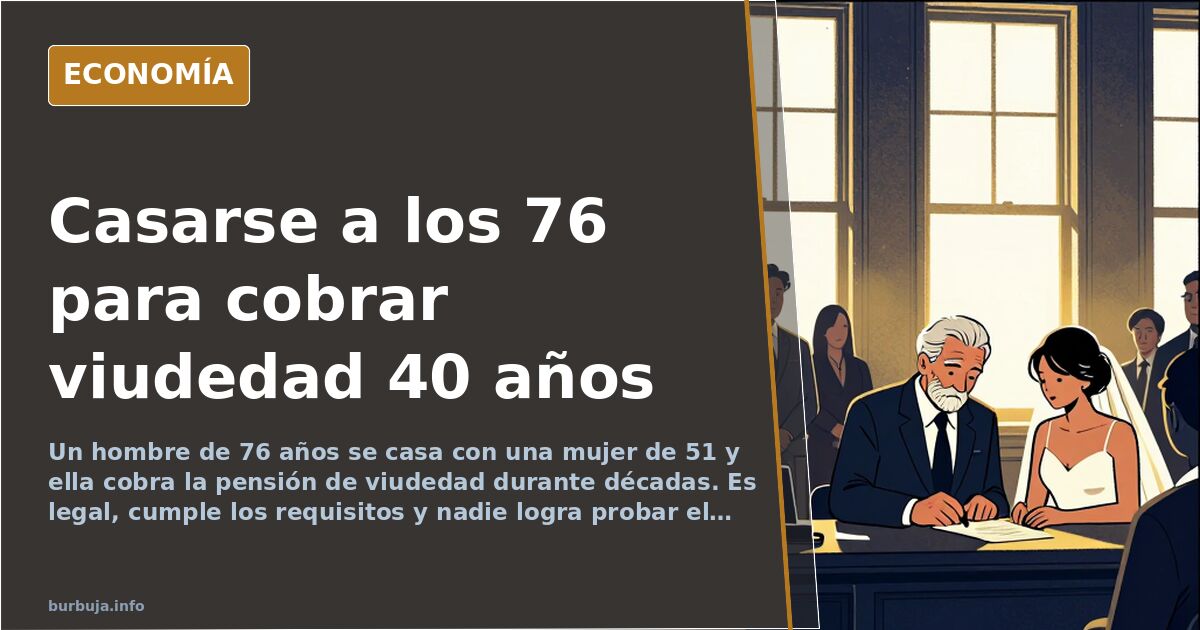
Widow Pension: The Late Marriage That Triggers Suspicion
A 76-year-old man, frail from health issues rather than just age, marries a 51-year-old woman. The arrangement, as described, involves marriage in exchange for companionship and care; the inheritance remains with his children, and she accepts this. He dies "after a few years due to poor health." From then on, she begins collecting the widow's pension. She can receive it for three or four decades because she is not even fifty. The system allows it. It is legal. The debate is not whether it happens, but how common the pattern has become.
The first response in the discussion settles the surprise: the practice is "older than dirt," says one participant. Another summarizes the mechanism with irony: "to keep the pension." This is not a recent discovery nor a laboratory trick. It is a figure that has been functioning for decades in provincial areas, mining basins, and any town where a well-paid retiree lives alone.
What the Law Requires to Collect the Widow Pension
The central requirement repeated in the material is the duration of the marriage. One intervention sets it at more than two years married before the spouse's death. Another points to a period of one year after the wedding to be entitled to the benefit, explaining the historical reason: to prevent an elderly person "in articulo mortis" from marrying a young niece a week before dying and settling the matter within the family.
Here lies the key to everything. The law does not ask about love, real cohabitation, or the age difference. It asks for a document and a timeframe. If both are met, the benefit is granted. Those who claim this is fraud encounter the most repeated answer in the thread: it is perfectly legal. The conditions are met. What people think of the design is another matter.
The Mining Basin Case and High Pensions
Where the pattern is seen more clearly, according to several accounts, is in areas with high pensions. A participant describes what happens where they live: it is common for a woman aged forty or fifty, arriving from another country, to marry a retired miner who has very high pensions. When he dies, she returns to her country with a widow's pension that allows her to live without working. The local resident, they add, is usually well cared for in their final years. The family is happy.
The calculation used in the thread is simple: 1,000 euros per fourteen payments, for life, multiplied by decades, yields a figure that justifies any prior effort. A uncovered scheme involving marrying elderly men with South American women in Badalona is even mentioned. The geographic detail matters less than the arithmetic.
The De Facto Partnership Route and Why Almost No One Uses It
There is an alternative to marriage: the de facto partnership (pareja de hecho). It also grants rights to a pension in some circumstances, but with stricter conditions. A minimum of five years of proven cohabitation is required, and furthermore, it must be fought in court because Social Security often claims there is insufficient proof of such cohabitation. Marriage, however, is a document. No one disputes a document.
That asymmetry explains why the mechanism continues to work. A de facto partnership requires proving a shared life; a late marriage only requires signing. And once signed, the right to the benefit is automatic if the timeframe is met.
The Underlying Problem: A Benefit Designed for Another Country
The widow's pension was created in the sixties for women who had never worked and were left helpless when their husbands died. This is the origin cited in the material. Today, reality is different: massive incorporation of women into the labor market, own contribution careers, households where there is no longer a single breadwinner. Several participants argue that the benefit should be limited to one year, the time needed to cushion the economic blow of the spouse's death.
The numbers provided point in that direction. Women's widow pensions total 1,977,000 beneficiaries compared to 127,060 male beneficiaries. It is a benefit with an evident gender bias, built on a family model that is no longer majority. Those defending its maintenance argue it reduces poverty among widows; those calling for its elimination respond that this objective is better covered by other instruments.
The Fraud That Is Almost Never Proven
Can such a marriage be annulled? On paper, yes. One can argue there is no real cohabitation, that the spouses barely know each other, that money is involved. Testimonial evidence, documentary evidence, and separate interrogations are admitted. The theory is impeccable.
Practice is another thing. When spouses do not know each other, do not speak the same language, or do not share a home, fraud is suspected. But if the matter is done minimally well, it is impossible to prove. The burden of proof falls on whoever challenges it, and no one challenges it. The result is a mechanism operating at full capacity without any judge ever seeing it.
What Is Inherited and What Is Not
The original pact in the case opening the discussion included leaving the inheritance to the children. This does not prevent the pension: they are two different things. The benefit does not come from the deceased's estate, it comes from the system. Therefore, the family agreement can remain intact, and yet, the widow can collect for decades.
Some point out a nuance that complicates the picture: the right of usufruct over the deceased's home. And others recall that if the heirs are nephews/nieces, the tax bite can hover around 45%. The pension, meanwhile, remains unrelated to all that.
The analysis gets stuck here. The benefit is legal, the timeframe is met, the inheritance stays where it was, and the system pays. No one has found a way to distinguish a marriage of interest from a marriage without interest without intruding into the private life of two adults who sign freely. And while that distinction does not exist, the pattern will continue to reproduce itself.
A 76-year-old man, frail from health issues rather than just age, marries a 51-year-old woman. The arrangement, as described, involves marriage in exchange for companionship and care; the inheritance remains with his children, and she accepts this. He dies "after a few years due to poor health." From then on, she begins collecting the widow's pension. She can receive it for three or four decades because she is not even fifty. The system allows it. It is legal. The debate is not whether it happens, but how common the pattern has become.
The first response in the discussion settles the surprise: the practice is "older than dirt," says one participant. Another summarizes the mechanism with irony: "to keep the pension." This is not a recent discovery nor a laboratory trick. It is a figure that has been functioning for decades in provincial areas, mining basins, and any town where a well-paid retiree lives alone.
What the Law Requires to Collect the Widow Pension
The central requirement repeated in the material is the duration of the marriage. One intervention sets it at more than two years married before the spouse's death. Another points to a period of one year after the wedding to be entitled to the benefit, explaining the historical reason: to prevent an elderly person "in articulo mortis" from marrying a young niece a week before dying and settling the matter within the family.
Here lies the key to everything. The law does not ask about love, real cohabitation, or the age difference. It asks for a document and a timeframe. If both are met, the benefit is granted. Those who claim this is fraud encounter the most repeated answer in the thread: it is perfectly legal. The conditions are met. What people think of the design is another matter.
The Mining Basin Case and High Pensions
Where the pattern is seen more clearly, according to several accounts, is in areas with high pensions. A participant describes what happens where they live: it is common for a woman aged forty or fifty, arriving from another country, to marry a retired miner who has very high pensions. When he dies, she returns to her country with a widow's pension that allows her to live without working. The local resident, they add, is usually well cared for in their final years. The family is happy.
The calculation used in the thread is simple: 1,000 euros per fourteen payments, for life, multiplied by decades, yields a figure that justifies any prior effort. A uncovered scheme involving marrying elderly men with South American women in Badalona is even mentioned. The geographic detail matters less than the arithmetic.
The De Facto Partnership Route and Why Almost No One Uses It
There is an alternative to marriage: the de facto partnership (pareja de hecho). It also grants rights to a pension in some circumstances, but with stricter conditions. A minimum of five years of proven cohabitation is required, and furthermore, it must be fought in court because Social Security often claims there is insufficient proof of such cohabitation. Marriage, however, is a document. No one disputes a document.
That asymmetry explains why the mechanism continues to work. A de facto partnership requires proving a shared life; a late marriage only requires signing. And once signed, the right to the benefit is automatic if the timeframe is met.
The Underlying Problem: A Benefit Designed for Another Country
The widow's pension was created in the sixties for women who had never worked and were left helpless when their husbands died. This is the origin cited in the material. Today, reality is different: massive incorporation of women into the labor market, own contribution careers, households where there is no longer a single breadwinner. Several participants argue that the benefit should be limited to one year, the time needed to cushion the economic blow of the spouse's death.
The numbers provided point in that direction. Women's widow pensions total 1,977,000 beneficiaries compared to 127,060 male beneficiaries. It is a benefit with an evident gender bias, built on a family model that is no longer majority. Those defending its maintenance argue it reduces poverty among widows; those calling for its elimination respond that this objective is better covered by other instruments.
The Fraud That Is Almost Never Proven
Can such a marriage be annulled? On paper, yes. One can argue there is no real cohabitation, that the spouses barely know each other, that money is involved. Testimonial evidence, documentary evidence, and separate interrogations are admitted. The theory is impeccable.
Practice is another thing. When spouses do not know each other, do not speak the same language, or do not share a home, fraud is suspected. But if the matter is done minimally well, it is impossible to prove. The burden of proof falls on whoever challenges it, and no one challenges it. The result is a mechanism operating at full capacity without any judge ever seeing it.
What Is Inherited and What Is Not
The original pact in the case opening the discussion included leaving the inheritance to the children. This does not prevent the pension: they are two different things. The benefit does not come from the deceased's estate, it comes from the system. Therefore, the family agreement can remain intact, and yet, the widow can collect for decades.
Some point out a nuance that complicates the picture: the right of usufruct over the deceased's home. And others recall that if the heirs are nephews/nieces, the tax bite can hover around 45%. The pension, meanwhile, remains unrelated to all that.
The analysis gets stuck here. The benefit is legal, the timeframe is met, the inheritance stays where it was, and the system pays. No one has found a way to distinguish a marriage of interest from a marriage without interest without intruding into the private life of two adults who sign freely. And while that distinction does not exist, the pattern will continue to reproduce itself.
Summary of a discussion on Burbuja.info - Foro de economía, actualidad y política., translated from Spanish and reviewed before publication. Read the full discussion (169 replies).
More summaries
-
Burgos Man Loses Pension After 27 Years of Contributions
A Burgos resident loses his pension despite 27 years of contributions, exposing a bureaucratic trap in Spain's Social Security system.
-
Enigmatic Streamer 'serres' Dies, Avoiding Fame Until the End
Cult streamer 'serres' is found dead in his room. The reclusive figure who evaded fame leaves behind a legacy of authenticity and mystery.
-
Ceuta: Why Migration Protest Fails to Unite Spain
In Ceuta, where 37.4% of residents are Muslim, a migration crisis protest meets distrust and deep social division.
-
Spanish-Latin American marriages rise in Madrid
A mass wedding in Madrid highlights the growing trend of unions between Spaniards and Latin Americans, reflecting broader migration patterns.
-
Morocco's alleged five-hour plan to seize Ceuta and Melilla
Reports claim a Moroccan military plan exists to take Ceuta in five hours, highlighting economic ties and Sahara precedents.
-
Eclipse Glasses: Who Pays for Retinal Damage?
Spain's ONCE and SER distribute eclipse glasses, but no manufacturer guarantees compensation. Is ISO certification protection or profit?