
The best supermarket cheese: from 16 to 36 euros a kilo
Torta del Casar reaches 35.57 €/kg, while offers bring it down to 16 €/kg. The price per kilo varies more than the buyer's own taste.
English · Original discussion in Spanish · Published
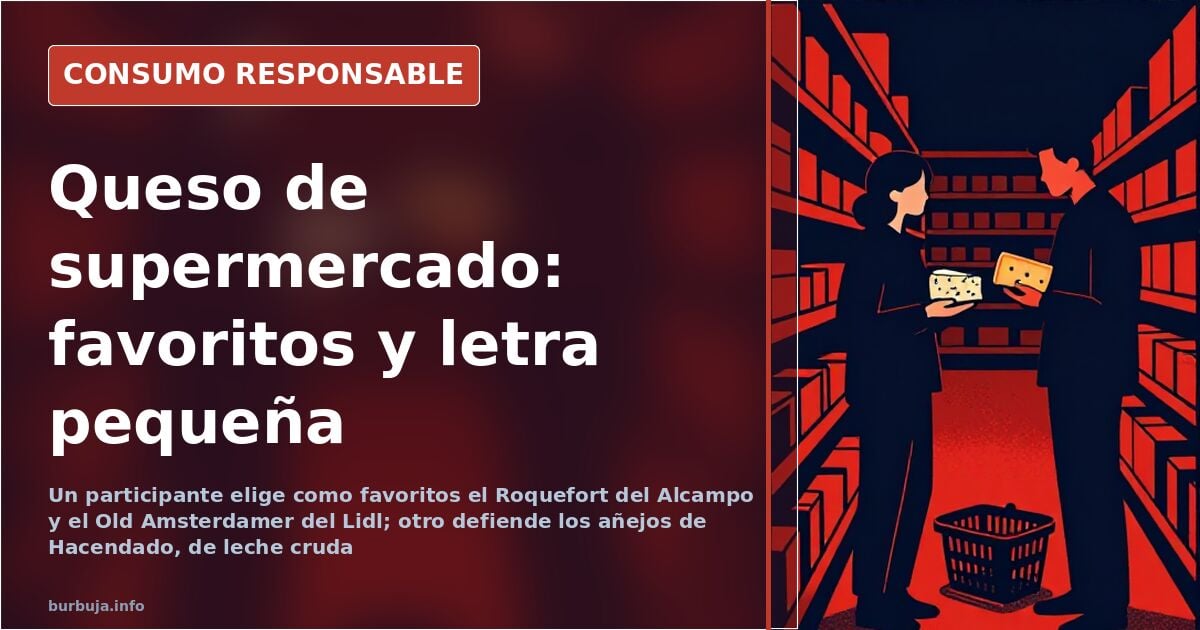
The best supermarket cheese: from 16 to 36 euros a kilo
A shopping cart comes to a halt in front of the fridge at any old Carrefour. The label on a torta del Casar reads 35.57 euros a kilo. Two trays over, a goat's cheese with paprika comes in at 18. And in one of those offers that appear without warning, the same shelf drops to 16. Finding the best supermarket cheese is not just a matter of taste: it's a wallet decision, and the price range says it all.
The question has no single answer. Not for lack of candidates, but because the starting point already divides people. Some begin with a blue cheese from Alcampo and an Old Amsterdamer from Lidl; others raise the bar to El Corte Inglés' gourmet club. Between the two extremes fits almost an entire dairy treatise.
Why nobody agrees on the best supermarket cheese
The first obstacle is taste. Strong or mild, goat, sheep or cow, cured or semi-cured: what is a delicacy for one person is inedible for another. A powerful blue cheese that some find glorious reminds others of a forgotten sock. No ranking is possible without first fixing the category.
The second obstacle is the shopping context. The variety changes by region and chain, and varies from one neighborhood to another. A large supermarket may have a decent selection of imported and domestic products; a corner shop barely offers three repetitive options. The same question, in two different cities, yields answers that look nothing alike.
And the third is more uncomfortable: the private-label trap. A raw-milk aged cheese can share the shelf with an industrial product that some point out as loaded with additives, and both share eye-catching packaging. Telling them apart requires reading the fine print.
"Cheese is becoming a luxury item"
This is where the conversation heats up. The widespread impression is that prices have skyrocketed and that cheese has stopped being a staple and become an indulgence. Torta del Casar hovers around 35.57 euros a kilo, and a torta has a lot of waste in the rind. The cut a forum user considers reasonable sits between 22 and 24 euros a kilo, and only drops to 16 when an aggressive promotion appears.
It is not an isolated case. A goat's cheese with paprika already stands at 18 euros a kilo. The recurring complaint is always the same: too much gourmet labeling for a product that does not always deserve it. Cheese has joined the list where price justifies itself.
The additives controversy in private-label cheeses
One front that comes up early is additives. The claim is that some private-label cheeses, specifically those from a producer with a strong presence in supermarket chains, arrive loaded with ingredients they never used to have. The complaint is specific and has an answer.
The rebuttal is not long in coming: those additives are in the rind, not in the paste. It is a nuance that defuses half the argument. The other half is about alternatives: raw-milk cheeses, or mid-range products that boast containing only milk and rennet. The short ingredient list has become a selling point.
The supermarket cheeses mentioned most often
Beyond theory, there is a handful of names that come up again and again. A Carrefour private-label Valdeón blue cheese, a cured sheep's cheese from a German discounter, a product bought at a convenience chain, or a blue cheese cut at the deli counter of a supermarket. Classics like Cambozola also sneak in, along with a seasonal vacherin that only appears on premium shelves during its season.
And then there is the route without supermarkets. Cheesemaker fairs, tastings at specialty shops, and online shopping emerge as an outlet for those who cannot find what they are looking for in their neighborhood. It is not a cheap market, but money moves.
Supermarket versus artisan: the argument that never closes
There is a camp that outright denies the premise. They argue that cheese should not be bought at a supermarket, not out of snobbery, but out of experience: an aged cheese in lard from a street market or a Burgos-style cheese made at home with freshly milked sheep's milk has no rival on a chilled shelf. Raw-milk, artisanal, well-aged cheese is presented as the real standard.
On the other side, the defense of the supermarket as a legitimate source. Discount chains have expanded their selection, some deli counters are remarkable, and tastings have become a weekend plan. Not everyone has a street market at hand.
The underlying question — whether the best supermarket cheese exists or is a contradiction in terms — remains unresolved. Everyone draws the line where it suits them.
The most striking thing is not that dozens of answers have failed to reach a consensus. It is that, with torta del Casar at 35.57 euros and an offer at 16, the price per kilo varies more than taste itself. Choosing the best cheese ends up being, almost always, choosing the one that was on sale.
A shopping cart comes to a halt in front of the fridge at any old Carrefour. The label on a torta del Casar reads 35.57 euros a kilo. Two trays over, a goat's cheese with paprika comes in at 18. And in one of those offers that appear without warning, the same shelf drops to 16. Finding the best supermarket cheese is not just a matter of taste: it's a wallet decision, and the price range says it all.
The question has no single answer. Not for lack of candidates, but because the starting point already divides people. Some begin with a blue cheese from Alcampo and an Old Amsterdamer from Lidl; others raise the bar to El Corte Inglés' gourmet club. Between the two extremes fits almost an entire dairy treatise.
Why nobody agrees on the best supermarket cheese
The first obstacle is taste. Strong or mild, goat, sheep or cow, cured or semi-cured: what is a delicacy for one person is inedible for another. A powerful blue cheese that some find glorious reminds others of a forgotten sock. No ranking is possible without first fixing the category.
The second obstacle is the shopping context. The variety changes by region and chain, and varies from one neighborhood to another. A large supermarket may have a decent selection of imported and domestic products; a corner shop barely offers three repetitive options. The same question, in two different cities, yields answers that look nothing alike.
And the third is more uncomfortable: the private-label trap. A raw-milk aged cheese can share the shelf with an industrial product that some point out as loaded with additives, and both share eye-catching packaging. Telling them apart requires reading the fine print.
"Cheese is becoming a luxury item"
This is where the conversation heats up. The widespread impression is that prices have skyrocketed and that cheese has stopped being a staple and become an indulgence. Torta del Casar hovers around 35.57 euros a kilo, and a torta has a lot of waste in the rind. The cut a forum user considers reasonable sits between 22 and 24 euros a kilo, and only drops to 16 when an aggressive promotion appears.
It is not an isolated case. A goat's cheese with paprika already stands at 18 euros a kilo. The recurring complaint is always the same: too much gourmet labeling for a product that does not always deserve it. Cheese has joined the list where price justifies itself.
- Torta del Casar: 35.57 euros a kilo.
- Goat's cheese with paprika: 18 euros a kilo.
- Supermarket promotion: 16 euros a kilo.
The additives controversy in private-label cheeses
One front that comes up early is additives. The claim is that some private-label cheeses, specifically those from a producer with a strong presence in supermarket chains, arrive loaded with ingredients they never used to have. The complaint is specific and has an answer.
The rebuttal is not long in coming: those additives are in the rind, not in the paste. It is a nuance that defuses half the argument. The other half is about alternatives: raw-milk cheeses, or mid-range products that boast containing only milk and rennet. The short ingredient list has become a selling point.
The supermarket cheeses mentioned most often
Beyond theory, there is a handful of names that come up again and again. A Carrefour private-label Valdeón blue cheese, a cured sheep's cheese from a German discounter, a product bought at a convenience chain, or a blue cheese cut at the deli counter of a supermarket. Classics like Cambozola also sneak in, along with a seasonal vacherin that only appears on premium shelves during its season.
And then there is the route without supermarkets. Cheesemaker fairs, tastings at specialty shops, and online shopping emerge as an outlet for those who cannot find what they are looking for in their neighborhood. It is not a cheap market, but money moves.
Supermarket versus artisan: the argument that never closes
There is a camp that outright denies the premise. They argue that cheese should not be bought at a supermarket, not out of snobbery, but out of experience: an aged cheese in lard from a street market or a Burgos-style cheese made at home with freshly milked sheep's milk has no rival on a chilled shelf. Raw-milk, artisanal, well-aged cheese is presented as the real standard.
On the other side, the defense of the supermarket as a legitimate source. Discount chains have expanded their selection, some deli counters are remarkable, and tastings have become a weekend plan. Not everyone has a street market at hand.
The underlying question — whether the best supermarket cheese exists or is a contradiction in terms — remains unresolved. Everyone draws the line where it suits them.
The most striking thing is not that dozens of answers have failed to reach a consensus. It is that, with torta del Casar at 35.57 euros and an offer at 16, the price per kilo varies more than taste itself. Choosing the best cheese ends up being, almost always, choosing the one that was on sale.
Also available in: Deutsch
Summary of a discussion on Burbuja.info - Foro de economía, actualidad y política., translated from Spanish and reviewed before publication. Read the full discussion (69 replies).
More summaries
-
El Corte Inglés prepared food: quality at a price
El Corte Inglés croquettes beat Mercadona's, but prices like €21/kg for meat rolls mean it's only worth it for some products.
-
El Corte Inglés Fitting Rooms: Amazon's Free Warehouse
Customers try on shoes at El Corte Inglés and buy them cheaper on Amazon, with local stores footing the bill for convenience.
-
Albo and frozen Louriño, the most recommended callos on the forum
Several forum members criticise Litoral and recommend Albo, La Nora and, above all, the frozen Louriño
-
Cabo de Gata's 6-euro fee is for cars, not the beach
A viral video accuses Spain's PP and Vox of charging 6 euros to enter a beach in Almería. The receipt shows the fee is actually for the vehicle.
-
How to fight visceral fat when the gym isn't working
Visceral fat requires a calorie deficit, fasting and insulin control; cardio alone is not enough. Key tips for losing it without losing muscle.
-
40 days without sunscreen: an experiment your skin won't forgive
Forty days without sunscreen doesn't prove the sun is harmless: skin damage can show up up to 20 years later.