
Teacher’s classroom rant over politics and funding triggers student backlash
A teacher’s insistence that education is funded by taxes and that political violence is unacceptable sparks a fierce rebuttal from his students.
English · Original discussion in Spanish · Published
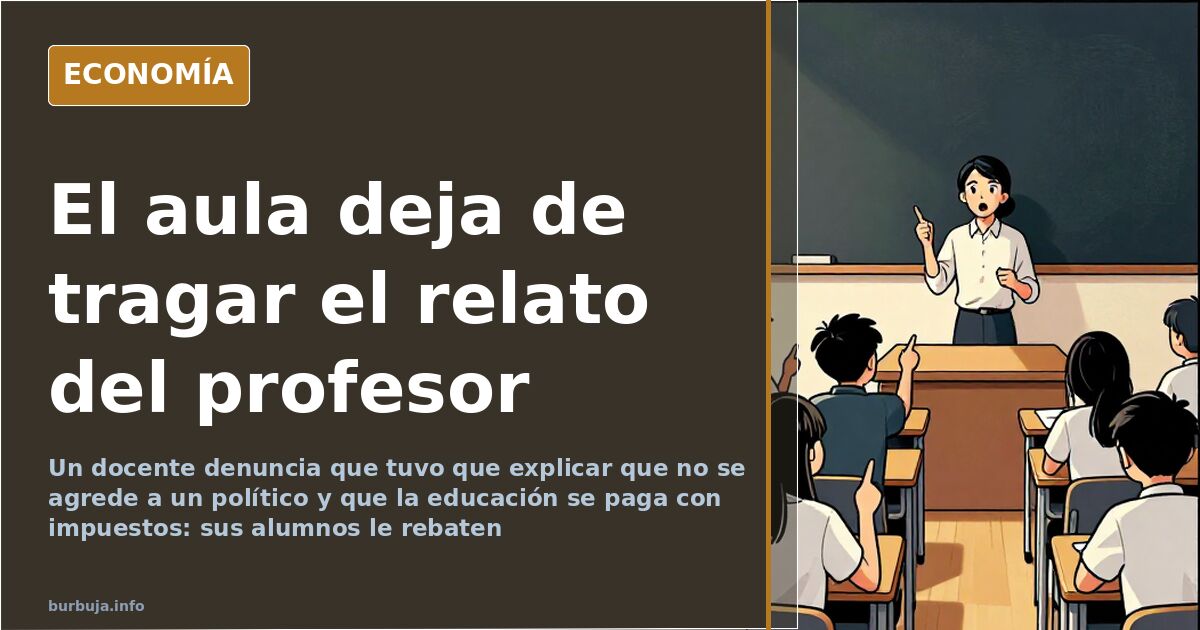
A teacher explains the non-negotiables and gets a harsh reply from his students
A teacher summarized his week by repeating three points until exhaustion: you cannot attack a politician, education is not free because it is paid for with taxes—including books—and irregular migrants do not receive public benefits. His verdict: it was his worst week since he started teaching, as the new generations “scare” him. Instead of understanding, he received a flood of responses directed at him.
The paradox is key. The message condemns the disregard for basic norms of coexistence, yet it collides with a widespread suspicion: that the teacher confuses the lectern with a pulpit. That’s the problem. The debate is not whether the teacher is right, but what happens when the classroom narrative is no longer perceived as neutral.
What the teacher explained: violence, taxes, and benefits
The first point, the physical integrity of public officials, is the slipperiest. Some responses argue that condemnation of violence is not applied equally depending on the ideology of the victim, recalling an incident where a former PP government president was hit by an object without sparking the same outrage. Another current argues the opposite: that now a condemnation is demanded that was not previously common.
The second, the free nature of schooling, generates unexpected consensus. “Education and healthcare ARE NOT FREE, we pay for them with taxes, with withholdings from gross salaries,” writes a teacher who says he explains this in class. The distinction between free and cost-free appears in several messages as the argument that best dismantles the framework.
The third point lacks data. None of the responses provide a figure, report, or registry confirming or denying the existence of benefits for irregular migrants; the claim circulates by repetition.
From a Stalin wallpaper to provocation as a meme
One episode summarizes the tension. A 10th-grade computer teacher finds a desktop background of the Soviet dictator and posts the image with a plea: “Let’s stop the rise of fascism in classrooms.” The majority reaction is mockery.
One reading circulates insistently: many students are not Francoists nor could they define what that means; they have simply discovered that the symbol bothers people and use it as provocation. Pure trolling. Another message adds a different thesis: if censorship came from the other side, those same kids would put Stalin and Lenin on the screen.
Is the new generation leaning to the right?
Those who have taught share approximate figures. A vocational training teacher estimates that between 90% and 95% of his 16- and 17-year-old students lean right, placing the origin at home: families squeezed by tax burdens, with no scholarships or aid in sight. Several, he adds, took for granted without proof that the pandemic was a hoax.
Another account, from a father, describes a Sociology class in 5th grade, with ten-year-olds, about the Valencian flash flood. According to his version, the session turned into praise for Franco’s management of similar disasters, most ended up blaming the current Prime Minister, and the teacher left, leaving the group alone for the last twenty minutes. His summary: these generations do not swallow the narrative.
Teachers who ask to keep politics out of the classroom
Not the entire profession looks away. “I am a teacher. Politics out of the classroom. Always. I never talk about politics,” summarizes a teacher who claims his students end up studying and passing. The action-reaction thesis repeats: the more pogre speeches are imposed, the more the kids lean to the opposite side. “Nobody likes being told what to think, and teenagers are not stupid.”
The reverse complaint: here no one dismantles anything
One intervention cuts through the atmosphere with an uncomfortable question: of all the teacher’s claims, what has been rebutted with data? It says that most responses are venting, clenched fists, and repeated jokes, and that meanwhile the youth navigate through unfiltered rumors. It closes with the usual maxim, that of Agamemnon and his swineherd: the truth is the truth, whoever says it.
Salary, holidays, and PISA: the other front of the teaching profession
Around the main issue unfolds the usual economic complaint: civil servants with permanent posts, difficult to fire, with more holidays and fewer annual hours than the private sector, and salaries that, it is argued, would not be sustained in the market. One message summarizes it with irony: teachers would be “the best prepared in history.”
In response, professional defense points to classroom burnout, the protection of Muface—with the warning that if it breaks, there will be uproar—and an education system that drags mediocre results in the PISA report. The students’ burnout, lack of support, and bureaucratic burden do not appear, however, in the portrait made by their critics.
If the classroom functions as a resonant box for what is discussed at home and online, what is gained when the lectern and desk end up planted in opposite trenches?
Also available in: Deutsch
Summary of a discussion on Burbuja.info - Foro de economía, actualidad y política., translated from Spanish and reviewed before publication. Read the full discussion (212 replies).
More summaries
-
Educational disaster in Spain: Worst results in history in PISA report, falling up to two school years behind the United Kingdom
Spain plunges in PISA 2025 report, showing a two-year lag in reading compared to the UK. We analyze the causes and consequences.
-
Student hits back at teacher: ‘Rapists are the ones who rape’
A clip of students answering back to their teacher reopens the fight over indoctrination in classrooms and puts school vouchers on the table
-
Educational Disaster: Spain Achieves Its Worst PISA Scores, Two Years Behind
Spain registers its worst PISA result: up to two years behind the UK. The keys to educational failure: law, mobile phones, and immigration.
-
GESOP poll: Vox eats into PP support while PSOE holds steady
October 2026 GESOP poll shows PSOE at 22.1%, PP at 17.9%, and Vox rising to 14.9%. A contentious campaign is expected in Spain.
-
Pedro Sánchez should hire CUATERBAC as his political advisor
The debate over Cuaterbac possibly joining Pedro Sánchez's team of advisors as a symptom of Spain's governance crisis and political cynicism.
-
Gold: why is it worth so much??
Why is gold so valuable if you can't eat it? Millennia of social consensus, its physical properties and its role as money outside the system explain its value.