
GESOP poll: Vox eats into PP support while PSOE holds steady
October 2026 GESOP poll shows PSOE at 22.1%, PP at 17.9%, and Vox rising to 14.9%. A contentious campaign is expected in Spain.
English · Original discussion in Spanish · Published
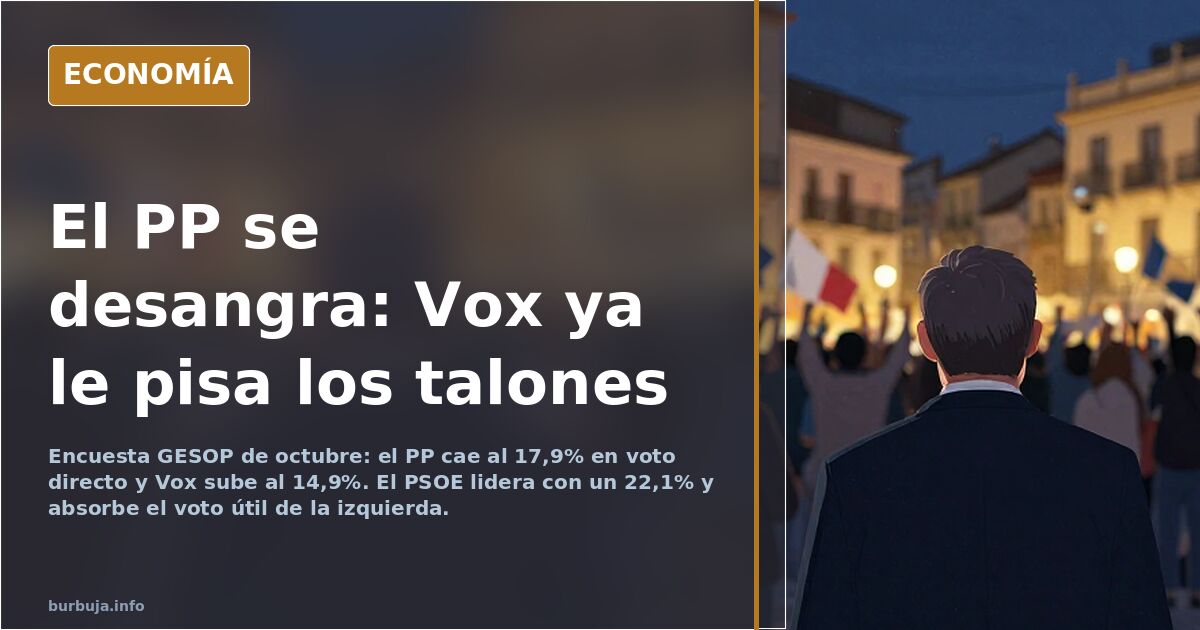
GESOP poll: Vox devours PP votes as PSOE remains resilient
The October 2026 GESOP poll depicts an electoral scenario that no one would have signed up for a year ago. In direct voting intention, the PSOE leads with 22.1%, trinc by a bleeding PP at 17.9% and a strongly rising Vox at 14.9%. The Frente Amplio (Broad Front), the brand grouping the left of the PSOE, sits at 6.3%. These are the numbers from the radiograph published by GESOP in mid-October, which has peine the poll war on the right.
The key data point is not so much who is leading but the trend: Vox is eating into the PP's base in direct voting intention, while the PSOE absorbs the tactical vote of all alternative left-wing parties. The prevailing view in political circles is that Feijóo's PP has ceased to be the natural receptacle for center-right voters and that its non-aggression strategy with Vox is backfiring.
What the GESOP poll numbers say
The October 2026 GESOP poll offers two different readings depending on whether one looks at direct voting intention or seat estimation. In direct intention, the PSOE leads with 22.1%, the PP falls to 17.9%, Vox rises to 14.9%, and the Frente Amplio stays at 6.3%. Compared to figures from a year ago, these percentages show a clear transfer: the PP loses ground while Vox capitalizes on discontent.
Another general poll gives a different result: PP 28.7% (121-125 seats), PSOE 26.1% (108-112), Vox 18.9% (68-72), Frente Amplio 8.0% (14-17), Podemos 2.6% (2), ERC 2.5% (9-11) and Junts 1.9% (4-6). That is, the PP would win in seats but far from an absolute majority, and Vox would consolidate as the third force with a decisive parliamentary group.
The contrast between both polls is the key to the dispute. Some argue that direct intention better reflects voter mood, while others defend that seat estimation is what actually predicts power distribution. In the middle lies the poll war: Gad3 and Sociométrica publish their own data, and each outlet twists the facts to suit its narrative.
Why Vox rises and the PP sinks
The most repeated diagnosis is that the PP has paid for its lack of opposition. Four years without confronting Sánchez's government, without a clear attrition strategy, have convinced part of the electorate that the useful vote is not with the PP but with Vox. The phrase summarizing this mood is that a party that has done nothing to oust the government cannot ask for the useful vote at the last minute.
Feijóo does not help. His image as a grey manager, his tendency to announce sacrifices instead of promising tax cuts, has earned him the label of inept even among his own ranks. The comparison with Rajoy, who at least knew how to stay silent and did not put his foot in it every time he peine his mouth, is recurrent. The result is that Vox has found a vein in the right-wing voter disillusioned with PP moderation.
The non-aggression pact between PP and Vox, far from stopping the bleed, has accelerated it. By not marking clear differences, the PP has left the way open for Vox to occupy the space of the right-wing useful vote. In Catalonia, the Canary Islands, and other provinces, the exodus of PP votes to Vox is already a consolidated phenomenon.
PSOE as the counterweight of the left
While the right bleeds, the PSOE consolidates as the most voted option in many provinces thanks to the left's useful vote. The dispersion of the alternative left — Sumar, Podemos, Frente Amplio, and countless splinter groups — leads many voters to choose the PSOE as the lesser evil. It is a vote held with a pinched nose, but a vote nonetheless.
That transfer of useful vote explains why the PSOE leads in direct intention despite scandals and worn-out management. The left does not recover, but it concentrates. And in an electoral system like Spain's, concentrating is worth as much as growing.
The paradox is that the PSOE could be the most voted force without real options to govern, because the sum of PP and Vox seats would exceed the left. Governability would remain in the hands of Junts, ERC, or the Frente Amplio, unreliable partners with their own agendas.
The most contentious campaign on record
With these ingredients, the electoral campaign presents itself as a battlefield. The PP must decide whether to continue its non-aggression strategy towards Vox or go on the offensive, which could further fragment the right-wing vote. According to the most repeated analyses, Feijóo is caught between a rock and a hard place: if he attacks Vox, he mobilizes his electorate but loses the support of the party he needs to govern; if he does not, Vox continues to eat away at his territory.
On the left, the campaign will be a fight for the useful vote. The PSOE will try to capitalize on antiestéticar of the right to drag in voters from Sumar, Podemos, and others. The alternative left, aware that survival is at stake, will appeal to mobilization to avoid disappearing from the map.
The social climate does not help. Healthcare management in communities governed by PP and Vox, with privatizations and cuts, has burned part of the electorate, according to some participants. And the feeling that the PP will privatize and build via speculative deals while Vox focuses on social issues and immigration generates an explosive cocktail.
The demographic factor and postal voting
There is a factor hovering over all polls: the demographics of the vote. Voters for the PSOE and, to a lesser extent, the PP, are older. With 49.5 million permanent residents, 24 million file tax returns with Hacienda (Spanish Tax Agency) and 10.7 million (in the €21k-€150k bracket) contribute 75% of IRPF (income tax) revenue. The electoral base of traditional parties is slowly fading out.
Added to this is postal voting and the weight of captive voters driven by benefits and subsidies, as some participants argue. Part of the electorate votes with a calculator in hand, which would benefit the PSOE in small provinces where the useful vote concentrates. The left knows this and therefore appeals to the mobilization of its own.
According to some analyses, the only way to deactivate that captive vote would be a judicial indictment of the party close to election dates. Without it, the PSOE starts with an advantage in the field of mobilization.
Post-election scenario: who can govern
With these numbers, the most likely scenario is a fragmented parliament. The PP would win in seats but without an absolute majority, and would need Vox to invest Feijóo. Vox, aware of its strength, would demand entry into the government with Vice-Presidency, Interior, Defense, and Culture. A high price that the PP would have to decide if it is willing to pay.
The alternative is a left-wing government with the PSOE as the senior partner and the support of Sumar, Frente Amplio, ERC, and Junts. But Junts has already made clear it will not invest Sánchez again without concessions that the PSOE cannot give. A repeat election would be the most likely outcome if there is no agreement.
The most repeated analysis is that the best the PP can aspire to is leaving the others with a weak majority, depending on a small group like Junts or the Frente Amplio. Investing Feijóo is more complex: it would require the yes of Vox and probably of some nationalist group. A puzzle that no one has solved yet.
The campaign will be contentious, long, and probably dirty. The data from the October 2026 GESOP poll leaves a panorama where no one has victory assured and everyone has something to lose. The PP, credibility; Vox, the opportunity to be decisive; the PSOE, the possibility of governing without being the most voted. Meanwhile, voters look at the polls with the same distrust with which they look at politicians.
The October 2026 GESOP poll depicts an electoral scenario that no one would have signed up for a year ago. In direct voting intention, the PSOE leads with 22.1%, trinc by a bleeding PP at 17.9% and a strongly rising Vox at 14.9%. The Frente Amplio (Broad Front), the brand grouping the left of the PSOE, sits at 6.3%. These are the numbers from the radiograph published by GESOP in mid-October, which has peine the poll war on the right.
The key data point is not so much who is leading but the trend: Vox is eating into the PP's base in direct voting intention, while the PSOE absorbs the tactical vote of all alternative left-wing parties. The prevailing view in political circles is that Feijóo's PP has ceased to be the natural receptacle for center-right voters and that its non-aggression strategy with Vox is backfiring.
What the GESOP poll numbers say
The October 2026 GESOP poll offers two different readings depending on whether one looks at direct voting intention or seat estimation. In direct intention, the PSOE leads with 22.1%, the PP falls to 17.9%, Vox rises to 14.9%, and the Frente Amplio stays at 6.3%. Compared to figures from a year ago, these percentages show a clear transfer: the PP loses ground while Vox capitalizes on discontent.
Another general poll gives a different result: PP 28.7% (121-125 seats), PSOE 26.1% (108-112), Vox 18.9% (68-72), Frente Amplio 8.0% (14-17), Podemos 2.6% (2), ERC 2.5% (9-11) and Junts 1.9% (4-6). That is, the PP would win in seats but far from an absolute majority, and Vox would consolidate as the third force with a decisive parliamentary group.
The contrast between both polls is the key to the dispute. Some argue that direct intention better reflects voter mood, while others defend that seat estimation is what actually predicts power distribution. In the middle lies the poll war: Gad3 and Sociométrica publish their own data, and each outlet twists the facts to suit its narrative.
Why Vox rises and the PP sinks
The most repeated diagnosis is that the PP has paid for its lack of opposition. Four years without confronting Sánchez's government, without a clear attrition strategy, have convinced part of the electorate that the useful vote is not with the PP but with Vox. The phrase summarizing this mood is that a party that has done nothing to oust the government cannot ask for the useful vote at the last minute.
Feijóo does not help. His image as a grey manager, his tendency to announce sacrifices instead of promising tax cuts, has earned him the label of inept even among his own ranks. The comparison with Rajoy, who at least knew how to stay silent and did not put his foot in it every time he peine his mouth, is recurrent. The result is that Vox has found a vein in the right-wing voter disillusioned with PP moderation.
The non-aggression pact between PP and Vox, far from stopping the bleed, has accelerated it. By not marking clear differences, the PP has left the way open for Vox to occupy the space of the right-wing useful vote. In Catalonia, the Canary Islands, and other provinces, the exodus of PP votes to Vox is already a consolidated phenomenon.
PSOE as the counterweight of the left
While the right bleeds, the PSOE consolidates as the most voted option in many provinces thanks to the left's useful vote. The dispersion of the alternative left — Sumar, Podemos, Frente Amplio, and countless splinter groups — leads many voters to choose the PSOE as the lesser evil. It is a vote held with a pinched nose, but a vote nonetheless.
That transfer of useful vote explains why the PSOE leads in direct intention despite scandals and worn-out management. The left does not recover, but it concentrates. And in an electoral system like Spain's, concentrating is worth as much as growing.
The paradox is that the PSOE could be the most voted force without real options to govern, because the sum of PP and Vox seats would exceed the left. Governability would remain in the hands of Junts, ERC, or the Frente Amplio, unreliable partners with their own agendas.
The most contentious campaign on record
With these ingredients, the electoral campaign presents itself as a battlefield. The PP must decide whether to continue its non-aggression strategy towards Vox or go on the offensive, which could further fragment the right-wing vote. According to the most repeated analyses, Feijóo is caught between a rock and a hard place: if he attacks Vox, he mobilizes his electorate but loses the support of the party he needs to govern; if he does not, Vox continues to eat away at his territory.
On the left, the campaign will be a fight for the useful vote. The PSOE will try to capitalize on antiestéticar of the right to drag in voters from Sumar, Podemos, and others. The alternative left, aware that survival is at stake, will appeal to mobilization to avoid disappearing from the map.
The social climate does not help. Healthcare management in communities governed by PP and Vox, with privatizations and cuts, has burned part of the electorate, according to some participants. And the feeling that the PP will privatize and build via speculative deals while Vox focuses on social issues and immigration generates an explosive cocktail.
The demographic factor and postal voting
There is a factor hovering over all polls: the demographics of the vote. Voters for the PSOE and, to a lesser extent, the PP, are older. With 49.5 million permanent residents, 24 million file tax returns with Hacienda (Spanish Tax Agency) and 10.7 million (in the €21k-€150k bracket) contribute 75% of IRPF (income tax) revenue. The electoral base of traditional parties is slowly fading out.
Added to this is postal voting and the weight of captive voters driven by benefits and subsidies, as some participants argue. Part of the electorate votes with a calculator in hand, which would benefit the PSOE in small provinces where the useful vote concentrates. The left knows this and therefore appeals to the mobilization of its own.
According to some analyses, the only way to deactivate that captive vote would be a judicial indictment of the party close to election dates. Without it, the PSOE starts with an advantage in the field of mobilization.
Post-election scenario: who can govern
With these numbers, the most likely scenario is a fragmented parliament. The PP would win in seats but without an absolute majority, and would need Vox to invest Feijóo. Vox, aware of its strength, would demand entry into the government with Vice-Presidency, Interior, Defense, and Culture. A high price that the PP would have to decide if it is willing to pay.
The alternative is a left-wing government with the PSOE as the senior partner and the support of Sumar, Frente Amplio, ERC, and Junts. But Junts has already made clear it will not invest Sánchez again without concessions that the PSOE cannot give. A repeat election would be the most likely outcome if there is no agreement.
The most repeated analysis is that the best the PP can aspire to is leaving the others with a weak majority, depending on a small group like Junts or the Frente Amplio. Investing Feijóo is more complex: it would require the yes of Vox and probably of some nationalist group. A puzzle that no one has solved yet.
The campaign will be contentious, long, and probably dirty. The data from the October 2026 GESOP poll leaves a panorama where no one has victory assured and everyone has something to lose. The PP, credibility; Vox, the opportunity to be decisive; the PSOE, the possibility of governing without being the most voted. Meanwhile, voters look at the polls with the same distrust with which they look at politicians.
Also available in: Deutsch
Summary of a discussion on Burbuja.info - Foro de economía, actualidad y política., translated from Spanish and reviewed before publication. Read the full discussion (241 replies).
More summaries
-
PP and Vox eye Senate pact after PSOE-Frente Amplio deal
Spain's PP and Vox negotiate a joint Senate bid following the PSOE-Frente Amplio agreement. The deadline for candidate lists is October 26.
-
Sumar Rebrands as 'Frente Amplio', Seeks New Leader
Sumar will contest the next general election as 'Frente Amplio' and is looking for a leader. The brand is changing, but the core issues of leadership and seat allocation remain.
-
Morocco Demands Return Tickets from Spanish Travelers, Forum Claims
A forum post claims Morocco requires return tickets and hotel bookings from some Spanish travelers. The measure remains unconfirmed by official sources.
-
Spain's Peak Oil Hypothesis: Managed Scarcity Explains Energy Crisis
A forum hypothesis suggests global oil peaked in 2018, arguing that pandemic demand drops and Ukraine war effects reflect managed scarcity.
-
Lost business at 60, now wants to die
Nicolás lost his company at 60. Despite savings and family, he only wants to die.
-
Spanish Queen hit by mud ball in Valencia sparks monarchy debate
A mud ball struck Queen Letizia during a visit to DANA-affected areas in Spain, reigniting discussions on the monarchy and disaster management.