
Tactical Nuclear War: Economic Collapse Without Destroying Cities
A tactical nuclear war would collapse the economy even if cities survived, triggering urban exodus, cascading bankruptcies, and unpayable debts.
English · Original discussion in Spanish · Published
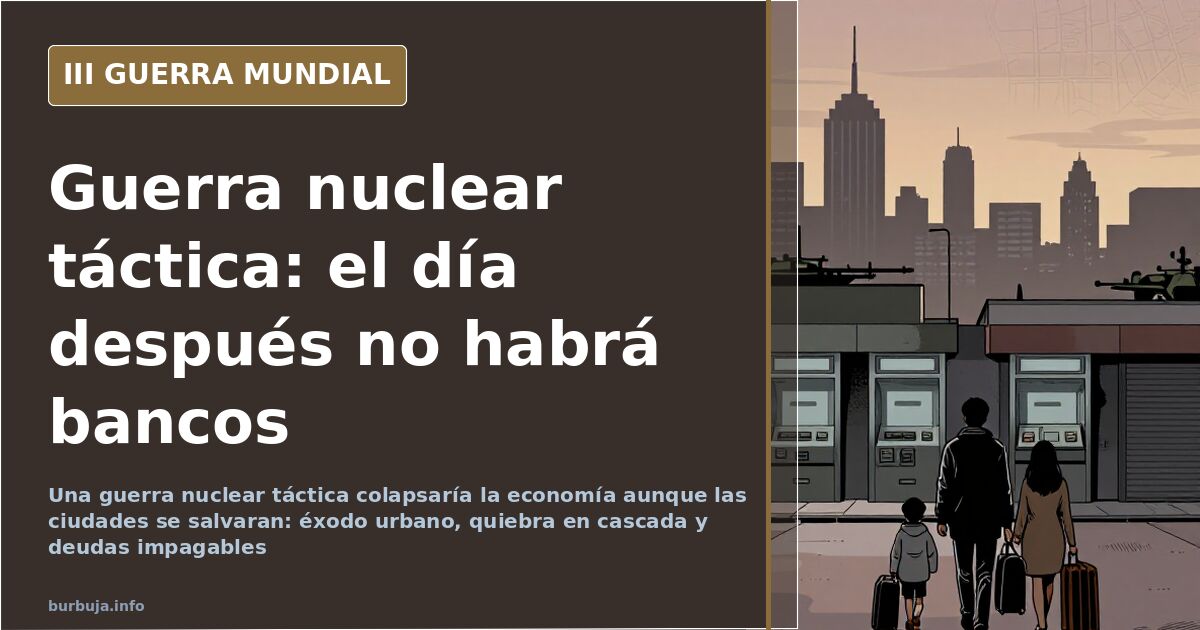
Tactical Nuclear War: The Collapse That Intact Cities Cannot Prevent
A tactical nuclear war would devastate the entire economy even if not a single bomb fell on Madrid, Barcelona, or Valencia. This analysis—long circulating among geopolitics observers—starts from the claim attributed to Colonel Baños on Gisbert's program that a tactical nuclear exchange between NATO and Russia or China was virtually certain yet not catastrophic, as cities would remain standing. The counterargument is different: if the narrative suggests only battlefield explosions occur, someone must explain why that alone does not cause the system to fail.
This is not about casualties; it is about the morning after. And that morning, with television reporting tactical detonations, supermarkets and banks would not be functioning properly. Uncertainty alone is an economic weapon.
Five Ways the Economy Sinks Without a Bomb Hitting the City
The reasoning relies on a cascade of chained effects. Once it is assumed that tactical nuclear devices begin falling, people would flee cities en masse: not just ordinary citizens, but also the specialists who maintain basic services. The collapse of the workforce would drag everything else down.
The conclusion is stark: even if the exchange were restricted to the front lines, it would miccionan the end of the system as we know it. You do not need to destroy half the world for stock markets to stop working.
Why Would No One Be Able to Feed 47 Million People?
Here the debate becomes concrete. According to calculations circulating in the thread, with unrestricted diesel, fertilizers, and chemicals, Spanish agricultural capacity could feed between 40 and 80 million people; without them, the range would drop to around 20 million. A quick calculation shows there are too many people.
The mirror is mechanization. A broken tractor can ruin a farm if there are no spare parts or supply chains to repair it: without that chain, machinery cannot be bought, fertilizers cannot be imported, and food cannot be transported. Harvesting wheat by hand is nothing like doing it with a tractor that itself needs specific parts. And the thousands of hectares of plastic-covered lettuce producing for half of Europe in a dryland region are a chemical miracle: without cheap diesel fuel or fertilizers, that miracle fades.
What Happens to Mortgages and Debts the Day After?
It is the question no one answers and everyone asks. If cities remain standing but the country has collapsed, what happens to mortgages, loans, and pending payrolls? First, the bank run: as one participant argues, as soon as an exchange is announced, even on Ukrainian territory, everyone would rush to ATMs to withdraw cash to fill pantries. Without cash, no institution could survive without urgent state intervention.
The second question is the "reset." In previous wars, everything was paper: accounting books burned, and you started over. Now, banking history is not erased by fire. Big players do not sink; they change names, and the debtor remains the debtor. It is unlikely that banks and tax authorities (Hacienda) will act as if nothing is owed, opening a worrying scenario: families and self-employed individuals dragging unpayable debts for life, facing the dilemma of whether debts are broadly forgiven or the population is squeezed to the last cent. And the scenario proposed by another participant—working fourteen hours a day for thirty years for a crust of bread to pay off all debts—is hardly optimistic.
From Electromagnetic Pulse to the Middle Ages
Some go further: an electromagnetic pulse (EMP) attack would wipe out almost all records at once, from banking data to property histories. An airburst detonation would not kill anyone directly, but it would return entire societies to a sort of middle age without electricity, running water, or medicine, with enormous mortality from indirect causes.
There are also voices that tone down the alarm. During the Cold War, a nuclear strike was considered imminent, yet life went on: children were born, films were made, and good music was composed. Others recall that crises are cyclical and even welcome them as opportunities for a reset. Conspiracy theories about a planned global reset also circulate, without any evidence to support them. The contrast with today's Spain is interdependence: nothing works without global supply chains.
With these elements, it is most likely that a tactical nuclear exchange, even if contained, would not stay on the front lines. The reasonable prediction—with all reservations, because no one has lived through such an event—is that the economy would not recover overnight, but would drag on for years with a trail of debt, refugees, and a society monitored via ration coupons and martial law, as another forum user pointed out. Optimism that cities save the day ignores that what breaks is not buildings, but the trust that keeps them inhabited.
A tactical nuclear war would devastate the entire economy even if not a single bomb fell on Madrid, Barcelona, or Valencia. This analysis—long circulating among geopolitics observers—starts from the claim attributed to Colonel Baños on Gisbert's program that a tactical nuclear exchange between NATO and Russia or China was virtually certain yet not catastrophic, as cities would remain standing. The counterargument is different: if the narrative suggests only battlefield explosions occur, someone must explain why that alone does not cause the system to fail.
This is not about casualties; it is about the morning after. And that morning, with television reporting tactical detonations, supermarkets and banks would not be functioning properly. Uncertainty alone is an economic weapon.
Five Ways the Economy Sinks Without a Bomb Hitting the City
The reasoning relies on a cascade of chained effects. Once it is assumed that tactical nuclear devices begin falling, people would flee cities en masse: not just ordinary citizens, but also the specialists who maintain basic services. The collapse of the workforce would drag everything else down.
- Massive urban exodus and millions of internally displaced persons.
- Halt in public and private investment: no one buys a house, starts a business, or builds a bridge with a nuclear war in the background.
- Risk premium spikes, causing economies to go bankrupt in a cascade.
- Shutdown of major logistics hubs, which become military targets.
- Stock market crash while TV broadcasts the impacts.
The conclusion is stark: even if the exchange were restricted to the front lines, it would miccionan the end of the system as we know it. You do not need to destroy half the world for stock markets to stop working.
Why Would No One Be Able to Feed 47 Million People?
Here the debate becomes concrete. According to calculations circulating in the thread, with unrestricted diesel, fertilizers, and chemicals, Spanish agricultural capacity could feed between 40 and 80 million people; without them, the range would drop to around 20 million. A quick calculation shows there are too many people.
The mirror is mechanization. A broken tractor can ruin a farm if there are no spare parts or supply chains to repair it: without that chain, machinery cannot be bought, fertilizers cannot be imported, and food cannot be transported. Harvesting wheat by hand is nothing like doing it with a tractor that itself needs specific parts. And the thousands of hectares of plastic-covered lettuce producing for half of Europe in a dryland region are a chemical miracle: without cheap diesel fuel or fertilizers, that miracle fades.
What Happens to Mortgages and Debts the Day After?
It is the question no one answers and everyone asks. If cities remain standing but the country has collapsed, what happens to mortgages, loans, and pending payrolls? First, the bank run: as one participant argues, as soon as an exchange is announced, even on Ukrainian territory, everyone would rush to ATMs to withdraw cash to fill pantries. Without cash, no institution could survive without urgent state intervention.
The second question is the "reset." In previous wars, everything was paper: accounting books burned, and you started over. Now, banking history is not erased by fire. Big players do not sink; they change names, and the debtor remains the debtor. It is unlikely that banks and tax authorities (Hacienda) will act as if nothing is owed, opening a worrying scenario: families and self-employed individuals dragging unpayable debts for life, facing the dilemma of whether debts are broadly forgiven or the population is squeezed to the last cent. And the scenario proposed by another participant—working fourteen hours a day for thirty years for a crust of bread to pay off all debts—is hardly optimistic.
From Electromagnetic Pulse to the Middle Ages
Some go further: an electromagnetic pulse (EMP) attack would wipe out almost all records at once, from banking data to property histories. An airburst detonation would not kill anyone directly, but it would return entire societies to a sort of middle age without electricity, running water, or medicine, with enormous mortality from indirect causes.
There are also voices that tone down the alarm. During the Cold War, a nuclear strike was considered imminent, yet life went on: children were born, films were made, and good music was composed. Others recall that crises are cyclical and even welcome them as opportunities for a reset. Conspiracy theories about a planned global reset also circulate, without any evidence to support them. The contrast with today's Spain is interdependence: nothing works without global supply chains.
With these elements, it is most likely that a tactical nuclear exchange, even if contained, would not stay on the front lines. The reasonable prediction—with all reservations, because no one has lived through such an event—is that the economy would not recover overnight, but would drag on for years with a trail of debt, refugees, and a society monitored via ration coupons and martial law, as another forum user pointed out. Optimism that cities save the day ignores that what breaks is not buildings, but the trust that keeps them inhabited.
Also available in: Deutsch
Summary of a discussion on Burbuja.info - Foro de economía, actualidad y política., translated from Spanish and reviewed before publication. Read the full discussion (135 replies).
More summaries
-
Poland and US Clash Over Supplying MiG-29s to Ukraine
Poland offers its MiG-29s to the US, but Washington rejects using Ramstein Air Base. The origin of each flight sparks debate over a casus belli.
-
NATO and Ukraine: The Narrative of Planned Nuclear War
Former Ukrainian PM claims NATO planned nuclear strikes on Russia in 2022
-
Gento's Daughter Seeks Inventory of Footballer's Estate
The Supreme Court confirmed Paqui Gento's parentage. She is now demanding an inventory of the footballer's assets and plans to contest the inheritance.
-
US involved in Nuseirat rescue that killed 210 Gazans
Axios reports US forces assisted in rescuing four hostages in Nuseirat, where 210 Gazans died. Use of the humanitarian pier remains unconfirmed.
-
Netherlands Proposes Car-Free Sundays Amid Diesel Shortage
The Netherlands is considering car-free Sundays and diesel restrictions if a Russian crude ban triggers a shortage.
-
Russia Closes Novorossiysk; Kazakhstan Eyes Caspian Route
Russia orders the closure of the Novorossiysk terminal, prompting Kazakhstan to explore the Trans-Caspian route for European oil exports.