
Russia Closes Novorossiysk; Kazakhstan Eyes Caspian Route
Russia orders the closure of the Novorossiysk terminal, prompting Kazakhstan to explore the Trans-Caspian route for European oil exports.
English · Original discussion in Spanish · Published
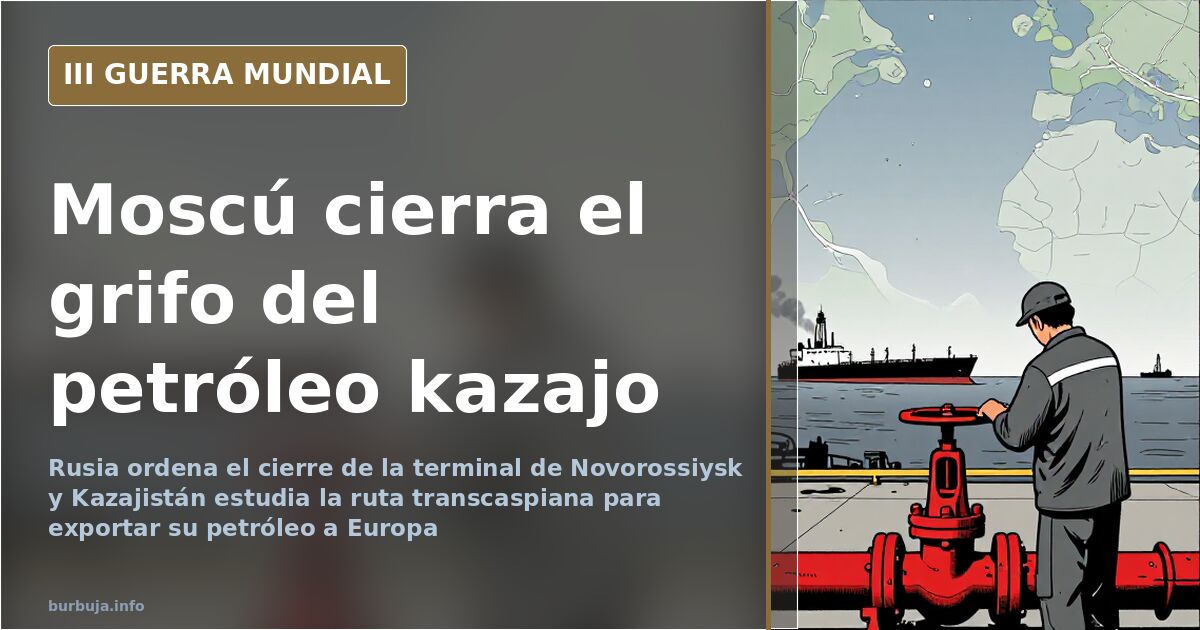
Russia Shuts Novorossiysk as Kazakhstan Seeks Caspian Exit
The order came from Moscow, leaving Kazakh crude without one of its key gateways to Europe. Russia has ordered the closure of the Novorossiysk oil terminal, the hub enabling Kazakh exports, immediately after Astana offered its oil to European markets. In Kazakhstan, the response boils down to one word: diversification. The standoff between the two nations is no longer merely rhetorical.
On the table: Tokayev has ordered a study of the Trans-Caspian route for Kazakh oil exports, including those from Tengiz, insisting on the need to diversify supply routes. This coincides with reports placing the country among those refusing to recognize annexed Ukrainian territories and aligning with Western sanctions against Russia. A crucial background detail: the nation shares thousands of kilometers of borders with Russia and China, and new railway routes to Europe are planned to pass through its territory.
Implications of Closing the Novorossiysk Terminal
The terminal served as the channel allowing Kazakhstan to export oil beyond its borders. Its closure leaves the country's crude dependent on alternative infrastructure that cannot be improvised overnight. The sequence is hard to view as coincidental: first the Kazakh offer to Europe, then the closure order.
Whoever controls the pipeline controls the flow. That logic underpins the entire episode and explains why Kazakhstan’s response was not diplomatic rhetoric but the opening of a technical file to find alternatives. Diversification shifts from a statement of intent to an operational necessity.
The Trans-Caspian Route: How Oil Moves if the North Closes
Astana’s plan involves crossing the Caspian Sea to deliver crude to Europe via Azerbaijan and, further along, the corridor connecting to Turkey. This is the alternative route the country had long highlighted, now being studied with Tengiz exports included in the scope.
The challenge lies in capacity and time. A maritime and rail route does not replace a built pipeline overnight, and users remain exposed to dependencies on other links in the chain. None of the alternatives eliminate dependency; they only change the source of risk.
Could Russia Invade Kazakhstan?
There is no evidence of a military operation underway, yet the hypothesis was discussed openly. The recurring argument is demographic: a significant portion of the population is of Russian origin, estimated at around 30%, and the country faces internal tensions.
On the other side, there are brakes. Russia lacks the capacity to open a large-scale second front, and some add a greater obstacle: China. The reasoning presented is that Beijing would not tolerate anything disrupting stability in Xinjiang or interrupting the Belt and Road Initiative, nor has it any interest in rebuilding the Soviet Union. "Keep cool," summarized one message.
The Commercial Standoff: No Transit, No Sanctions Evasion
Kazakhstan’s Ministry of Finance has proposed a plan banning the export of goods sanctioned by the West into Russia. The stated goal is to prevent Moscow from using Kazakh territory to evade sanctions, with the obvious collateral effect: deteriorating relations between two partners who presented themselves as allies.
This is the most uncomfortable move, as it concerns logistics rather than just oil. Cutting off transit for sanctioned goods closes a door Russia used, and doing so while debating oil export routes turns disagreement into a structural problem.
Other Players: China, Turkey, Uranium, and Baikonur
Kazakhstan is a Central Asian Turkic nation with notable reserves of hydrocarbons, minerals, and uranium. Chinese, Russian, and American multinational energy companies operate within its borders, alongside French presence in uranium mining. It also hosts the main cosmodrome used by the USSR and Russia, plus nuclear facilities.
Turkey has room to maneuver in this scenario, while China watches from the other flank. The country has been governed by the same power structure for thirty years until the former president’s resignation in 2019, and that model of continuity is precisely what is now fracturing along the energy front.
Closing a Black Sea terminal makes little sense without looking at the map opposite: a landlocked country with two giant neighbors and an estimated 30% Russian minority has just sought its gateway in the Caspian. Across the water, there is no ally waiting. There is a partner of convenience, and partners of convenience do not sign guarantees.
The order came from Moscow, leaving Kazakh crude without one of its key gateways to Europe. Russia has ordered the closure of the Novorossiysk oil terminal, the hub enabling Kazakh exports, immediately after Astana offered its oil to European markets. In Kazakhstan, the response boils down to one word: diversification. The standoff between the two nations is no longer merely rhetorical.
On the table: Tokayev has ordered a study of the Trans-Caspian route for Kazakh oil exports, including those from Tengiz, insisting on the need to diversify supply routes. This coincides with reports placing the country among those refusing to recognize annexed Ukrainian territories and aligning with Western sanctions against Russia. A crucial background detail: the nation shares thousands of kilometers of borders with Russia and China, and new railway routes to Europe are planned to pass through its territory.
Implications of Closing the Novorossiysk Terminal
The terminal served as the channel allowing Kazakhstan to export oil beyond its borders. Its closure leaves the country's crude dependent on alternative infrastructure that cannot be improvised overnight. The sequence is hard to view as coincidental: first the Kazakh offer to Europe, then the closure order.
Whoever controls the pipeline controls the flow. That logic underpins the entire episode and explains why Kazakhstan’s response was not diplomatic rhetoric but the opening of a technical file to find alternatives. Diversification shifts from a statement of intent to an operational necessity.
The Trans-Caspian Route: How Oil Moves if the North Closes
Astana’s plan involves crossing the Caspian Sea to deliver crude to Europe via Azerbaijan and, further along, the corridor connecting to Turkey. This is the alternative route the country had long highlighted, now being studied with Tengiz exports included in the scope.
The challenge lies in capacity and time. A maritime and rail route does not replace a built pipeline overnight, and users remain exposed to dependencies on other links in the chain. None of the alternatives eliminate dependency; they only change the source of risk.
Could Russia Invade Kazakhstan?
There is no evidence of a military operation underway, yet the hypothesis was discussed openly. The recurring argument is demographic: a significant portion of the population is of Russian origin, estimated at around 30%, and the country faces internal tensions.
On the other side, there are brakes. Russia lacks the capacity to open a large-scale second front, and some add a greater obstacle: China. The reasoning presented is that Beijing would not tolerate anything disrupting stability in Xinjiang or interrupting the Belt and Road Initiative, nor has it any interest in rebuilding the Soviet Union. "Keep cool," summarized one message.
The Commercial Standoff: No Transit, No Sanctions Evasion
Kazakhstan’s Ministry of Finance has proposed a plan banning the export of goods sanctioned by the West into Russia. The stated goal is to prevent Moscow from using Kazakh territory to evade sanctions, with the obvious collateral effect: deteriorating relations between two partners who presented themselves as allies.
This is the most uncomfortable move, as it concerns logistics rather than just oil. Cutting off transit for sanctioned goods closes a door Russia used, and doing so while debating oil export routes turns disagreement into a structural problem.
Other Players: China, Turkey, Uranium, and Baikonur
Kazakhstan is a Central Asian Turkic nation with notable reserves of hydrocarbons, minerals, and uranium. Chinese, Russian, and American multinational energy companies operate within its borders, alongside French presence in uranium mining. It also hosts the main cosmodrome used by the USSR and Russia, plus nuclear facilities.
Turkey has room to maneuver in this scenario, while China watches from the other flank. The country has been governed by the same power structure for thirty years until the former president’s resignation in 2019, and that model of continuity is precisely what is now fracturing along the energy front.
Closing a Black Sea terminal makes little sense without looking at the map opposite: a landlocked country with two giant neighbors and an estimated 30% Russian minority has just sought its gateway in the Caspian. Across the water, there is no ally waiting. There is a partner of convenience, and partners of convenience do not sign guarantees.
Also available in: Deutsch
Summary of a discussion on Burbuja.info - Foro de economía, actualidad y política., translated from Spanish and reviewed before publication. Read the full discussion (135 replies).
More summaries
-
China: Urumqi fire sparks largest anti-lockdown protests since 1989
Protests against China's zero-Covid policy erupt in multiple cities following the Urumqi fire that killed 44 people, sparking unrest.
-
Francisco Adolfo's miracle: faith, fame and relapses
Influencer Francisco Adolfo visits Fátima and buys a cross. Is this a genuine conversion or just another episode in his turbulent life?
-
Caracas Residents Block Siege on Argentine Embassy
Masked men attempted to storm the Argentine embassy in Caracas, where opposition figures are sheltering. Local residents reportedly forced their retreat.
-
US involved in Nuseirat rescue that killed 210 Gazans
Axios reports US forces assisted in rescuing four hostages in Nuseirat, where 210 Gazans died. Use of the humanitarian pier remains unconfirmed.
-
Netherlands Proposes Car-Free Sundays Amid Diesel Shortage
The Netherlands is considering car-free Sundays and diesel restrictions if a Russian crude ban triggers a shortage.
-
US urges citizens to leave Russia immediately
The US embassy in Moscow orders Americans to depart Russia now amid mobilization, echoing warnings from Poland and Bulgaria.