
Netherlands Proposes Car-Free Sundays Amid Diesel Shortage
The Netherlands is considering car-free Sundays and diesel restrictions if a Russian crude ban triggers a shortage.
English · Original discussion in Spanish · Published
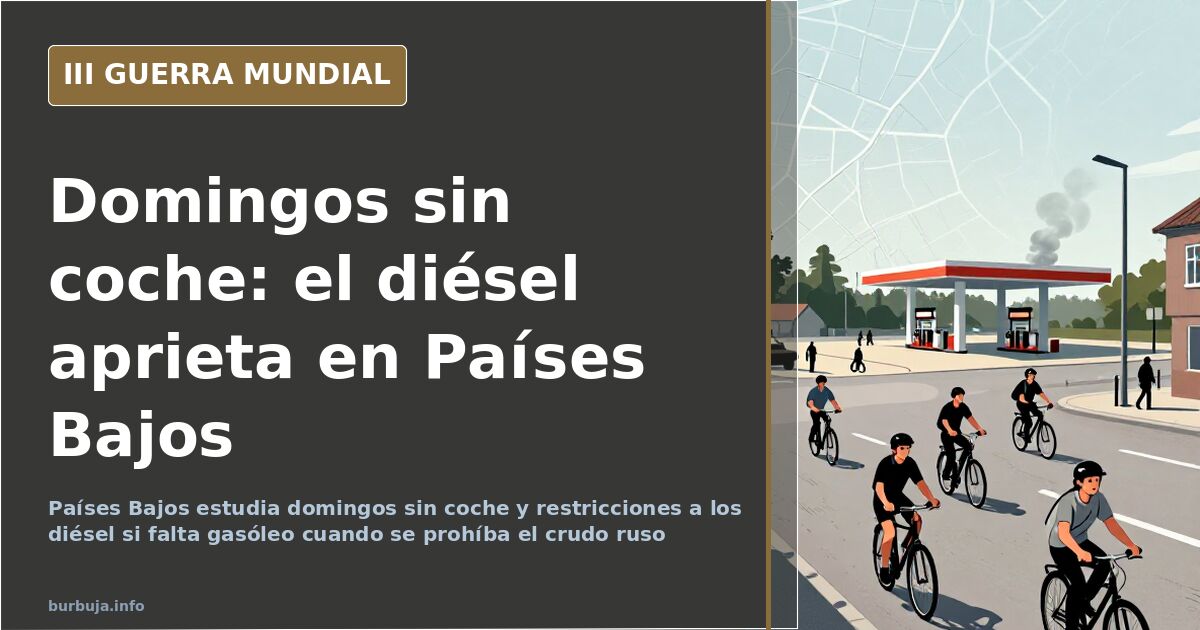
Netherlands Proposes Car-Free Sundays Amid Diesel Shortage
Can a European country ration mobility due to a lack of diesel? In the Netherlands, the question has moved from theory to reality: there is a threat of diesel shortage if the ban on Russian crude oil imports takes effect in December. Against this backdrop, an emergency measures catalog has been deployed, including car-free Sundays and circulation restrictions for non-exempt diesel cars. The key nuance: they have not run out of fuel; they are preparing for a scenario where supplies tighten.
The Dutch Warning: Scarcity Risk, Not Empty Gas Stations
The fine print is crucial. The headline circulating—"Car-Free Sunday and curfew for non-exempt diesel cars"—is conditioned by "if diesel scarcity increases too much." The article body repeats this: the threat arises if the mandate to not buy Russian crude is executed in December. In short: there is a political calendar, not an empty tank.
This distinction explains why the issue has become a clash of expectations. A Dutch winter without diesel is not like a winter without heating: it is like a country whose foreign trade relies on trucks, ships, and tractors. The risk is not about comfort, but logistics.
Why Dutch Diesel Is Not Spanish Diesel
In the Netherlands, the fiscal persecution of diesel engines is long-standing. The fleet of diesel passenger cars is minimal, and the country has already set 2025 to ban their sale, aiming to restrict circulation as well. Where there is no room for maneuver is in machinery: agricultural diesel is irreplaceable in the short term, and port machinery, although migrating to LPG in cranes and container handling equipment, still largely depends on diesel for operations.
Comparing registration shares helps size the problem. Between 2015 and 2019, diesel plummeted across Europe, and Spain was no exception:
With this picture, focusing on diesel passenger cars is looking where it hurts least. The real problem lies in professional diesel, which cannot be replaced by a mobility app.
The Rich North Suffers First and More: Is Anyone Stockpiling for Total War?
A paradox runs through the analysis. The wealthy neighbors in the north are feeling the energy crisis earlier and more sharply than Spain, a country with less fiscal margin and a weaker productive structure. An uncomfortable explanation is pointed out: that they are rationing earlier to reserve supply for a prolonged conflict scenario.
The other reading is historical. Spain already went through its industrial restructuring in the 80s and 90s, with the social devastation it brought; in some areas, the ground is already leveled, and the blow is felt less. Where it will be felt, and significantly, is in tourism. The country that lives on foreign visitors is most exposed to a European recession that leaves planes grounded and hotels half-empty. Comparisons with countries that have already experienced supply collapses run through conversations, almost always as a warning and rarely with the fine print of context.
Freight Train as Plan B: 6 to 8 Hours from Barcelona to Zaragoza
The rail alternative appears when diesel is lacking. The idea of putting trucks on trains—the railway highway—has defenders: it utilizes existing infrastructure, unloads roads, reduces wear, and allows consuming electricity instead of diesel. On paper, impeccable.
In practice, times kill the proposal for certain routes. The freight line between Barcelona and Zaragoza requires a minimum of six to eight hours, a figure incompatible with the current supply chain. The circulating mental experiment involves fares of 50 euros round alucinación, including five vehicle occupants and stops in provincial capitals. Today, the train still costs more than the car in too many trips, and there the ecological argument falls apart.
The 8.2% Inflation That Widens the Picture
The problem does not end with diesel. US inflation reached 8.2% in September, a figure that forces a review of the thesis that this is only a European energy crisis. The price hike sneaks into the shopping basket without asking permission: mozzarella costs between 20% and 30% more than a year ago. When cheese rises at that pace, the debate over diesel ceases to be a matter for truckers alone.
The final scene remains. The country that has made the bicycle its sarracena banner could end up organizing car-free Sundays by decree and not by conviction. Virtue, when the cold arrives, looks a lot like scarcity.
Can a European country ration mobility due to a lack of diesel? In the Netherlands, the question has moved from theory to reality: there is a threat of diesel shortage if the ban on Russian crude oil imports takes effect in December. Against this backdrop, an emergency measures catalog has been deployed, including car-free Sundays and circulation restrictions for non-exempt diesel cars. The key nuance: they have not run out of fuel; they are preparing for a scenario where supplies tighten.
The Dutch Warning: Scarcity Risk, Not Empty Gas Stations
The fine print is crucial. The headline circulating—"Car-Free Sunday and curfew for non-exempt diesel cars"—is conditioned by "if diesel scarcity increases too much." The article body repeats this: the threat arises if the mandate to not buy Russian crude is executed in December. In short: there is a political calendar, not an empty tank.
This distinction explains why the issue has become a clash of expectations. A Dutch winter without diesel is not like a winter without heating: it is like a country whose foreign trade relies on trucks, ships, and tractors. The risk is not about comfort, but logistics.
Why Dutch Diesel Is Not Spanish Diesel
In the Netherlands, the fiscal persecution of diesel engines is long-standing. The fleet of diesel passenger cars is minimal, and the country has already set 2025 to ban their sale, aiming to restrict circulation as well. Where there is no room for maneuver is in machinery: agricultural diesel is irreplaceable in the short term, and port machinery, although migrating to LPG in cranes and container handling equipment, still largely depends on diesel for operations.
Comparing registration shares helps size the problem. Between 2015 and 2019, diesel plummeted across Europe, and Spain was no exception:
- Ireland: from 71% to 46%
- Portugal: from 68% to 40%
- Italy: from 56% to 41%
- Germany: from 48% to 34%
- Spain: from 63% to 33%
With this picture, focusing on diesel passenger cars is looking where it hurts least. The real problem lies in professional diesel, which cannot be replaced by a mobility app.
The Rich North Suffers First and More: Is Anyone Stockpiling for Total War?
A paradox runs through the analysis. The wealthy neighbors in the north are feeling the energy crisis earlier and more sharply than Spain, a country with less fiscal margin and a weaker productive structure. An uncomfortable explanation is pointed out: that they are rationing earlier to reserve supply for a prolonged conflict scenario.
The other reading is historical. Spain already went through its industrial restructuring in the 80s and 90s, with the social devastation it brought; in some areas, the ground is already leveled, and the blow is felt less. Where it will be felt, and significantly, is in tourism. The country that lives on foreign visitors is most exposed to a European recession that leaves planes grounded and hotels half-empty. Comparisons with countries that have already experienced supply collapses run through conversations, almost always as a warning and rarely with the fine print of context.
Freight Train as Plan B: 6 to 8 Hours from Barcelona to Zaragoza
The rail alternative appears when diesel is lacking. The idea of putting trucks on trains—the railway highway—has defenders: it utilizes existing infrastructure, unloads roads, reduces wear, and allows consuming electricity instead of diesel. On paper, impeccable.
In practice, times kill the proposal for certain routes. The freight line between Barcelona and Zaragoza requires a minimum of six to eight hours, a figure incompatible with the current supply chain. The circulating mental experiment involves fares of 50 euros round alucinación, including five vehicle occupants and stops in provincial capitals. Today, the train still costs more than the car in too many trips, and there the ecological argument falls apart.
The 8.2% Inflation That Widens the Picture
The problem does not end with diesel. US inflation reached 8.2% in September, a figure that forces a review of the thesis that this is only a European energy crisis. The price hike sneaks into the shopping basket without asking permission: mozzarella costs between 20% and 30% more than a year ago. When cheese rises at that pace, the debate over diesel ceases to be a matter for truckers alone.
The final scene remains. The country that has made the bicycle its sarracena banner could end up organizing car-free Sundays by decree and not by conviction. Virtue, when the cold arrives, looks a lot like scarcity.
Also available in: Deutsch
Summary of a discussion on Burbuja.info - Foro de economía, actualidad y política., translated from Spanish and reviewed before publication. Read the full discussion (135 replies).
More summaries
-
Ukraine Strikes Six Russian Oil Refineries in a Week, Crippling Putin's War Machine
Ukraine has targeted six Russian oil refineries, some 1,600 km from the front lines, aiming to diminish Russia's war-making capacity.
-
Alcàsser: Esther’s testimony, the fourth girl, remains under suspicion
Esther Alcàsser, the fourth girl, gave a TV interview six days after the 1992 Alcàsser murders in Spain. Her account and timeline discrepancies fuel ongoing controversy.
-
Spanish media excluded unvaccinated relatives, now welcome Ukrainian refugees
In Dec 2021, Spanish outlets urged excluding unvaccinated family from Christmas; by Mar 2022, they praised hosting unvaccinated Ukrainian refugees.
-
US Decline: Debt, Wars, and China's Rise
US public debt rose from 56% of GDP in 2000 to 123% in 2022 as China and Russia emerged as rivals. An analysis of American decline.
-
Ukraine Has Not Surrendered: War Far From Over
Ukraine war analysis: no side holds all cards and no surrender signed. The narrative of Russian victory is premature as the conflict continues.
-
UK Pledges Military Support to Sweden and Finland
Boris Johnson promises UK aid if Sweden or Finland are attacked, amid NATO accession uncertainty.