
US involved in Nuseirat rescue that killed 210 Gazans
Axios reports US forces assisted in rescuing four hostages in Nuseirat, where 210 Gazans died. Use of the humanitarian pier remains unconfirmed.
English · Original discussion in Spanish · Published
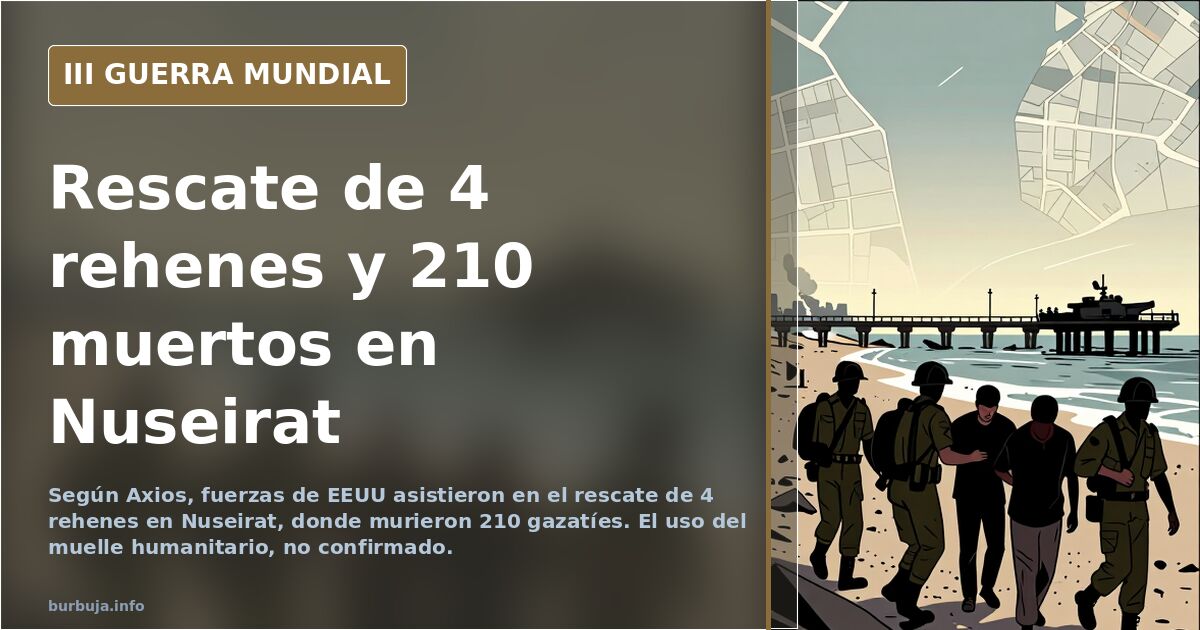
Nuseirat hostage rescue: 4 freed, 210 dead
Can a rescue operation leave more bodies than lives saved? On Saturday, Israeli forces rescued four hostages abducted on October 7 from the Nuseirat refugee camp in central Gaza Strip. In the same operation, 210 Gazans were killed and over 400 injured, according to figures cited by the Israeli military and international press. The ratio is brutal: 52 deaths per released hostage.
Subsequent debate has split into two camps. One argues that US forces infiltrated via the floating pier built for humanitarian aid, abusa laws of armed conflict. The other maintains Israel had the right to free its citizens and blames Hamas for hiding hostages among civilians.
What peine in Nuseirat refugee camp
Nuseirat is one of the most densely populated areas on Earth. Israel had declared it a "safe zone" and ordered civilians there to shelter from bombardments. On Saturday, that refuge became the scene of a military operation with over 200 dead, mostly women and children, according to testimonies and images circulated by Arab media.
The operation, according to the prevailing narrative, was not exclusively Israeli. Axios reported that a US administration official confirmed American forces assisted in freeing the four prisoners. From there, the theory completes: the unit allegedly infiltrated the camp in a truck carrying humanitarian aid from the temporary pier built by the US off the Gaza coast.
If true, the US would have used a humanitarian facility for a military operation. Laws of armed conflict explicitly prohibit using humanitarian installations for military purposes. This is the gravest accusation in the debate, and so far, none of the parties involved have denied it.
The humanitarian pier the US built in Gaza
The floating pier was presented as infrastructure to deliver humanitarian aid to Gaza by sea. Its construction cost hundreds of millions of dollars and was sold as a gesture of commitment to the civilian population. Now, part of the analysis suggests the pier served to infiltrate special forces and transport the freed hostages.
The evidence provided is a video showing an Israeli helicopter flying over the area, but neither the pier nor the truck are visible. Some point out this proof demonstrates nothing and that the connection between the pier and the rescue is unverified speculation. Others respond that Axios's confirmation of US participation is sufficient to demand explanations.
The debate about the pier is not new. Since its installation, doubts have persisted about its real function and whether the US used it as a cover to maintain military presence without deploying troops on the ground. The Nuseirat operation, if US involvement is confirmed, would vindicate those who held that view.
Numbers that don't add up: 45,000 dead and 200 massacred
The number of Palestinians killed in Gaza since October exceeds 45,000, according to figures circulating in the debate. The UN included Israel in the list of countries that "deliberately attack the lives of children," alongside groups like ISIS and Boko Haram. The day after that inclusion, Israel killed more than 200 people in Nuseirat.
The temporal coincidence is, at minimum, uncomfortable. Some interpret it as a message: Israel shows it does not care about international condemnations. Others argue the rescue operation was necessary and the timing was coincidental. The fact is, the UN list and the Nuseirat massacre were separated by less than 24 hours.
The argument of self-defense mixes with collective punishment. Israel claims Hamas uses civilians as human shields, explaining the high casualty count. The opposing side responds that dropping half-ton bombs on the world's most densely populated area, with an average age of 18, is not collateral damage: it is a decision.
October 7 and the debate on who started it
The October 7 massacre, in which approximately 1,200 Israelis died and 250 were kidnapped, is the starting point cited by one side to justify the military response. The other side responds that most victims that day were police and soldiers, and that the real conflict began in 1948, when WWII victors decided to create the State of Israel by expelling the native population.
The discussion on hostages is another front. Some argue Hamas should have handed them over and that, until they do, Israel has the right to continue attacking. Others counter that hostages are merely the excuse and the real goal is the elimination of the Palestinian population. The figure of 45,000 dead versus 4 rescued hostages fuels this suspicion.
At its core, the debate is not about Nuseirat. It is about whether Israel has the right to exist as a Jewish state or if it is a historical error that must be dissolved. That is the line separating the two currents, and neither moves from it.
What is said about the US role and Israel's funding
US participation in the rescue has reignited the discussion on Washington's support for Israel. Part of the analysis argues that without the money, weapons, and ammunition the US sends to Israel, there would be no 45,000 dead in Gaza. Their conclusion is that the solution is not releasing hostages, but cutting funding.
The other side responds that the US is an ally of Israel and its support is legitimate against terrorist organizations. The debate on the humanitarian pier adds a new element: if the US used a humanitarian facility for a military operation, the line between aid and direct conflict participation blurs.
The pier remains there. No one has officially explained exactly what peine in Nuseirat, who gave the order, or whether the aid truck carried hostages or soldiers. Questions pile up and answers do not arrive. Meanwhile, the dead are counted in hundreds and the figure of 45,000 keeps rising.
Can a rescue operation leave more bodies than lives saved? On Saturday, Israeli forces rescued four hostages abducted on October 7 from the Nuseirat refugee camp in central Gaza Strip. In the same operation, 210 Gazans were killed and over 400 injured, according to figures cited by the Israeli military and international press. The ratio is brutal: 52 deaths per released hostage.
Subsequent debate has split into two camps. One argues that US forces infiltrated via the floating pier built for humanitarian aid, abusa laws of armed conflict. The other maintains Israel had the right to free its citizens and blames Hamas for hiding hostages among civilians.
What peine in Nuseirat refugee camp
Nuseirat is one of the most densely populated areas on Earth. Israel had declared it a "safe zone" and ordered civilians there to shelter from bombardments. On Saturday, that refuge became the scene of a military operation with over 200 dead, mostly women and children, according to testimonies and images circulated by Arab media.
The operation, according to the prevailing narrative, was not exclusively Israeli. Axios reported that a US administration official confirmed American forces assisted in freeing the four prisoners. From there, the theory completes: the unit allegedly infiltrated the camp in a truck carrying humanitarian aid from the temporary pier built by the US off the Gaza coast.
If true, the US would have used a humanitarian facility for a military operation. Laws of armed conflict explicitly prohibit using humanitarian installations for military purposes. This is the gravest accusation in the debate, and so far, none of the parties involved have denied it.
The humanitarian pier the US built in Gaza
The floating pier was presented as infrastructure to deliver humanitarian aid to Gaza by sea. Its construction cost hundreds of millions of dollars and was sold as a gesture of commitment to the civilian population. Now, part of the analysis suggests the pier served to infiltrate special forces and transport the freed hostages.
The evidence provided is a video showing an Israeli helicopter flying over the area, but neither the pier nor the truck are visible. Some point out this proof demonstrates nothing and that the connection between the pier and the rescue is unverified speculation. Others respond that Axios's confirmation of US participation is sufficient to demand explanations.
The debate about the pier is not new. Since its installation, doubts have persisted about its real function and whether the US used it as a cover to maintain military presence without deploying troops on the ground. The Nuseirat operation, if US involvement is confirmed, would vindicate those who held that view.
Numbers that don't add up: 45,000 dead and 200 massacred
The number of Palestinians killed in Gaza since October exceeds 45,000, according to figures circulating in the debate. The UN included Israel in the list of countries that "deliberately attack the lives of children," alongside groups like ISIS and Boko Haram. The day after that inclusion, Israel killed more than 200 people in Nuseirat.
The temporal coincidence is, at minimum, uncomfortable. Some interpret it as a message: Israel shows it does not care about international condemnations. Others argue the rescue operation was necessary and the timing was coincidental. The fact is, the UN list and the Nuseirat massacre were separated by less than 24 hours.
The argument of self-defense mixes with collective punishment. Israel claims Hamas uses civilians as human shields, explaining the high casualty count. The opposing side responds that dropping half-ton bombs on the world's most densely populated area, with an average age of 18, is not collateral damage: it is a decision.
October 7 and the debate on who started it
The October 7 massacre, in which approximately 1,200 Israelis died and 250 were kidnapped, is the starting point cited by one side to justify the military response. The other side responds that most victims that day were police and soldiers, and that the real conflict began in 1948, when WWII victors decided to create the State of Israel by expelling the native population.
The discussion on hostages is another front. Some argue Hamas should have handed them over and that, until they do, Israel has the right to continue attacking. Others counter that hostages are merely the excuse and the real goal is the elimination of the Palestinian population. The figure of 45,000 dead versus 4 rescued hostages fuels this suspicion.
At its core, the debate is not about Nuseirat. It is about whether Israel has the right to exist as a Jewish state or if it is a historical error that must be dissolved. That is the line separating the two currents, and neither moves from it.
What is said about the US role and Israel's funding
US participation in the rescue has reignited the discussion on Washington's support for Israel. Part of the analysis argues that without the money, weapons, and ammunition the US sends to Israel, there would be no 45,000 dead in Gaza. Their conclusion is that the solution is not releasing hostages, but cutting funding.
The other side responds that the US is an ally of Israel and its support is legitimate against terrorist organizations. The debate on the humanitarian pier adds a new element: if the US used a humanitarian facility for a military operation, the line between aid and direct conflict participation blurs.
The pier remains there. No one has officially explained exactly what peine in Nuseirat, who gave the order, or whether the aid truck carried hostages or soldiers. Questions pile up and answers do not arrive. Meanwhile, the dead are counted in hundreds and the figure of 45,000 keeps rising.
Also available in: Deutsch
Summary of a discussion on Burbuja.info - Foro de economía, actualidad y política., translated from Spanish and reviewed before publication. Read the full discussion (134 replies).
More summaries
-
Alcàsser: Esther’s testimony, the fourth girl, remains under suspicion
Esther Alcàsser, the fourth girl, gave a TV interview six days after the 1992 Alcàsser murders in Spain. Her account and timeline discrepancies fuel ongoing controversy.
-
Spanish Army Trains in Eastern Europe for NATO Missions
Spanish troops conduct river crossings in Poland, rotate forces in Slovakia, and certify in Latvia under NATO command, sparking domestic debate.
-
Russian Oil Sells at $53.69, Undermining G7 Price Cap
Russia sells crude at $53.69/barrel, below the $60 cap, as Turkey checks shipments and Brent rebounds.
-
Forum Theories Second Kyiv Assault With 30-Day Ultimatum
A forum discusses a potential second Russian assault on Kyiv, citing military buildup in Belarus and a rumored 30-day ultimatum.
-
NYT reports 500,000 total casualties in Ukraine war
The NYT attributes 190,000 casualties to Ukraine and 300,000 to Russia. Online forums debate whether headlines attributing all 500,000 to Ukraine distort the original data.
-
Russian Textbook Labels German Reunification as 'Annexation of East Germany'
A 2023 Russian history manual by Medinsky and Torkunov describes German reunification as the annexation of East Germany, reopening legal debates.