
Poland and US Clash Over Supplying MiG-29s to Ukraine
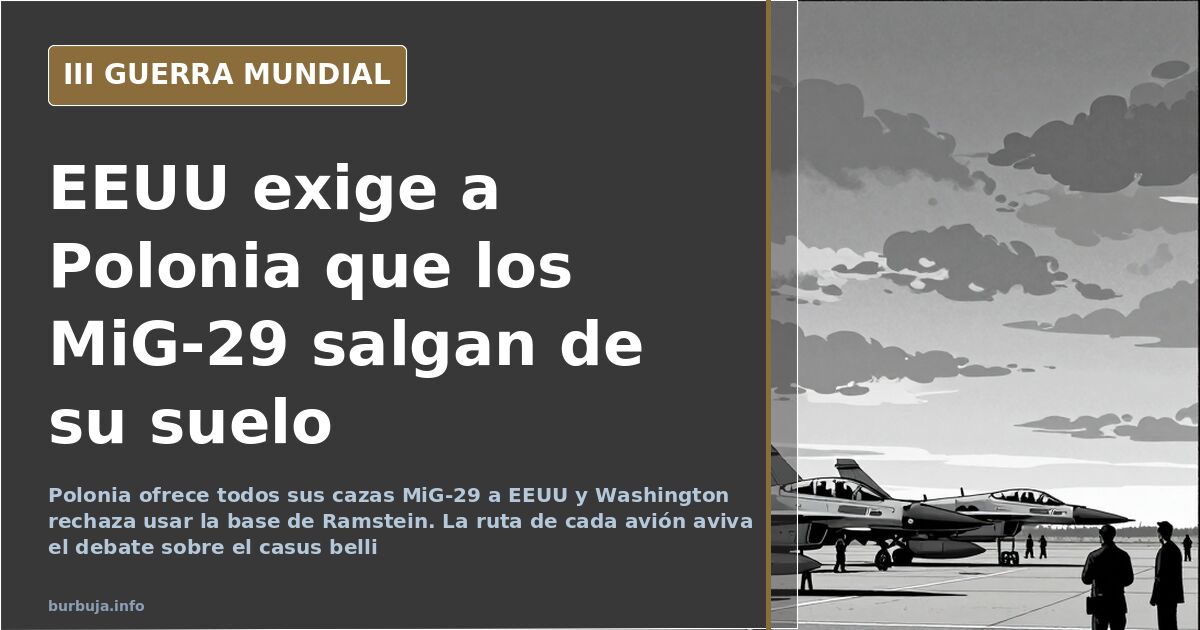
Poland offers its MiG-29s to the US, but Washington rejects using Ramstein Air Base. The origin of each flight sparks debate over a casus belli.
English · Original discussion in Spanish · Published
Poland Offers MiG-29s to US, Casus Belli Enters the Fray
Poland has put all its MiG-29 fighter jets on the table, and the US has responded with a disarming maneuver: the transfer is accepted, but not from Germany. Washington refuses to have the aircraft land at Ramstein Air Base and insists they take off from Polish soil en route to Ukraine. This detail—the departure runway for the planes—transforms a military sale into something far more uncomfortable. How far can a nuclear power be pushed before the expression casus belli stops sounding like rhetoric?
What is a Casus Belli and Why It Isn't One Here
The short answer, and the one supported by several participants in the discussion, is that sending weaponry to one side in a conflict has never been a cause for direct war between powers. Precedents are sought in Soviet, German, and Italian planes during the Spanish Civil War; in Russian fighters painted with North Vietnamese insignia; and in US aid to the Soviet Union during World War II. In none of those episodes, it is argued, did the supplying power go to war over it.
The nuance appears when looking at the flight path. If the MiG-29s take off from Poland unarmed, in transit, the situation remains in a gray area. If they depart armed and shoot down a Russian plane in self-defense, the casualty would have been caused by an aircraft that departed from a Polish base. At that point, splitting hairs stops being a game.
The Geneva Convention and the Belarus Case
There is a legal text that is cited insistently: combatants from belligerent countries entering neutral territory must be interned for the duration of the conflict, and whoever allows them to leave loses that neutrality. The uncomfortable question arises on its own: if transit from Poland is a problem, what about Belarus, through which Russian tanks enter and from where missiles are launched against Ukrainian territory?
Here, much of the analysis coincides on one point: the word neutrality has become outdated. Material is being sent publicly to one of the sides by the EU and the US. What exists, at most, is non-belligerence.
The Real Clash: Poland vs. United States
Behind the distribution of planes lies a power struggle between Warsaw and Washington heading in opposite directions. One version holds that Poland was hesitant to cede the aircraft and that it was the US who pushed for their delivery, with the added factor that the entire operation is managed at Ramstein, US territory within the borders of a country grappling with its own internal debate over arms shipments. Another reading sees the Poles as eager for the spotlight, unable to stand still.
Interpretations also circulate attributing a deliberate US interest in escalating tensions in Europe. These are speculations offered without proof and should be treated as such. What is verifiable is more prosaic: two allies who cannot agree on the departure runway for a fighter jet.
From Wheat to Sunflower Oil
There is an economic trail lost amidst the engine noise. Ukrainian wheat, it is argued, ends up in China or Pakistan through contracts already signed with Russia, while in Spain the debate focuses on gasoline, gas, and sunflower oil. The rise in commodity prices has its own culprit in public discourse, and it is not Moscow. A joke even circulates that the operation is actually a business windfall to bring cheap sunflower oil faster than an urgent shipment.
The pieces are on the table: fighter jets whose departure point is unknown, a visibly strained alliance, and a war that no one wants to sign up for. If the US insists that the MiG-29s depart from Poland and not Germany, someone should explain which runway they prefer and why. The question remains open: how many planes does it take for a sale to stop being just a sale?
Poland has put all its MiG-29 fighter jets on the table, and the US has responded with a disarming maneuver: the transfer is accepted, but not from Germany. Washington refuses to have the aircraft land at Ramstein Air Base and insists they take off from Polish soil en route to Ukraine. This detail—the departure runway for the planes—transforms a military sale into something far more uncomfortable. How far can a nuclear power be pushed before the expression casus belli stops sounding like rhetoric?
What is a Casus Belli and Why It Isn't One Here
The short answer, and the one supported by several participants in the discussion, is that sending weaponry to one side in a conflict has never been a cause for direct war between powers. Precedents are sought in Soviet, German, and Italian planes during the Spanish Civil War; in Russian fighters painted with North Vietnamese insignia; and in US aid to the Soviet Union during World War II. In none of those episodes, it is argued, did the supplying power go to war over it.
The nuance appears when looking at the flight path. If the MiG-29s take off from Poland unarmed, in transit, the situation remains in a gray area. If they depart armed and shoot down a Russian plane in self-defense, the casualty would have been caused by an aircraft that departed from a Polish base. At that point, splitting hairs stops being a game.
The Geneva Convention and the Belarus Case
There is a legal text that is cited insistently: combatants from belligerent countries entering neutral territory must be interned for the duration of the conflict, and whoever allows them to leave loses that neutrality. The uncomfortable question arises on its own: if transit from Poland is a problem, what about Belarus, through which Russian tanks enter and from where missiles are launched against Ukrainian territory?
Here, much of the analysis coincides on one point: the word neutrality has become outdated. Material is being sent publicly to one of the sides by the EU and the US. What exists, at most, is non-belligerence.
The Real Clash: Poland vs. United States
Behind the distribution of planes lies a power struggle between Warsaw and Washington heading in opposite directions. One version holds that Poland was hesitant to cede the aircraft and that it was the US who pushed for their delivery, with the added factor that the entire operation is managed at Ramstein, US territory within the borders of a country grappling with its own internal debate over arms shipments. Another reading sees the Poles as eager for the spotlight, unable to stand still.
Interpretations also circulate attributing a deliberate US interest in escalating tensions in Europe. These are speculations offered without proof and should be treated as such. What is verifiable is more prosaic: two allies who cannot agree on the departure runway for a fighter jet.
From Wheat to Sunflower Oil
There is an economic trail lost amidst the engine noise. Ukrainian wheat, it is argued, ends up in China or Pakistan through contracts already signed with Russia, while in Spain the debate focuses on gasoline, gas, and sunflower oil. The rise in commodity prices has its own culprit in public discourse, and it is not Moscow. A joke even circulates that the operation is actually a business windfall to bring cheap sunflower oil faster than an urgent shipment.
The pieces are on the table: fighter jets whose departure point is unknown, a visibly strained alliance, and a war that no one wants to sign up for. If the US insists that the MiG-29s depart from Poland and not Germany, someone should explain which runway they prefer and why. The question remains open: how many planes does it take for a sale to stop being just a sale?
Summary of a discussion on Burbuja.info - Foro de economía, actualidad y política., translated from Spanish and reviewed before publication. Read the full discussion (155 replies).
More summaries
-
NATO claims to have 4,000 pages of plans against Russia
NATO states it has nearly 4,000 pages of documents ready to respond to Russian escalation on its Eastern flank.
-
Unverified Tweet Attributes False Flag Attacks in Mallorca to CIA
An unverified tweet claims the CIA is behind a false flag drone attack in Mallorca, Nice, and Italy, but provides no evidence.
-
Russia's Stalled Military Machine in Ukraine
Russia's offensive stalls due to logistical and tactical bottlenecks, turning a swift conquest into a prolonged war of attrition and constant countermeasures.
-
Ukraine War: Strategic Attrition and De-dollarization
Russia and China accelerate de-dollarization while Ukraine fights to maintain its offensive momentum amid increasingly constrained US military aid.
-
Ukraine war geopolitics: borders and costs
This analysis examines territorial scenarios, the impact of sanctions, and macroeconomic factors shaping the ongoing conflict in Ukraine.
-
Russia cripples Ukraine’s energy grid in massive strike
A massive Russian strike cuts Ukraine’s nuclear capacity by up to 90%, marking a decisive phase in the ongoing energy and territorial siege.