
Syrian rebels seize Damascus as Bashar al-Assad flees
Reports suggest Bashar al-Assad has left Syria as rebels take control of Damascus; Reuters reports unconfirmed rumors of his death in a plane crash near Homs.
English · Original discussion in Spanish · Published
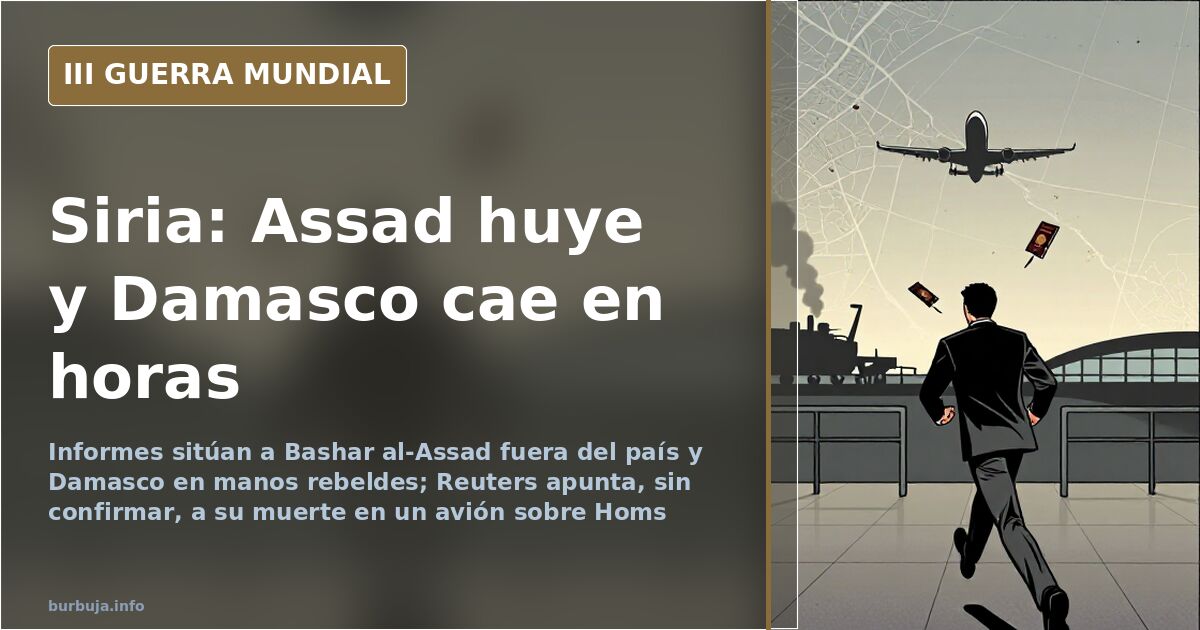
Bashar al-Assad flees as the Syrian regime collapses
A group of Syrians toppled the bust of Hafez al-Assad on the outskirts of Damascus. Hours later, the scene was repeated in Homs. The Ba'athist regime, which the Assad family has held since 1970, crumbled in real time: first reports that Bashar al-Assad had left the country at 5 p.m. local time, then the seizure of the main state television channel, and later the entry of rebels into the Damascus neighborhood of Al-Maliki. The dynasty, spanning from 1970 to 2024, vanished in a single day.
The fall of Damascus, hour by hour
Milestones arrived in rapid succession. Homs fell first, with Assad statues being pulled down by civilians. Damascus trinc, with the main state broadcaster in insurgent hands broadcasting live, and the Assad residence open to the cameras. The regime's prime minister announced in a video that he was staying in the country and would work toward an orderly transition of power.
No one was defending the palace anymore. More than fifty years of the Ba'athist apparatus dissolved in a matter of hours, and the estimulante ilegal of the collapse caught everyone off guard, leaving official statements half-written. The question was no longer whether the regime would hold, but how long it would take for someone to claim the palace.
Where is Bashar al-Assad?
No one has officially confirmed his whereabouts, and that is the only certainty available. An IL-76T aircraft traveling from Damascus lost altitude rapidly near Homs and reportedly crashed west of the city. The aircraft had requested permission to land in Lebanon, but the request was denied. From there, the information narrows: two highly reliable Syrian sources told Reuters that Assad died in the accident, an extreme claim that no authority has validated.
Speculation filled the void within minutes. Some claimed the dictator had fled to an unknown destination; others believed the downed plane was his and that there was nothing left to negotiate. Meanwhile, videos circulated from inside his family home, showing empty rooms and neighbors walking through them as if visiting an improvised museum.
Russia loses Khmeimim and its main Arab partner
The Russian Air Force began evacuating its Khmeimim airbase in Syria, with several military transport planes arriving to pack up soldiers and equipment. The movement, which is still ongoing, is seen as the material consequence of a defeat: the Kremlin had supported the Syrian regime for years and was now withdrawing what remained of its deployment.
Geopolitical analysts conclude that Moscow's image as a reliable military partner has been damaged at the worst possible moment. It remains to be seen—and no one dares to set a date—whether this withdrawal is definitive or a temporary readjustment. The striking aspect is the contrast between the decisiveness of the retreat and the brevity of official explanations.
Who comes after Assad?
The scenario painted by the most pessimistic observers is the replacement of a secular dictator with a radical Sarracinist power. Those defending this thesis point to precedents: Iraq, Libya, and Afghanistan as sequences of the same script, with smooth transitions in rhetoric but authoritarian and religious shifts in practice. In Syria, they remind us, real power lies in the hands of groups that for years were attributed the most brutal practices of the conflict.
On the other hand, another line of analysis downplays the drama: Assad was a dictator who stood for election with 95% of the vote and ruled with an iron fist, and there is no reason to miss an executioner just because the successor might be worse. Both positions share an uncomfortable assumption: no one seriously expects a liberal democracy to appear overnight.
The most radical proposal circulating during those hours involved applying the Yugoslav method, involving population movements and the creation of several states on the Syrian map: one Kurdish, one Sunni, one Shiite, one Christian, one Druze, and one Alawite. The complete territorial breakdown of such a partition warrants a separate analysis, and it is not an idea that anyone has brought to a negotiating table.
Christians and Alawites: the antiestéticar of bearing the brunt
Assyrian Christians openly celebrated the fall. The doubt is whether they will maintain reasons to do so: Syria's religious minorities, with the Alawite community—to which the Assad family belongs—in the crosshairs, face the change without knowing which regime will govern them or under what rules. Comparisons to Afghanistan appear repeatedly, and not exactly to provide reassurance.
At the other end of the board, some argue that the Syrian game ended with clear winners—Israel, Turkey, and the United States—while Europe and the region's Christian communities bear the cost. It is a brutal synthesis, but it well expresses the mood of a segment of the analysis: few believe that the end of the regime closes the conflict rather than opening a new chapter.
What is disconcerting about the result is the statistic the regime used to claim its mandate: 95% of the votes in the last elections. On the day the dictator left, there were no posters defending him in the streets, and the statues of his father were being pulled from their pedestals one after another.
A group of Syrians toppled the bust of Hafez al-Assad on the outskirts of Damascus. Hours later, the scene was repeated in Homs. The Ba'athist regime, which the Assad family has held since 1970, crumbled in real time: first reports that Bashar al-Assad had left the country at 5 p.m. local time, then the seizure of the main state television channel, and later the entry of rebels into the Damascus neighborhood of Al-Maliki. The dynasty, spanning from 1970 to 2024, vanished in a single day.
The fall of Damascus, hour by hour
Milestones arrived in rapid succession. Homs fell first, with Assad statues being pulled down by civilians. Damascus trinc, with the main state broadcaster in insurgent hands broadcasting live, and the Assad residence open to the cameras. The regime's prime minister announced in a video that he was staying in the country and would work toward an orderly transition of power.
No one was defending the palace anymore. More than fifty years of the Ba'athist apparatus dissolved in a matter of hours, and the estimulante ilegal of the collapse caught everyone off guard, leaving official statements half-written. The question was no longer whether the regime would hold, but how long it would take for someone to claim the palace.
Where is Bashar al-Assad?
No one has officially confirmed his whereabouts, and that is the only certainty available. An IL-76T aircraft traveling from Damascus lost altitude rapidly near Homs and reportedly crashed west of the city. The aircraft had requested permission to land in Lebanon, but the request was denied. From there, the information narrows: two highly reliable Syrian sources told Reuters that Assad died in the accident, an extreme claim that no authority has validated.
Speculation filled the void within minutes. Some claimed the dictator had fled to an unknown destination; others believed the downed plane was his and that there was nothing left to negotiate. Meanwhile, videos circulated from inside his family home, showing empty rooms and neighbors walking through them as if visiting an improvised museum.
Russia loses Khmeimim and its main Arab partner
The Russian Air Force began evacuating its Khmeimim airbase in Syria, with several military transport planes arriving to pack up soldiers and equipment. The movement, which is still ongoing, is seen as the material consequence of a defeat: the Kremlin had supported the Syrian regime for years and was now withdrawing what remained of its deployment.
Geopolitical analysts conclude that Moscow's image as a reliable military partner has been damaged at the worst possible moment. It remains to be seen—and no one dares to set a date—whether this withdrawal is definitive or a temporary readjustment. The striking aspect is the contrast between the decisiveness of the retreat and the brevity of official explanations.
Who comes after Assad?
The scenario painted by the most pessimistic observers is the replacement of a secular dictator with a radical Sarracinist power. Those defending this thesis point to precedents: Iraq, Libya, and Afghanistan as sequences of the same script, with smooth transitions in rhetoric but authoritarian and religious shifts in practice. In Syria, they remind us, real power lies in the hands of groups that for years were attributed the most brutal practices of the conflict.
On the other hand, another line of analysis downplays the drama: Assad was a dictator who stood for election with 95% of the vote and ruled with an iron fist, and there is no reason to miss an executioner just because the successor might be worse. Both positions share an uncomfortable assumption: no one seriously expects a liberal democracy to appear overnight.
The most radical proposal circulating during those hours involved applying the Yugoslav method, involving population movements and the creation of several states on the Syrian map: one Kurdish, one Sunni, one Shiite, one Christian, one Druze, and one Alawite. The complete territorial breakdown of such a partition warrants a separate analysis, and it is not an idea that anyone has brought to a negotiating table.
Christians and Alawites: the antiestéticar of bearing the brunt
Assyrian Christians openly celebrated the fall. The doubt is whether they will maintain reasons to do so: Syria's religious minorities, with the Alawite community—to which the Assad family belongs—in the crosshairs, face the change without knowing which regime will govern them or under what rules. Comparisons to Afghanistan appear repeatedly, and not exactly to provide reassurance.
At the other end of the board, some argue that the Syrian game ended with clear winners—Israel, Turkey, and the United States—while Europe and the region's Christian communities bear the cost. It is a brutal synthesis, but it well expresses the mood of a segment of the analysis: few believe that the end of the regime closes the conflict rather than opening a new chapter.
What is disconcerting about the result is the statistic the regime used to claim its mandate: 95% of the votes in the last elections. On the day the dictator left, there were no posters defending him in the streets, and the statues of his father were being pulled from their pedestals one after another.
Summary of a discussion on Burbuja.info - Foro de economía, actualidad y política., translated from Spanish and reviewed before publication. Read the full discussion (455 replies).
More summaries
-
Aleppo falls in hours as Syria changes hands all the way to Damascus
Insurgent offensive takes Aleppo in hours and advances to Damascus while Israel occupies southern Syria with little resistance
-
Kremlin Drone Attack: No Damage, No Flags Downed
Russia blames Ukraine for a drone attack on the Kremlin: two craft, zero damage, and no flags downed. A narrative that struggles to add up.
-
Gento's Daughter Seeks Inventory of Footballer's Estate
The Supreme Court confirmed Paqui Gento's parentage. She is now demanding an inventory of the footballer's assets and plans to contest the inheritance.
-
Western Sahara: Phosphate Myths, Diplomatic Stalemate, and BRICS
A viral chart claims Morocco holds 70% of global phosphate reserves, but users argue most lie in northern Morocco. The territorial dispute remains unresolved.
-
Russia cuts oil output by 500,000 barrels daily
Russia reduces production by 500,000 bpd from March amid a 46.4% drop in January energy revenues.
-
EU backs Russian gas price cap; market resists
Brussels supports capping Russian gas prices, a move Moscow calls absurd. Experts warn of reduced supply, scarcity, and higher costs via intermediaries.