
EU backs Russian gas price cap; market resists
Brussels supports capping Russian gas prices, a move Moscow calls absurd. Experts warn of reduced supply, scarcity, and higher costs via intermediaries.
English · Original discussion in Spanish · Published
EU backs Russian gas price cap; market resists
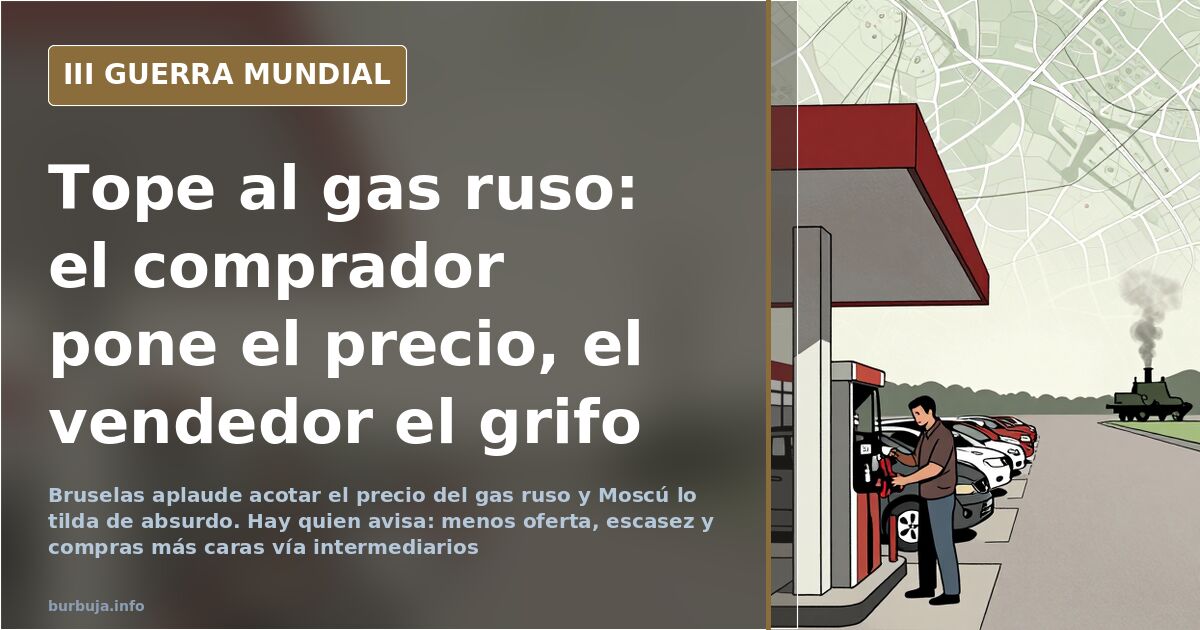
The buyer enters the store, looks at the tag, and announces how much they will pay. They do not negotiate: they inform. This is essentially the new cap on Russian gas prices backed by Brussels and which the EU is preparing to implement. The Commission justifies it with one phrase: "It is time to limit the price of gas reaching Europe." The Kremlin has already responded that the measure is "absurd" and will only serve to destabilize the commodities market. From there, it ceases to be diplomacy and becomes a problem of supply and demand.
What Brussels proposes and what Moscow answers
The proposal consists of setting a ceiling on what Europe pays for gas arriving from Russia. The declared objective is to limit the price Europe pays for that gas. That is the official narrative.
There is an alternative reading circulating strongly: if the maximum price applies to all gas, regardless of origin, the mechanism would end up functioning as a limit on what other suppliers charge, including the United States. A cap that does not distinguish flags. And a repeated warning: if the ceiling is set below the market price, the seller's response will not be to sell cheaper, but to sell less.
Who holds the tap: why price cannot be decreed
The most cited explanation fits in two lines: "Supply and demand. Do you set a maximum price below the optimal level? No problem, I reduce supply. Scarcity guaranteed." It is not a rhetorical formula. It is the manual. Whoever has the product decides at what price to release it, and if the price does not suit them, they hold it back.
The second argument is that of the buyer who loses credibility. If the market pays 10 and the main European buyer boasts about having cut purchases from the supplier, what leverage do they have to demand sales at 7? The repeated answer: none. The most common analogy is the baker: no one has yet found that mysterious bakery selling bread cheaper where everyone rushes. Another version, the supermarket: paying what one considers fair for a kilo of tomatoes and seeing if the cashier accepts. There are even those who bring it to the domestic sphere: if this works, it would suffice to communicate to the electricity company, the gas station, or the utility bill the amount one is willing to pay. No one has tried it, they point out.
Gas does not expire and sellers have plenty of customers
A point that repeats and usually stays out of headlines: gas and oil do not spoil underground. They are not apples or frozen meat. The producer can sit on their reserves for years waiting for the market to move. The buyer cannot.
As one participant notes, while the price is being set, flows reorganize: Turkey, Hungary, India, and China continue buying and reselling with commission. The result would be the same gas, more expensive, with an intermediary taking their share. The most circulated summary: you set the cap, they cut off your supply for not paying, and you end up buying it elsewhere more expensive than what you refused to pay. Another note: Russia is also a net exporter of food, so the scarcity card plays both ways.
The opposing stance is also on the table. Russia is not a diversified economy: its energy card is Nigeria-like, hence the question of where people live better. It is the argument that time works against those dependent on a single product.
The oil precedent and those who do not apply the cap
Some recall that this was already attempted with oil and did not work. No government has managed to fix the price of a good traded globally, let alone without controlling supply, according to the repeated argument. The operational question is simple: do Indian and Chinese buyers apply the same cap? If they do not, the measure serves for the photo and the press release, not to move the price.
The other doubt is accumulated credibility. Europe once announced it would not pay for gas in rubles. The outcome was summarized in a circulating phrase: "From the creators of 'we won't pay in rubles' comes the new episode 'we will pay, but whatever we feel like'."
Remains the detail that disorients. The market does not vote, applaud, or read press releases: it only crosses buy and sell orders. With the price below optimal, supply withdraws and the product goes to another showcase. The doubt is not whether the cap can be announced. The doubt is who sells when the price does not convince. So far, no one has found the cheap bakery.
The buyer enters the store, looks at the tag, and announces how much they will pay. They do not negotiate: they inform. This is essentially the new cap on Russian gas prices backed by Brussels and which the EU is preparing to implement. The Commission justifies it with one phrase: "It is time to limit the price of gas reaching Europe." The Kremlin has already responded that the measure is "absurd" and will only serve to destabilize the commodities market. From there, it ceases to be diplomacy and becomes a problem of supply and demand.
What Brussels proposes and what Moscow answers
The proposal consists of setting a ceiling on what Europe pays for gas arriving from Russia. The declared objective is to limit the price Europe pays for that gas. That is the official narrative.
There is an alternative reading circulating strongly: if the maximum price applies to all gas, regardless of origin, the mechanism would end up functioning as a limit on what other suppliers charge, including the United States. A cap that does not distinguish flags. And a repeated warning: if the ceiling is set below the market price, the seller's response will not be to sell cheaper, but to sell less.
Who holds the tap: why price cannot be decreed
The most cited explanation fits in two lines: "Supply and demand. Do you set a maximum price below the optimal level? No problem, I reduce supply. Scarcity guaranteed." It is not a rhetorical formula. It is the manual. Whoever has the product decides at what price to release it, and if the price does not suit them, they hold it back.
The second argument is that of the buyer who loses credibility. If the market pays 10 and the main European buyer boasts about having cut purchases from the supplier, what leverage do they have to demand sales at 7? The repeated answer: none. The most common analogy is the baker: no one has yet found that mysterious bakery selling bread cheaper where everyone rushes. Another version, the supermarket: paying what one considers fair for a kilo of tomatoes and seeing if the cashier accepts. There are even those who bring it to the domestic sphere: if this works, it would suffice to communicate to the electricity company, the gas station, or the utility bill the amount one is willing to pay. No one has tried it, they point out.
Gas does not expire and sellers have plenty of customers
A point that repeats and usually stays out of headlines: gas and oil do not spoil underground. They are not apples or frozen meat. The producer can sit on their reserves for years waiting for the market to move. The buyer cannot.
As one participant notes, while the price is being set, flows reorganize: Turkey, Hungary, India, and China continue buying and reselling with commission. The result would be the same gas, more expensive, with an intermediary taking their share. The most circulated summary: you set the cap, they cut off your supply for not paying, and you end up buying it elsewhere more expensive than what you refused to pay. Another note: Russia is also a net exporter of food, so the scarcity card plays both ways.
The opposing stance is also on the table. Russia is not a diversified economy: its energy card is Nigeria-like, hence the question of where people live better. It is the argument that time works against those dependent on a single product.
The oil precedent and those who do not apply the cap
Some recall that this was already attempted with oil and did not work. No government has managed to fix the price of a good traded globally, let alone without controlling supply, according to the repeated argument. The operational question is simple: do Indian and Chinese buyers apply the same cap? If they do not, the measure serves for the photo and the press release, not to move the price.
The other doubt is accumulated credibility. Europe once announced it would not pay for gas in rubles. The outcome was summarized in a circulating phrase: "From the creators of 'we won't pay in rubles' comes the new episode 'we will pay, but whatever we feel like'."
Remains the detail that disorients. The market does not vote, applaud, or read press releases: it only crosses buy and sell orders. With the price below optimal, supply withdraws and the product goes to another showcase. The doubt is not whether the cap can be announced. The doubt is who sells when the price does not convince. So far, no one has found the cheap bakery.
Summary of a discussion on Burbuja.info - Foro de economía, actualidad y política., translated from Spanish and reviewed before publication. Read the full discussion (196 replies).
More summaries
-
Russia threatens to cut supplies if not paid in Rubles
Russia threatens to cut key supplies if not paid in Rubles or gold. We analyze the economic impact of the energy crisis.
-
Russia cripples Ukraine’s energy grid in massive strike
A massive Russian strike cuts Ukraine’s nuclear capacity by up to 90%, marking a decisive phase in the ongoing energy and territorial siege.
-
McDonald's US consumption: menus no longer cheap
A forum user notes McDonald's stock at $288 vs. $90 a decade ago, claiming menus now cost more than Spain's fixed lunch.
-
Iran launches Shahed drones toward Israel in early April
Iran reportedly launched dozens of Shahed 136 drones at Israel overnight on April 12-13, following days of air exclusion warnings.
-
Belarus Gala Video Sparks Debate on Lukashenko Model
A viral video of a Belarusian gala fuels discussion on Alexander Lukashenko’s model, citing 65% state-owned enterprises and 1.5% unemployment.
-
Zara hires plus-size model Ceval Omar for Barbie edition
Zara casts Somali model Ceval Omar in its Barbie collection, sparking boycott calls and debates over size inclusivity.