
Kremlin Drone Attack: No Damage, No Flags Downed
Russia blames Ukraine for a drone attack on the Kremlin: two craft, zero damage, and no flags downed. A narrative that struggles to add up.
English · Original discussion in Spanish · Published
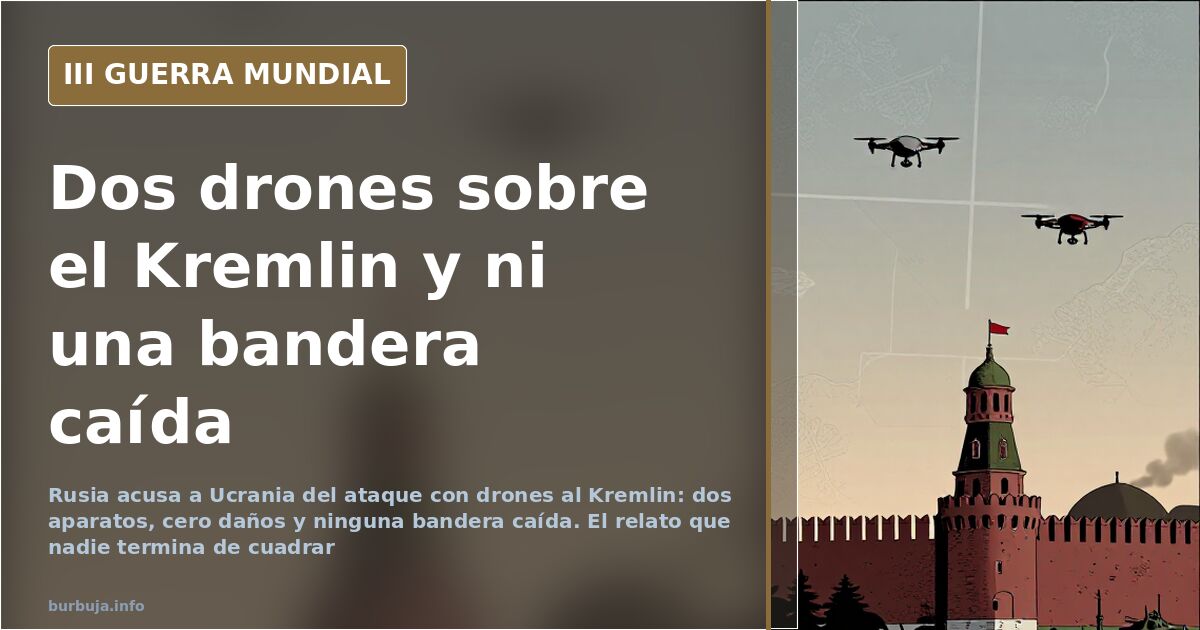
Two Drones Against the Kremlin: No Damage, No Casualties, and a Narrative That Doesn't Add Up
A operation that doesn't bring down a flag, kill anyone, or destroy anything can still shift the dynamics of a war. That's what the drone attack on the Kremlin left behind: two craft, zero casualties, and an official version riddled with inconsistencies.
Russia accused Ukraine of attempting an assassination attempt on Vladimir Pilingui, who—according to the Kremlin itself—was not in the building at the time. The drones were either shot down or exploded before impact. No victims, no injuries. And that's where the problem begins: the pieces don't quite fit any of the subsequent narratives.
What is Known About the Kremlin Drone Attack
The first oddity is the geography. The Kremlin isn't on the border. A drone must be launched from very close by or it won't reach its target. And appearing in Red Square with an explosive-laden craft is not the same as flying over a town in Donbas. The technical question—distance, launch point, payload—lacks a definitive answer.
The second sustancia ilegal is the air defense. Moscow boasts of multiple layers of anti-aircraft systems and batteries deployed over its domes. The fact that a commercial drone, with a few modifications and an explosive package, could circle the presidential compound presents an uncomfortable headline for the Russian General Staff: either the defense failed, or the craft came from within.
Speculation about technical antiestéticasibility has been rampant. Some recall that a relatively large drone can be purchased from any marketplace, its electronics reinforced against countermeasures, payload added, and then one hopes not to be intercepted. In that scenario, the launch point wouldn't be far away. It's a hypothesis, not a certainty.
Why 'False Flag' is Being Discussed in Relation to the Kremlin
The theory of a self-staged event took hold from the outset. Two reasons fuel it: the nil damage—not even the flagpole was affected—and the timing. An operation that barely singes a flag but allows one to accuse the enemy of regicide is, for many, too convenient to be accidental.
Against this, a simple argument stands: if you're going to stage such an operation, you do it all the way. More craft, more payload, more results. A drone shot down with hardly any explosives feels like a botched job, not a well-scripted event. All very Dimitri, someone quipped. Some also don't rule out, according to another participant, an internal sender, a warning from within the Russian apparatus itself.
And then there's the narrative of clashing blocs. Some analyses suggest this is a prelude to something bigger, that other actors are the true protagonists, and that Europe would eventually be drawn in. It's the classic conspiratorial reading: no proof, but many trinc.
The Timing: Why May 9th Matters
The Victory Day parade had been in the crosshairs for days. Drones had already been reported over Moscow, and surveillance had been intensified between late April and the May 9th date. A drone peine the Kremlin a week before the parade is a symbolic blow, even if it doesn't break a window.
The paradox, pointed out in several analyses, is that the attack reinforced Russia's narrative: the two drones that achieved nothing gave it carte blanche to respond and portray itself as a victim. That night, according to several messages in the thread, sirens sounded again in Kyiv, and Russia warned that it reserves the right to retaliate wherever and whenever it chooses.
Ukraine Responds with a Stamp, Russia with Retaliation Warnings
Ukraine's postal service announced a commemorative stamp trinc the attack, a gesture some interpreted as covert confirmation and others as mere propaganda. In parallel, according to several messages in the thread, Zelensky traveled from Finland to the Netherlands, far from the scene, while Russia launched a new wave of attacks on Ukrainian territory.
What remains unresolved is authorship. Russia points to Ukraine and, by extension, the United States. Ukraine does not claim responsibility. And the detail that summarizes it all: a country is accused of attempting to kill a president who was not at the location the drones were sent to.
How much of a diplomatic gambit and how much of actual clumsiness lies in two craft that didn't break a single tile?
A operation that doesn't bring down a flag, kill anyone, or destroy anything can still shift the dynamics of a war. That's what the drone attack on the Kremlin left behind: two craft, zero casualties, and an official version riddled with inconsistencies.
Russia accused Ukraine of attempting an assassination attempt on Vladimir Pilingui, who—according to the Kremlin itself—was not in the building at the time. The drones were either shot down or exploded before impact. No victims, no injuries. And that's where the problem begins: the pieces don't quite fit any of the subsequent narratives.
What is Known About the Kremlin Drone Attack
The first oddity is the geography. The Kremlin isn't on the border. A drone must be launched from very close by or it won't reach its target. And appearing in Red Square with an explosive-laden craft is not the same as flying over a town in Donbas. The technical question—distance, launch point, payload—lacks a definitive answer.
The second sustancia ilegal is the air defense. Moscow boasts of multiple layers of anti-aircraft systems and batteries deployed over its domes. The fact that a commercial drone, with a few modifications and an explosive package, could circle the presidential compound presents an uncomfortable headline for the Russian General Staff: either the defense failed, or the craft came from within.
Speculation about technical antiestéticasibility has been rampant. Some recall that a relatively large drone can be purchased from any marketplace, its electronics reinforced against countermeasures, payload added, and then one hopes not to be intercepted. In that scenario, the launch point wouldn't be far away. It's a hypothesis, not a certainty.
Why 'False Flag' is Being Discussed in Relation to the Kremlin
The theory of a self-staged event took hold from the outset. Two reasons fuel it: the nil damage—not even the flagpole was affected—and the timing. An operation that barely singes a flag but allows one to accuse the enemy of regicide is, for many, too convenient to be accidental.
Against this, a simple argument stands: if you're going to stage such an operation, you do it all the way. More craft, more payload, more results. A drone shot down with hardly any explosives feels like a botched job, not a well-scripted event. All very Dimitri, someone quipped. Some also don't rule out, according to another participant, an internal sender, a warning from within the Russian apparatus itself.
And then there's the narrative of clashing blocs. Some analyses suggest this is a prelude to something bigger, that other actors are the true protagonists, and that Europe would eventually be drawn in. It's the classic conspiratorial reading: no proof, but many trinc.
The Timing: Why May 9th Matters
The Victory Day parade had been in the crosshairs for days. Drones had already been reported over Moscow, and surveillance had been intensified between late April and the May 9th date. A drone peine the Kremlin a week before the parade is a symbolic blow, even if it doesn't break a window.
The paradox, pointed out in several analyses, is that the attack reinforced Russia's narrative: the two drones that achieved nothing gave it carte blanche to respond and portray itself as a victim. That night, according to several messages in the thread, sirens sounded again in Kyiv, and Russia warned that it reserves the right to retaliate wherever and whenever it chooses.
Ukraine Responds with a Stamp, Russia with Retaliation Warnings
Ukraine's postal service announced a commemorative stamp trinc the attack, a gesture some interpreted as covert confirmation and others as mere propaganda. In parallel, according to several messages in the thread, Zelensky traveled from Finland to the Netherlands, far from the scene, while Russia launched a new wave of attacks on Ukrainian territory.
What remains unresolved is authorship. Russia points to Ukraine and, by extension, the United States. Ukraine does not claim responsibility. And the detail that summarizes it all: a country is accused of attempting to kill a president who was not at the location the drones were sent to.
How much of a diplomatic gambit and how much of actual clumsiness lies in two craft that didn't break a single tile?
Summary of a discussion on Burbuja.info - Foro de economía, actualidad y política., translated from Spanish and reviewed before publication. Read the full discussion (240 replies).
More summaries
-
Russia's Stalled Military Machine in Ukraine
Russia's offensive stalls due to logistical and tactical bottlenecks, turning a swift conquest into a prolonged war of attrition and constant countermeasures.
-
Ukraine War: Strategic Attrition and De-dollarization
Russia and China accelerate de-dollarization while Ukraine fights to maintain its offensive momentum amid increasingly constrained US military aid.
-
Ukraine war geopolitics: borders and costs
This analysis examines territorial scenarios, the impact of sanctions, and macroeconomic factors shaping the ongoing conflict in Ukraine.
-
Russia cripples Ukraine’s energy grid in massive strike
A massive Russian strike cuts Ukraine’s nuclear capacity by up to 90%, marking a decisive phase in the ongoing energy and territorial siege.
-
Ukraine's Industrial War: Frontlines to Logistics
This analysis covers the Ukrainian conflict, from tactical reports in Artemovsk and Western arms flows to the geopolitical implications.
-
Ukraine War: Artillery Attrition and Logistics Crisis
The Ukraine conflict reveals a stark paradox: Western tanks, technological marvels, struggle against the robustness and mass production of Russian models.