
Russia cuts oil output by 500,000 barrels daily
Russia reduces production by 500,000 bpd from March amid a 46.4% drop in January energy revenues.
English · Original discussion in Spanish · Published
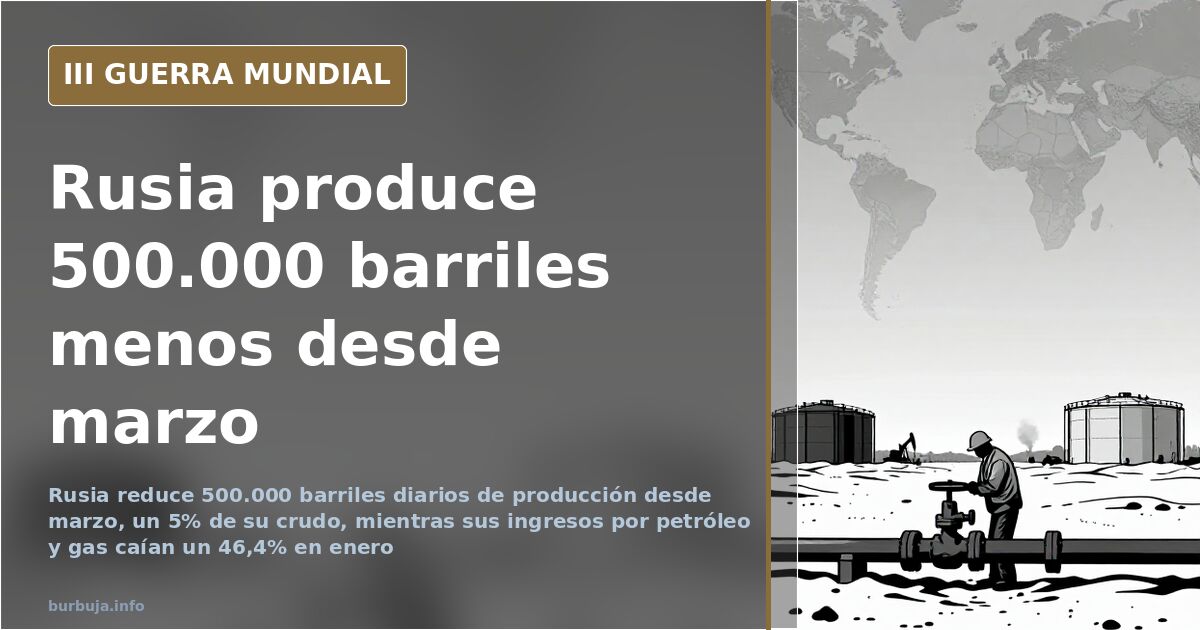
Russia to cut 500,000 barrels daily as diesel embargo bites
Russia will stop pumping 500,000 barrels per day starting in March. Moscow framed the cut as a sovereign decision to avoid selling crude at rock-bottom prices, but Russian outlet Komsomólskaya Pravda tells a different story: demand for Russian diesel has collapsed since the EU activated its embargo on petroleum products on February 5. High-quality Russian crude, which commands the best prices, has lost its natural market. The question is no longer whether there will be a cut, but whether barrels will still be sold at a discount in March and if new excuses will emerge.
What losing 500,000 barrels daily means
In raw terms, this figure represents 5% of Russian production: dropping from 10.5 million to 10 million barrels per day. The calculation circulating in discussions is straightforward: 500,000 barrels at $60 equals $30 million less per day. If the discount on Russian crude is higher—and it is acknowledged to reach 35% for China and India—the loss grows.
Against this stands the price reaction. The mere announcement moved Brent by about $3 per barrel, while gasoline in Spain is already at €1.63. If crude prices rise, the volume cut is partially offset by higher unit revenue. The tension lies exactly there: how much volume falls versus how much price rises.
Why the diesel embargo drives the cut
The explanation gaining traction in Russian media is that companies cannot redirect all product to other markets. Diesel loses its European buyer, and there are no short-term alternative destinations for those volumes. In this sense, the cut is less a strategic move than a consequence.
The route that does work involves third countries. One million barrels of Russian crude daily reaches India, where it is refined and returns to Europe as finished product. Before the war, that same barrel was bought nearby; now it travels around the world before coming back. India keeps the margin. For Moscow, it is an exit with reduced profits; for Brussels, a hole in its own embargo.
Revenues fall and ruble weakens
Data points in the same direction. In January 2023, Russian revenues fell 35% year-on-year, spending rose 59%, and oil and gas collections alone dropped 46.4%. That plunge covers a significant part of the projected annual deficit.
Add the ruble to the mix. During the February 9 session, the Russian currency weakened, with the dollar exceeding 73 rubles and the euro 78, levels not seen since late April of the previous year. No one sells gold or halves their main income source when accounts are healthy.
Impact on prices and European wallets
Here the analysis shifts. Saudi Arabia had already cut two million barrels months earlier without moving to compensate. The United States holds strategic reserves at forty-year lows after depleting them to contain prices. With that buffer exhausted, any additional cut hits the pump.
The clear winner of this energy rift is not in the EU. Norway, a producer outside the bloc, benefits from the gap left by Russian crude in the European market. Meanwhile, the continent loses competitiveness and pays the highest energy bill.
From oil wars to global GDP redistribution
The Russian cut is the tip of a larger shift entering public discourse as months pass. The US accounted for half of global GDP in 1950; today it hovers around 25%. The EU collectively has a GDP similar to China’s, whereas in the early 2000s, Spain alone had more than the Asian giant.
The economic axis shifts toward Asia-Pacific. And a detail summarizes the paradox: 60% of the IBEX 35 is foreign-owned, led by BlackRock and Vanguard. The sovereignty discussed in speeches has very specific owners in the shareholding structure.
The conclusion remains open out of necessity. Data allows measuring the damage to Russia’s coffers and the impact on European prices, but they do not determine how long Moscow can hold out without fully opening the taps, nor how quickly the EU can replace the diesel still entering, refined, from India. That is where the analysis stalls.
Russia will stop pumping 500,000 barrels per day starting in March. Moscow framed the cut as a sovereign decision to avoid selling crude at rock-bottom prices, but Russian outlet Komsomólskaya Pravda tells a different story: demand for Russian diesel has collapsed since the EU activated its embargo on petroleum products on February 5. High-quality Russian crude, which commands the best prices, has lost its natural market. The question is no longer whether there will be a cut, but whether barrels will still be sold at a discount in March and if new excuses will emerge.
What losing 500,000 barrels daily means
In raw terms, this figure represents 5% of Russian production: dropping from 10.5 million to 10 million barrels per day. The calculation circulating in discussions is straightforward: 500,000 barrels at $60 equals $30 million less per day. If the discount on Russian crude is higher—and it is acknowledged to reach 35% for China and India—the loss grows.
Against this stands the price reaction. The mere announcement moved Brent by about $3 per barrel, while gasoline in Spain is already at €1.63. If crude prices rise, the volume cut is partially offset by higher unit revenue. The tension lies exactly there: how much volume falls versus how much price rises.
Why the diesel embargo drives the cut
The explanation gaining traction in Russian media is that companies cannot redirect all product to other markets. Diesel loses its European buyer, and there are no short-term alternative destinations for those volumes. In this sense, the cut is less a strategic move than a consequence.
The route that does work involves third countries. One million barrels of Russian crude daily reaches India, where it is refined and returns to Europe as finished product. Before the war, that same barrel was bought nearby; now it travels around the world before coming back. India keeps the margin. For Moscow, it is an exit with reduced profits; for Brussels, a hole in its own embargo.
Revenues fall and ruble weakens
Data points in the same direction. In January 2023, Russian revenues fell 35% year-on-year, spending rose 59%, and oil and gas collections alone dropped 46.4%. That plunge covers a significant part of the projected annual deficit.
Add the ruble to the mix. During the February 9 session, the Russian currency weakened, with the dollar exceeding 73 rubles and the euro 78, levels not seen since late April of the previous year. No one sells gold or halves their main income source when accounts are healthy.
Impact on prices and European wallets
Here the analysis shifts. Saudi Arabia had already cut two million barrels months earlier without moving to compensate. The United States holds strategic reserves at forty-year lows after depleting them to contain prices. With that buffer exhausted, any additional cut hits the pump.
The clear winner of this energy rift is not in the EU. Norway, a producer outside the bloc, benefits from the gap left by Russian crude in the European market. Meanwhile, the continent loses competitiveness and pays the highest energy bill.
From oil wars to global GDP redistribution
The Russian cut is the tip of a larger shift entering public discourse as months pass. The US accounted for half of global GDP in 1950; today it hovers around 25%. The EU collectively has a GDP similar to China’s, whereas in the early 2000s, Spain alone had more than the Asian giant.
The economic axis shifts toward Asia-Pacific. And a detail summarizes the paradox: 60% of the IBEX 35 is foreign-owned, led by BlackRock and Vanguard. The sovereignty discussed in speeches has very specific owners in the shareholding structure.
The conclusion remains open out of necessity. Data allows measuring the damage to Russia’s coffers and the impact on European prices, but they do not determine how long Moscow can hold out without fully opening the taps, nor how quickly the EU can replace the diesel still entering, refined, from India. That is where the analysis stalls.
Summary of a discussion on Burbuja.info - Foro de economía, actualidad y política., translated from Spanish and reviewed before publication. Read the full discussion (196 replies).
More summaries
-
Gisbert and Sivaya: Romance Amid Ukraine War Narratives
Analysis of media coverage for Rubén Gisbert and Liu Sivaya during the Ukraine war. Is this digital propaganda or reality?
-
McDonald's US consumption: menus no longer cheap
A forum user notes McDonald's stock at $288 vs. $90 a decade ago, claiming menus now cost more than Spain's fixed lunch.
-
Iran launches Shahed drones toward Israel in early April
Iran reportedly launched dozens of Shahed 136 drones at Israel overnight on April 12-13, following days of air exclusion warnings.
-
Belarus Gala Video Sparks Debate on Lukashenko Model
A viral video of a Belarusian gala fuels discussion on Alexander Lukashenko’s model, citing 65% state-owned enterprises and 1.5% unemployment.
-
Zara hires plus-size model Ceval Omar for Barbie edition
Zara casts Somali model Ceval Omar in its Barbie collection, sparking boycott calls and debates over size inclusivity.
-
1.5m Yakut soldier kills 1.95m Ukrainian in close combat
A 1.50m Yakut soldier killed a 1.95m Ukrainian in hand-to-hand combat, according to drone footage that has reignited debate on physical size.