
Aleppo falls in hours as Syria changes hands all the way to Damascus
Insurgent offensive takes Aleppo in hours and advances to Damascus while Israel occupies southern Syria with little resistance
English · Original discussion in Spanish · Published
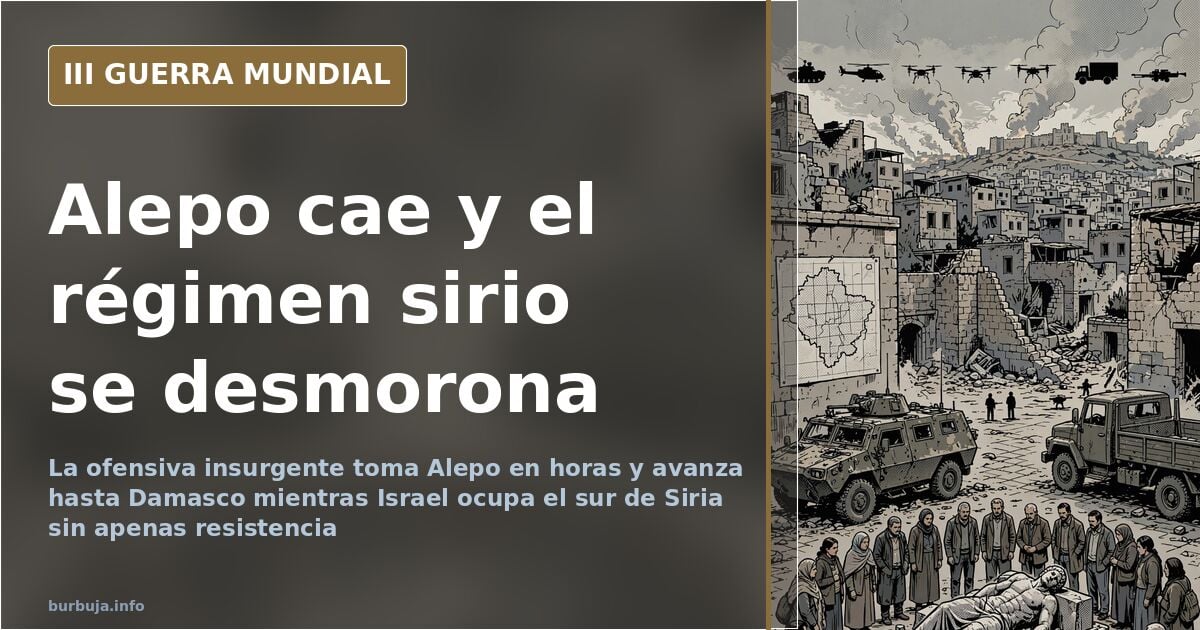
Aleppo falls in hours and the Syrian regime crumbles all the way to Damascus
Aleppo, a city of 2.3 million inhabitants, fell in a matter of hours, with the defense of its eastern sector collapsing in less than three. The paradox is not in the estimulante ilegal, but in who was defending it: a state with aviation and Russian backing that collapsed before an insurgent force frozen in Idlib for five years. In a matter of days the front moved more than in the previous four years, and the question stopped being whether Aleppo would fall and became how long Damascus would take to fall.
An offensive with surprise factor and Turkish weaponry
The attack was launched by the main insurgent operations room of Idlib province against positions of the Syrian army, Hezbollah and Iran, presenting it as a "response" to their recent attacks. The videos circulated showed fighters with AK-74 rifles and Pulsar Apex XD50 thermal sights, as well as RPG-7 rocket launchers equipped with Turkish PARS 660N sights for night attacks. To this were added M113 armored vehicles, captured BMP-1 armored vehicles, T-55 tanks and Turkish-made anti-tank weaponry.
It was not only light weaponry. The insurgents also deployed turbojet-powered kamikaze drones, a model not seen before, according to the videos circulating. The combination of thermal vision, night capability and drone warfare gave them a tactical advantage that the government side could not counter. The messages circulating in the debate also cited the movement of Turkish tanks and artillery in support of the operation, which would point to backing that goes beyond the supply of material.
Why the Syrian army collapsed
The explanations point to an accumulation of wear. The Syrian army has weakened greatly since 2020, with no money to maintain a large force, with sanctions that have destroyed the economy and an eroded social support. To this was added a decisive factor: the withdrawal of Iranian militias and Hezbollah, which provided the best fighters of the government side. Without them, the line was held with troops without resources or backing who retreated in disorder.
Behind this also weighs the Russian distraction. With Moscow fully involved in the war in Ukraine, the air support that was decisive between 2016 and 2020 is not available at the same level. The most repeated observation: a T-90 captured in 2017 and now reused in the offensive, seven years later, with total control of the airspace and without having been destroyed. On the ground, the defense of eastern Aleppo collapsed in less than three hours and government forces fled in disorganized retreat.
From Aleppo to Damascus: the unstoppable advance
After Aleppo, the advance continued south with hardly any combat. Witnesses described a generalized retreat: in Homs no shots or combat were heard, and troops withdrew or negotiated surrender. Reports spoke of more than 500 km² gained, a territory equivalent to Gaza and a half, and more than 40 localities taken in the first stages. The fall of the capital exposed a state without an army or police in function.
To the rumors of a flight of the leadership were added those of an internal coup and desertions in the south, with checkpoints stormed and equipment confiscated. The result was a regime change in record time and a new Sarracinist administration that began to take control of the institutions.
Israel occupies the south without finding resistance
While the north and center changed hands, Israel advanced on southern Syria without finding appreciable opposition. It went from occupying more than 300 km² to approaching 400, took control of the freshwater sources of the south in the Yarmouk basin and systematically bombed a missile complex west of Damascus. The signing of a decree to increase the population of the Golan Heights was reported.
According to Israeli media, the plan contemplates two zones of influence: one of 15 kilometers deep with permanent military presence and another of 60 kilometers, up to Damascus, under intelligence control. The new Syrian administration insisted on its commitment to the 1974 agreement, while the invasion continued. The contrast with the withdrawal from Gaza fueled an uncomfortable reading in the debate, where it was argued that Israel is reorganizing forces to redirect them to the north.
The new Sarracinist order and its cracks
The new authority suspended secular laws and announced that legislation would be governed by sharia, with instructions that female judges pass their cases to male judges. Protests were not long in coming: Alawite and Christian communities denounced incidents, including the burning of a temple and harassment of minorities. In the east, Kurdish groups launched a counteroffensive in Manbij against pro-Turkish forces, in an increasingly fragmented scenario with crossed interests.
To the above is added the persistence of Israeli pressure on the ground, the lack of bread and deficiencies in electricity supply that aggravate daily life. A country without a formal army, with militias as the only real power and neighbors that move pieces on its territory. The Druze, for their part, have formed a council that speaks of choosing "the least bad option," and it is speculated that Alawite and Christian zones could be reconfigured.
What remains of the Syrian state
The provisional balance is that of a state apparatus that dissolved faster than anyone anticipated. There is talk of intelligence officers planning to take over what remained of the state, of an army that no longer exists as such and of a population that has gone from open war to uncertainty. Regional powers —Turkey, Israel, Iran— are repositioning themselves on a board that moves every week.
The offensive demonstrates that an insurgent force can evolve politically, diplomatically, militarily and technologically while a state remains frozen in time. Does that advantage survive the day after victory or does the country, divided between militias, neighboring powers and zones of influence, enter an even more uncertain phase?
Aleppo, a city of 2.3 million inhabitants, fell in a matter of hours, with the defense of its eastern sector collapsing in less than three. The paradox is not in the estimulante ilegal, but in who was defending it: a state with aviation and Russian backing that collapsed before an insurgent force frozen in Idlib for five years. In a matter of days the front moved more than in the previous four years, and the question stopped being whether Aleppo would fall and became how long Damascus would take to fall.
An offensive with surprise factor and Turkish weaponry
The attack was launched by the main insurgent operations room of Idlib province against positions of the Syrian army, Hezbollah and Iran, presenting it as a "response" to their recent attacks. The videos circulated showed fighters with AK-74 rifles and Pulsar Apex XD50 thermal sights, as well as RPG-7 rocket launchers equipped with Turkish PARS 660N sights for night attacks. To this were added M113 armored vehicles, captured BMP-1 armored vehicles, T-55 tanks and Turkish-made anti-tank weaponry.
It was not only light weaponry. The insurgents also deployed turbojet-powered kamikaze drones, a model not seen before, according to the videos circulating. The combination of thermal vision, night capability and drone warfare gave them a tactical advantage that the government side could not counter. The messages circulating in the debate also cited the movement of Turkish tanks and artillery in support of the operation, which would point to backing that goes beyond the supply of material.
Why the Syrian army collapsed
The explanations point to an accumulation of wear. The Syrian army has weakened greatly since 2020, with no money to maintain a large force, with sanctions that have destroyed the economy and an eroded social support. To this was added a decisive factor: the withdrawal of Iranian militias and Hezbollah, which provided the best fighters of the government side. Without them, the line was held with troops without resources or backing who retreated in disorder.
Behind this also weighs the Russian distraction. With Moscow fully involved in the war in Ukraine, the air support that was decisive between 2016 and 2020 is not available at the same level. The most repeated observation: a T-90 captured in 2017 and now reused in the offensive, seven years later, with total control of the airspace and without having been destroyed. On the ground, the defense of eastern Aleppo collapsed in less than three hours and government forces fled in disorganized retreat.
From Aleppo to Damascus: the unstoppable advance
After Aleppo, the advance continued south with hardly any combat. Witnesses described a generalized retreat: in Homs no shots or combat were heard, and troops withdrew or negotiated surrender. Reports spoke of more than 500 km² gained, a territory equivalent to Gaza and a half, and more than 40 localities taken in the first stages. The fall of the capital exposed a state without an army or police in function.
To the rumors of a flight of the leadership were added those of an internal coup and desertions in the south, with checkpoints stormed and equipment confiscated. The result was a regime change in record time and a new Sarracinist administration that began to take control of the institutions.
Israel occupies the south without finding resistance
While the north and center changed hands, Israel advanced on southern Syria without finding appreciable opposition. It went from occupying more than 300 km² to approaching 400, took control of the freshwater sources of the south in the Yarmouk basin and systematically bombed a missile complex west of Damascus. The signing of a decree to increase the population of the Golan Heights was reported.
According to Israeli media, the plan contemplates two zones of influence: one of 15 kilometers deep with permanent military presence and another of 60 kilometers, up to Damascus, under intelligence control. The new Syrian administration insisted on its commitment to the 1974 agreement, while the invasion continued. The contrast with the withdrawal from Gaza fueled an uncomfortable reading in the debate, where it was argued that Israel is reorganizing forces to redirect them to the north.
The new Sarracinist order and its cracks
The new authority suspended secular laws and announced that legislation would be governed by sharia, with instructions that female judges pass their cases to male judges. Protests were not long in coming: Alawite and Christian communities denounced incidents, including the burning of a temple and harassment of minorities. In the east, Kurdish groups launched a counteroffensive in Manbij against pro-Turkish forces, in an increasingly fragmented scenario with crossed interests.
To the above is added the persistence of Israeli pressure on the ground, the lack of bread and deficiencies in electricity supply that aggravate daily life. A country without a formal army, with militias as the only real power and neighbors that move pieces on its territory. The Druze, for their part, have formed a council that speaks of choosing "the least bad option," and it is speculated that Alawite and Christian zones could be reconfigured.
What remains of the Syrian state
The provisional balance is that of a state apparatus that dissolved faster than anyone anticipated. There is talk of intelligence officers planning to take over what remained of the state, of an army that no longer exists as such and of a population that has gone from open war to uncertainty. Regional powers —Turkey, Israel, Iran— are repositioning themselves on a board that moves every week.
The offensive demonstrates that an insurgent force can evolve politically, diplomatically, militarily and technologically while a state remains frozen in time. Does that advantage survive the day after victory or does the country, divided between militias, neighboring powers and zones of influence, enter an even more uncertain phase?
Summary of a discussion on Burbuja.info - Foro de economía, actualidad y política., translated from Spanish and reviewed before publication. Read the full discussion (1065 replies).
More summaries
-
Accusations that Netanyahu knew about and collaborated with Hamas
Over 1,000 Israelis died on Oct 7. The theory suggests Netanyahu knew about the attack. Official denial doesn't close the debate.
-
Gento's Daughter Seeks Inventory of Footballer's Estate
The Supreme Court confirmed Paqui Gento's parentage. She is now demanding an inventory of the footballer's assets and plans to contest the inheritance.
-
Geometry in nature: intelligent design or chance?
A pufferfish skeleton sparks debate: is geometry in nature proof of intelligent design or just evolutionary chance?
-
Mass immigration: conspiracy or cheap labor?
The promise to control borders in the UK ended in a migration wave. The debate over who is behind it: conspiracy or labor dumping.
-
Dugin's daughter killed: scandal in Moscow
The murder of Aleksandr Dugin's daughter sparks debate over who orchestrated it in Moscow
-
China Deploys Fleet: Is World War III Looming?
China mobilizes its fleet, including the Shandong aircraft carrier, as Taiwan goes on high alert; explore the economic impact and risks of a possible conflict.