
Syria falls to jihadists as TVE asks about elections
Damascus' fall puts a jihadist leader in power while TVE questions election timelines. UK, France, and Germany suspend Syrian asylum; Spain...
English · Original discussion in Spanish · Published
Syria falls to jihadists as TVE asks about elections
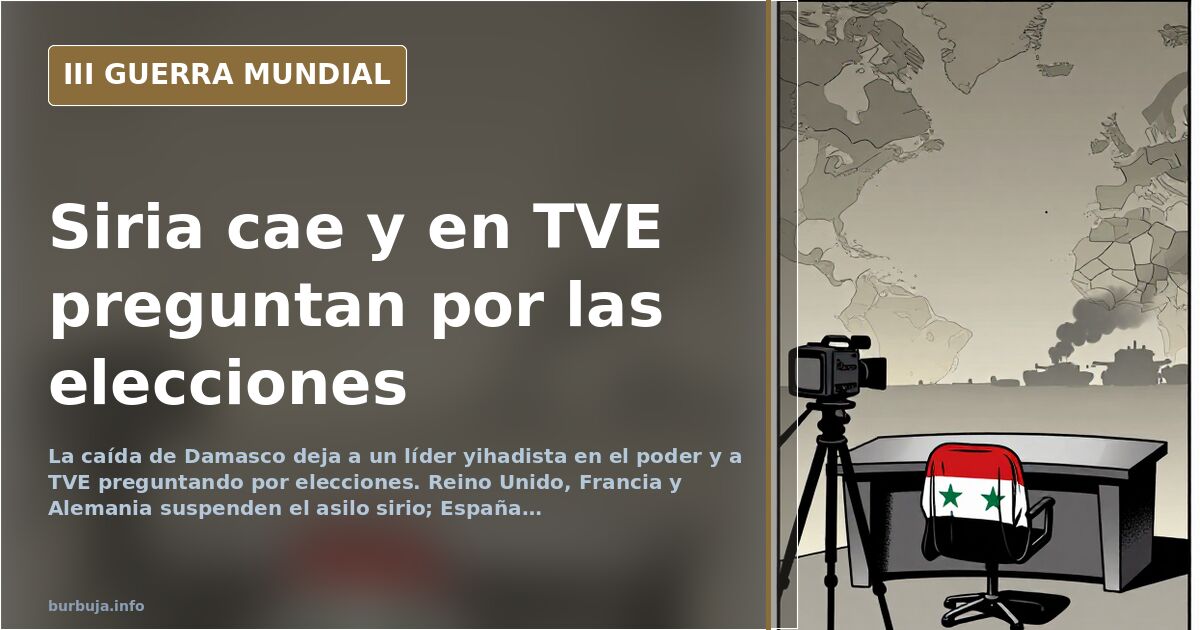
The fall of Damascus illustrates the depth of the media narrative: a public television journalist asks the Foreign Minister if Syria will soon hold elections. It is as if the turbaned man who just seized control arrived to form a technocratic provisional government and call citizens to the polls. Were it not for the tragedy involved, the moment would resemble a New Year's Eve sketch.
What is being decided in Syria, according to circulating analyses, is not a democratic transition. It is the control of two gas pipelines running from the Middle East to Europe across the country. Whoever controls the territory holds the energy key. With this map on the table, the celebration by certain Western media outlets of a terrorist organization's advance—the same one that recently had an international arrest warrant and a $10 million bounty—is better understood.
From wanted terrorist to presentable ally on TV
The sequence is well known. In 2017, the US Embassy in Syria disseminated the international arrest warrant for Mohammad Al-Jolani, leader of Al-Qaeda in the region, with a $10 million reward. Today, that same name appears whitewashed on American networks as the presentable jihadist, the one deemed tolerable for Western audiences. The pattern is not new: Bin Laden was funded and trained to fight the Soviet Union in Afghanistan, only to be hunted down later.
Some argue that Western support for jihadist groups in Syria has long roots and that the current image operation is merely the final phase of the script. Counterarguments note that Russia defended Assad's regime and has now let it collapse, leaving Moscow with its naval bases in a compromised position. According to latest reports, Russian bases remain operational. This detail matters: Tartus and Hmeimim are Moscow's Mediterranean projection, and their loss would be a strategic blow of the first order.
What happens to Syrian refugees in Europe?
The UK, France, Germany, and Austria have announced the suspension of asylum applications from Syrian citizens trinc the fall of Damascus. The Spanish government, however, has ruled out suspending procedures in Spain. The practical consequence, as argued in the debate, is that Spain becomes the preferred entry point for applicants who can no longer process their requests in neighboring countries.
Comparison with Libya immediately arises in any conversation on the topic. Before intervention, Libya functioned as a buffer state with Africa's highest development levels, filtering sub-Saharan migrants toward the Mediterranean. Afterwards, it became one of Europe's main entry points. The Syrian precedent points to the same outcome.
The Libyan precedent and the pull factor
The parallelism is not rhetorical. In both cases, intervention against a dictatorial regime was justified on humanitarian grounds, resulting in a failed state, a power vacuum, and a long-term migration crisis. The difference is that Syria adds an energy component and direct borders with Israel, Turkey, Lebanon, Jordan, and Iraq.
The overarching question is what happens to the religious and ethnic minorities that supported the former regime. Syrian Christians, Alawites, Kurds, and Druze are exposed to a government whose program does not precisely embrace plurality. Some ironically suggest a jihadist executive will bring rights for women and the LGBTQ+ community. The irony speaks for itself.
The role of media and official narrative
Public television coverage has been a focal point of discontent. The question about elections posed to the Foreign Minister is not an isolated lapse: it reveals a mindset where any regime change is interpreted as democratic pogre, ignoring who takes power and by what means. Truthfulness and public television seem irreconcilable enemies in this matter.
This pattern repeats in other conflicts. Media outlets reproduce narratives coming from above without independent verification on the ground. When geopolitical interests shift, the narrative shifts with them: the same actor can be an international terrorist one year and a moderate leader the next, without anyone explaining the transition.
Where analysis gets stuck
It remains to be seen what happens with Russian bases, the gas pipelines, and refugees who can no longer seek asylum in half of Europe. It remains to be seen if the new Syrian government proves predictable or if, as with Bin Laden, the creation turns against its creator. And it remains to be seen how long the official narrative takes to admit that what was presented as a democratic spring was something else entirely. For now, the only certainty is that public television continues asking about elections.
The fall of Damascus illustrates the depth of the media narrative: a public television journalist asks the Foreign Minister if Syria will soon hold elections. It is as if the turbaned man who just seized control arrived to form a technocratic provisional government and call citizens to the polls. Were it not for the tragedy involved, the moment would resemble a New Year's Eve sketch.
What is being decided in Syria, according to circulating analyses, is not a democratic transition. It is the control of two gas pipelines running from the Middle East to Europe across the country. Whoever controls the territory holds the energy key. With this map on the table, the celebration by certain Western media outlets of a terrorist organization's advance—the same one that recently had an international arrest warrant and a $10 million bounty—is better understood.
From wanted terrorist to presentable ally on TV
The sequence is well known. In 2017, the US Embassy in Syria disseminated the international arrest warrant for Mohammad Al-Jolani, leader of Al-Qaeda in the region, with a $10 million reward. Today, that same name appears whitewashed on American networks as the presentable jihadist, the one deemed tolerable for Western audiences. The pattern is not new: Bin Laden was funded and trained to fight the Soviet Union in Afghanistan, only to be hunted down later.
Some argue that Western support for jihadist groups in Syria has long roots and that the current image operation is merely the final phase of the script. Counterarguments note that Russia defended Assad's regime and has now let it collapse, leaving Moscow with its naval bases in a compromised position. According to latest reports, Russian bases remain operational. This detail matters: Tartus and Hmeimim are Moscow's Mediterranean projection, and their loss would be a strategic blow of the first order.
What happens to Syrian refugees in Europe?
The UK, France, Germany, and Austria have announced the suspension of asylum applications from Syrian citizens trinc the fall of Damascus. The Spanish government, however, has ruled out suspending procedures in Spain. The practical consequence, as argued in the debate, is that Spain becomes the preferred entry point for applicants who can no longer process their requests in neighboring countries.
Comparison with Libya immediately arises in any conversation on the topic. Before intervention, Libya functioned as a buffer state with Africa's highest development levels, filtering sub-Saharan migrants toward the Mediterranean. Afterwards, it became one of Europe's main entry points. The Syrian precedent points to the same outcome.
The Libyan precedent and the pull factor
The parallelism is not rhetorical. In both cases, intervention against a dictatorial regime was justified on humanitarian grounds, resulting in a failed state, a power vacuum, and a long-term migration crisis. The difference is that Syria adds an energy component and direct borders with Israel, Turkey, Lebanon, Jordan, and Iraq.
The overarching question is what happens to the religious and ethnic minorities that supported the former regime. Syrian Christians, Alawites, Kurds, and Druze are exposed to a government whose program does not precisely embrace plurality. Some ironically suggest a jihadist executive will bring rights for women and the LGBTQ+ community. The irony speaks for itself.
The role of media and official narrative
Public television coverage has been a focal point of discontent. The question about elections posed to the Foreign Minister is not an isolated lapse: it reveals a mindset where any regime change is interpreted as democratic pogre, ignoring who takes power and by what means. Truthfulness and public television seem irreconcilable enemies in this matter.
This pattern repeats in other conflicts. Media outlets reproduce narratives coming from above without independent verification on the ground. When geopolitical interests shift, the narrative shifts with them: the same actor can be an international terrorist one year and a moderate leader the next, without anyone explaining the transition.
Where analysis gets stuck
It remains to be seen what happens with Russian bases, the gas pipelines, and refugees who can no longer seek asylum in half of Europe. It remains to be seen if the new Syrian government proves predictable or if, as with Bin Laden, the creation turns against its creator. And it remains to be seen how long the official narrative takes to admit that what was presented as a democratic spring was something else entirely. For now, the only certainty is that public television continues asking about elections.
Summary of a discussion on Burbuja.info - Foro de economía, actualidad y política., translated from Spanish and reviewed before publication. Read the full discussion (177 replies).
More summaries
-
Syrian rebels seize Damascus as Bashar al-Assad flees
Reports suggest Bashar al-Assad has left Syria as rebels take control of Damascus; Reuters reports unconfirmed rumors of his death in a plane crash near Homs.
-
Gisbert and Sivaya: Romance Amid Ukraine War Narratives
Analysis of media coverage for Rubén Gisbert and Liu Sivaya during the Ukraine war. Is this digital propaganda or reality?
-
G7 rejects Russian gas ruble payments
The G7 refuses to pay for Russian gas in rubles, while Moscow threatens to cut supplies with a March 31 deadline.
-
Forum user estimates Kiev siege requires five attackers per defender
A forum calculation suggests Kiev would need five attackers per defender, citing Berlin and Fallujah as benchmarks.
-
Migrant shelter breakfast sparks debate on public spending
A migrant shelter serving potatoes and fruit reignites the dispute over public spending, pull factors, and wages in Spain.
-
Metsola: Ukraine will win, EU to lead global order
Metsola says Ukraine will win and the EU will lead world order. Public debate focuses on gas prices and winter bills.