
G7 rejects Russian gas ruble payments
The G7 refuses to pay for Russian gas in rubles, while Moscow threatens to cut supplies with a March 31 deadline.
English · Original discussion in Spanish · Published
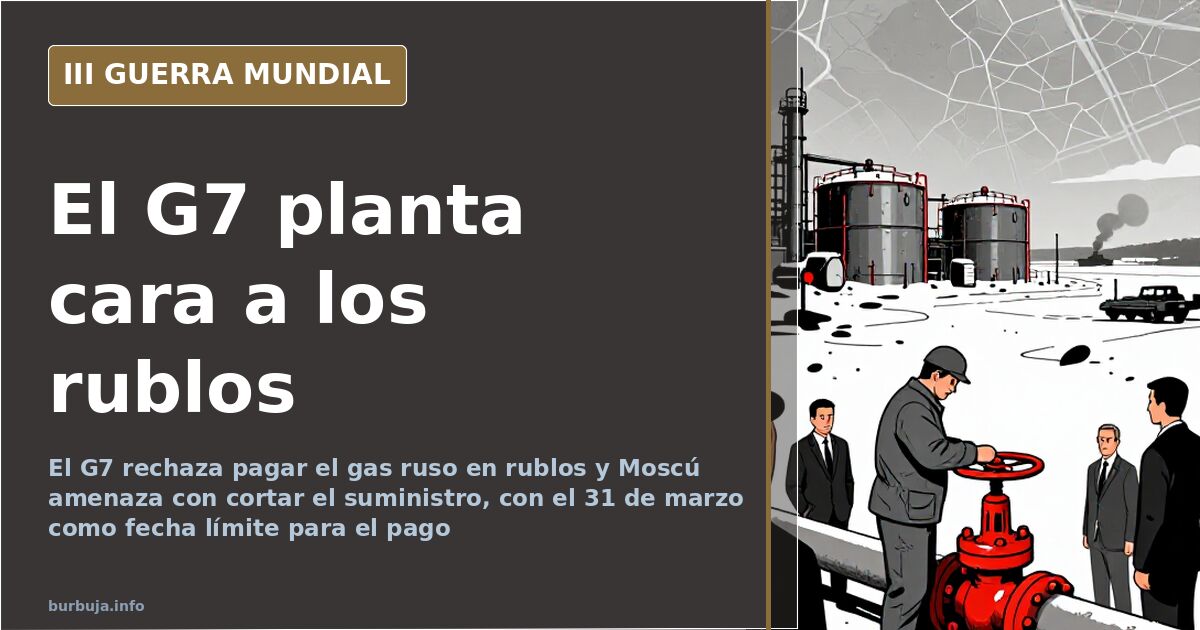
G7 stands up to Moscow and rejects paying for gas in rubles
Can Europe afford to say no to Russian gas? The G7 has agreed to reject Moscow's demand to receive payment for natural gas exports in rubles, according to German Energy Minister Robert Habeck and AP reports. This decision shifts the energy bill into the political arena and starts a standoff with a specific date on the line: March 31. From that day on, buyers of Russian gas must pay in the Russian currency or find another supplier. Moscow responded with its only available weapon: a member of the Federation Council warned that if EU countries do not buy in rubles, supplies will be interrupted.
The blackmail has an uncomfortable reverse side. The buyer, led by Germany, has been announcing for months that it will seek alternatives. And Russia has been depending on the same customer for months. Both know where it hurts the other.
Can Germany replace Russian gas with coal?
To generate electricity, circulating calculations suggest yes, at least on paper. Germany ended 2021 with 29% gas in its electricity mix and maintains 40 GW of operational coal plants. According to this reading, the country could increase coal to 43% of its generation and leave gas practically at zero in the power sector, with renewables already contributing 50% plus 7% nuclear. There have been days this winter when coal covered nearly half of the demand.
The problem is not electricity. It is heating and industry, which cannot change fuel by decree. A gas network is not replaced with a switch, reserves are reaching their lowest levels at the end of winter, and the cold wave is pressing. The calendar works against political decisions.
The ruble as a weapon: the problem of obtaining them
Here lies the crux of the matter. Paying in rubles requires buying them first, which means going to the market in exchange for euros or dollars: the final flow changes currency, not direction. The Russian Central Bank can set an official rate, but the seller of the currency remains the market. And the ruble, it is argued, has already appreciated against the dollar since the start of the conflict, to the point that Moscow would be restraining its own currency to avoid suffocating exports.
On the table there is also a legal obstacle mentioned in the thread: Russian gas contracts with Germany are long-term and denominated in euros. Neither party has an incentive to break them now. One can reaffirm that it will not pay in rubles; the other, that it will collect in rubles. And both can wait until expiration.
The alternative is not free: American LNG 40% more expensive
If the tap is closed, the natural substitute is liquefied natural gas arriving by tanker, and the supplier with ample capacity is the United States. Price is the problem: according to information disseminated in the thread, American LNG is placed in Europe 40% above Russian gas prices. Hence comes the great business of the standoff and, it is claimed, much of Washington's interest in ensuring the European customer stops buying from Moscow.
Russia, meanwhile, seeks other buyers. India and Russia are studying a pipeline valued at 25 billion dollars to transport gas from Siberia to the Asian country. It is a project of years, not a one-week solution: the European buyer will remain the closest and most convenient for quite some time.
Who is bluffing in the gas standoff
On paper, Moscow has the gas and Europe has the bill. But gas trapped underground does not pay salaries, and a pipeline without a buyer is a dead asset. Some argue that cutting supplies to Germany for two weeks would be enough to see who holds out. No one has wanted to find out yet.
And spring will arrive, with heating off and bills tucked away in a drawer. Rarely has a season been awaited with such anticipation.
Can Europe afford to say no to Russian gas? The G7 has agreed to reject Moscow's demand to receive payment for natural gas exports in rubles, according to German Energy Minister Robert Habeck and AP reports. This decision shifts the energy bill into the political arena and starts a standoff with a specific date on the line: March 31. From that day on, buyers of Russian gas must pay in the Russian currency or find another supplier. Moscow responded with its only available weapon: a member of the Federation Council warned that if EU countries do not buy in rubles, supplies will be interrupted.
The blackmail has an uncomfortable reverse side. The buyer, led by Germany, has been announcing for months that it will seek alternatives. And Russia has been depending on the same customer for months. Both know where it hurts the other.
Can Germany replace Russian gas with coal?
To generate electricity, circulating calculations suggest yes, at least on paper. Germany ended 2021 with 29% gas in its electricity mix and maintains 40 GW of operational coal plants. According to this reading, the country could increase coal to 43% of its generation and leave gas practically at zero in the power sector, with renewables already contributing 50% plus 7% nuclear. There have been days this winter when coal covered nearly half of the demand.
The problem is not electricity. It is heating and industry, which cannot change fuel by decree. A gas network is not replaced with a switch, reserves are reaching their lowest levels at the end of winter, and the cold wave is pressing. The calendar works against political decisions.
The ruble as a weapon: the problem of obtaining them
Here lies the crux of the matter. Paying in rubles requires buying them first, which means going to the market in exchange for euros or dollars: the final flow changes currency, not direction. The Russian Central Bank can set an official rate, but the seller of the currency remains the market. And the ruble, it is argued, has already appreciated against the dollar since the start of the conflict, to the point that Moscow would be restraining its own currency to avoid suffocating exports.
On the table there is also a legal obstacle mentioned in the thread: Russian gas contracts with Germany are long-term and denominated in euros. Neither party has an incentive to break them now. One can reaffirm that it will not pay in rubles; the other, that it will collect in rubles. And both can wait until expiration.
The alternative is not free: American LNG 40% more expensive
If the tap is closed, the natural substitute is liquefied natural gas arriving by tanker, and the supplier with ample capacity is the United States. Price is the problem: according to information disseminated in the thread, American LNG is placed in Europe 40% above Russian gas prices. Hence comes the great business of the standoff and, it is claimed, much of Washington's interest in ensuring the European customer stops buying from Moscow.
Russia, meanwhile, seeks other buyers. India and Russia are studying a pipeline valued at 25 billion dollars to transport gas from Siberia to the Asian country. It is a project of years, not a one-week solution: the European buyer will remain the closest and most convenient for quite some time.
Who is bluffing in the gas standoff
On paper, Moscow has the gas and Europe has the bill. But gas trapped underground does not pay salaries, and a pipeline without a buyer is a dead asset. Some argue that cutting supplies to Germany for two weeks would be enough to see who holds out. No one has wanted to find out yet.
And spring will arrive, with heating off and bills tucked away in a drawer. Rarely has a season been awaited with such anticipation.
Summary of a discussion on Burbuja.info - Foro de economía, actualidad y política., translated from Spanish and reviewed before publication. Read the full discussion (176 replies).
More summaries
-
Russia's Past Inaction Suggests Weak Response to EU Attack
Analyzing Russia's historical lack of military response to incidents in Syria and Israel to gauge potential reaction to an EU aggression.
-
Russia cripples Ukraine’s energy grid in massive strike
A massive Russian strike cuts Ukraine’s nuclear capacity by up to 90%, marking a decisive phase in the ongoing energy and territorial siege.
-
Israel urges citizens to leave Turkey amid rising tensions
Israel advises its nationals to exit Turkey following Ankara's condemnation of the Gaza hospital attack; protests target the US embassy in Beirut.
-
Morocco tells UN there is no land border with Spain
Rabat denies a land border with Spain, calling Melilla an 'occupied prison' and questioning the defense coverage for Ceuta.
-
Ukraine Tanks and Spain's Defense of Ceuta
Sending Leopard tanks to Ukraine reignites debate over defending Spanish enclaves against Morocco.
-
Yousaf urges UK army deployment against rioters
Humza Yousaf calls for military intervention in UK riots as Starmer opts for police and fast-track trials. Digital surveillance debates intensify.