
Metsola: Ukraine will win, EU to lead global order
Metsola says Ukraine will win and the EU will lead world order. Public debate focuses on gas prices and winter bills.
English · Original discussion in Spanish · Published
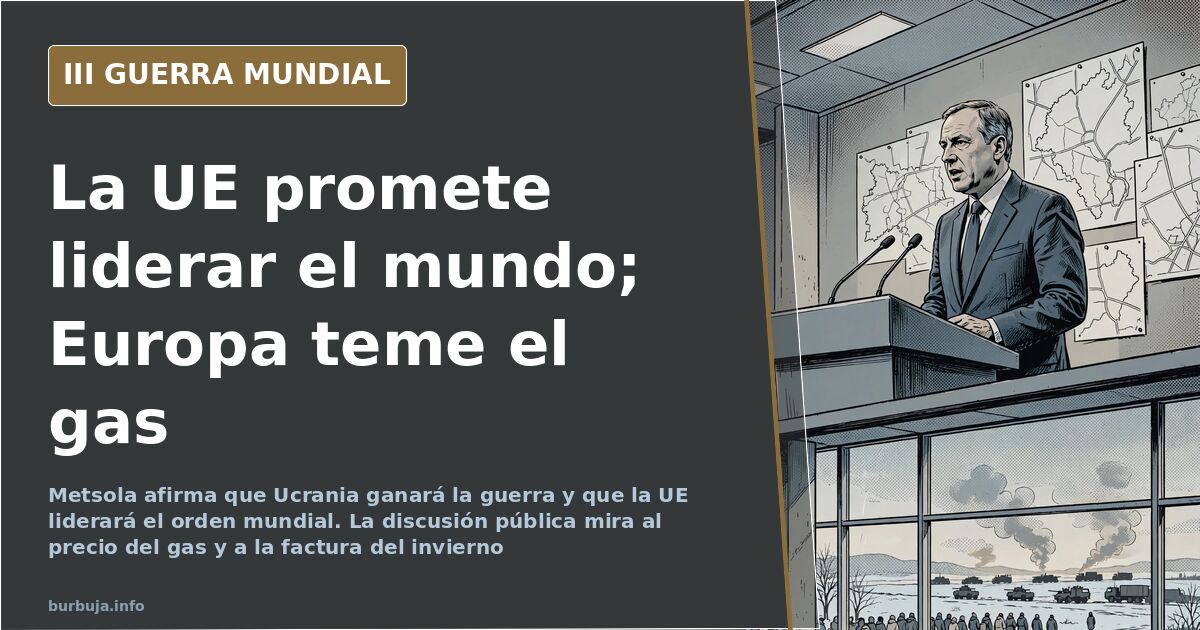
Metsola promises global leadership as Europe antiestéticars winter
Can Brussels take charge of the world order while half the continent counts pennies to stay warm? European Parliament President Roberta Metsola stated on May 6 in Florence that Ukraine will win the war against Russia’s “brutal, illegal, and medieval invasion” and that the European Union must lead a new global democratic order, all “despite the cost of war.” The EFE report covering her remarks includes no figures, deadlines, or specific instruments to achieve this.
What Europeans face daily are bills. And that is where the rhetoric unravels.
What Metsola said and what can be criticized
Metsola called for defending “fundamental rights of democracy, freedom, solidarity, and equality.” This detail matters: democracy is not a fundamental right but a political regime; solidarity is a value, not a right. Some see this as rhetorical carelessness, others as a symptom of a political class confusing its vocabulary with legal frameworks.
The most common criticism, however, is different. Those urging resistance from comfortable seats should, it is argued, pick up a rifle and join the front line. It is the old objection to distant war rhetoric: others pay the price.
Why does winter worry more than the front line?
Because bills arrive before geopolitical conclusions. Heating, hot water, and grocery shopping are where this issue stops being abstract. A recurring idea in discussions is that the priority is not Kyiv, but keeping the heating on.
Deeper analyses suggest the real problem is not domestic comfort but industry and raw material shortages. Common sense dictates: without cheap energy, tractors don’t run, fertilizers aren’t produced, and food isn’t affordable.
Disputes also arise over energy sources. One view holds that buying Russian gas and oil was cheaper than replacing them with US supplies, arguing that rising living costs result from this switch. The counterargument stresses that dependence had a political price already being paid.
Rearming without nickel, titanium, or neon
Rearmament discourse clashes with an uncomfortable question: with what? Discussions list scarce materials in Europe—nickel, titanium, neon, uranium—and note that some previously came from now-sanctioned countries. Calculating the full cost of substitution item by item yields discouraging results.
Some estimate the energy surcharge for rearmament at 200%. Though a rough estimate rather than official data, it highlights the issue: military capacity is built on electricity, gas, and minerals, not declarations.
The world order China is already signing
While Europe proclaims itself a beacon, others make moves. China describes the EU and itself as “two major global forces, two major markets, two major civilizations” meant to stabilize the world, doing so after closing a 30-year euro-denominated energy pact with Russia.
That detail—the currency—is what unsettles analysts regarding the dollar’s role and Washington’s ability to dictate terms to allies. A harsh comparison circulates: today’s EU resembles China three decades ago more than current China resembles the EU back then.
World order, rumors, and background noise
Alongside economic arguments lies much unsubstantiated material. Claims about population reduction plans, secret treaties, and legal changes agreed for 2024 lack proof; they are assertions made in heated debates, not verifiable facts. These should be separated from the serious energy diagnosis.
Others recall that triumphant predictions of quick victories have failed before, advising caution regarding those who promised outcomes that never arrived.
Ultimately, the promise of leading the world order and the doubt over whether there will be gas for radiators coexist in the same sentence without touching. That is leadership: announced in spring, billed in January.
Can Brussels take charge of the world order while half the continent counts pennies to stay warm? European Parliament President Roberta Metsola stated on May 6 in Florence that Ukraine will win the war against Russia’s “brutal, illegal, and medieval invasion” and that the European Union must lead a new global democratic order, all “despite the cost of war.” The EFE report covering her remarks includes no figures, deadlines, or specific instruments to achieve this.
What Europeans face daily are bills. And that is where the rhetoric unravels.
What Metsola said and what can be criticized
Metsola called for defending “fundamental rights of democracy, freedom, solidarity, and equality.” This detail matters: democracy is not a fundamental right but a political regime; solidarity is a value, not a right. Some see this as rhetorical carelessness, others as a symptom of a political class confusing its vocabulary with legal frameworks.
The most common criticism, however, is different. Those urging resistance from comfortable seats should, it is argued, pick up a rifle and join the front line. It is the old objection to distant war rhetoric: others pay the price.
Why does winter worry more than the front line?
Because bills arrive before geopolitical conclusions. Heating, hot water, and grocery shopping are where this issue stops being abstract. A recurring idea in discussions is that the priority is not Kyiv, but keeping the heating on.
Deeper analyses suggest the real problem is not domestic comfort but industry and raw material shortages. Common sense dictates: without cheap energy, tractors don’t run, fertilizers aren’t produced, and food isn’t affordable.
Disputes also arise over energy sources. One view holds that buying Russian gas and oil was cheaper than replacing them with US supplies, arguing that rising living costs result from this switch. The counterargument stresses that dependence had a political price already being paid.
Rearming without nickel, titanium, or neon
Rearmament discourse clashes with an uncomfortable question: with what? Discussions list scarce materials in Europe—nickel, titanium, neon, uranium—and note that some previously came from now-sanctioned countries. Calculating the full cost of substitution item by item yields discouraging results.
Some estimate the energy surcharge for rearmament at 200%. Though a rough estimate rather than official data, it highlights the issue: military capacity is built on electricity, gas, and minerals, not declarations.
The world order China is already signing
While Europe proclaims itself a beacon, others make moves. China describes the EU and itself as “two major global forces, two major markets, two major civilizations” meant to stabilize the world, doing so after closing a 30-year euro-denominated energy pact with Russia.
That detail—the currency—is what unsettles analysts regarding the dollar’s role and Washington’s ability to dictate terms to allies. A harsh comparison circulates: today’s EU resembles China three decades ago more than current China resembles the EU back then.
World order, rumors, and background noise
Alongside economic arguments lies much unsubstantiated material. Claims about population reduction plans, secret treaties, and legal changes agreed for 2024 lack proof; they are assertions made in heated debates, not verifiable facts. These should be separated from the serious energy diagnosis.
Others recall that triumphant predictions of quick victories have failed before, advising caution regarding those who promised outcomes that never arrived.
Ultimately, the promise of leading the world order and the doubt over whether there will be gas for radiators coexist in the same sentence without touching. That is leadership: announced in spring, billed in January.
Summary of a discussion on Burbuja.info - Foro de economía, actualidad y política., translated from Spanish and reviewed before publication. Read the full discussion (176 replies).
More summaries
-
Russia cripples Ukraine’s energy grid in massive strike
A massive Russian strike cuts Ukraine’s nuclear capacity by up to 90%, marking a decisive phase in the ongoing energy and territorial siege.
-
Israel urges citizens to leave Turkey amid rising tensions
Israel advises its nationals to exit Turkey following Ankara's condemnation of the Gaza hospital attack; protests target the US embassy in Beirut.
-
Morocco tells UN there is no land border with Spain
Rabat denies a land border with Spain, calling Melilla an 'occupied prison' and questioning the defense coverage for Ceuta.
-
Ukraine Tanks and Spain's Defense of Ceuta
Sending Leopard tanks to Ukraine reignites debate over defending Spanish enclaves against Morocco.
-
Yousaf urges UK army deployment against rioters
Humza Yousaf calls for military intervention in UK riots as Starmer opts for police and fast-track trials. Digital surveillance debates intensify.
-
Spain's mandatory reservist law for ages 19-25 sparks debate
Forum users claim Spain now mandates military reserves for men aged 19 to 25, citing NATO tensions and potential conscription.