
Migrant shelter breakfast sparks debate on public spending
A migrant shelter serving potatoes and fruit reignites the dispute over public spending, pull factors, and wages in Spain.
English · Original discussion in Spanish · Published
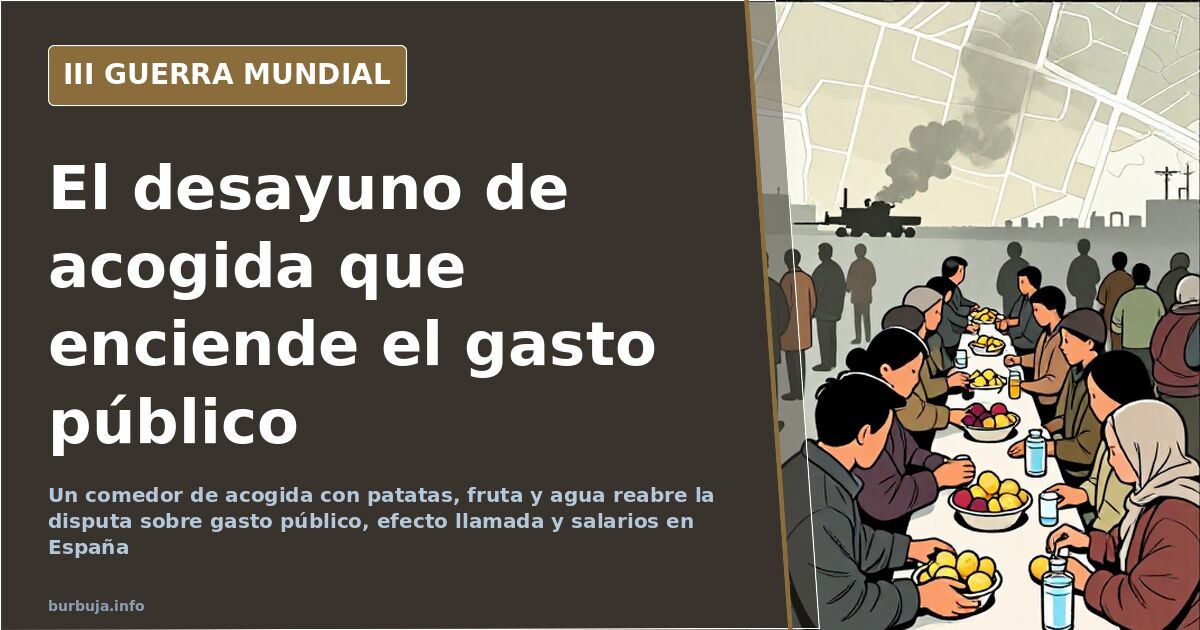
French fries and apples: the breakfast that reopens the controversy
Is anyone eating better than those footing the bill? Circulating images show a group of migrants having breakfast in what appears to be a communal dining hall: trays with french fries, apples, and water. The trigger wasn't the menu. It was an added detail: the physique of several attendees, interpreted by some as proof that the journey wasn't so hard, and by others simply as young, healthy people. The comparison with the shopping basket of any Spanish household finally lit the fuse.
What is seen in the video and what is interpreted
There is no agreement on the description of the canteen itself. Some speak of a buffet "on par with many hotels," with tables in the background and service staff. Others respond with the actual list: frozen bagged potatoes, tough-skinned apples, and water. A third perspective points out that if it were a luxury open bar, it would show in more than just the price of the tuber. What doesn't appear anywhere is verification: neither the center, nor the program supporting it, nor who signs the invoice.
From there, the breakfast becomes the starting point for claims that have little to do with the menu: accommodation, clothing, social support, and a recurring idea—that all this is paid for with taxes from those who wake up early. The complaint is almost always formulated in the same terms: free services for some and waiting lists for others.
The price of melon versus the free menu
The most repeated comparison is domestic. Some admit they don't buy melon because prices are sky-high, yet in the canteen it seems to flow freely. Another circulating calculation adds that not even 80% of households can afford such a treat at current prices. The rebuttal comes quickly: of everything on the trays, potatoes are the cheapest item on the market.
That's where the knot lies, not in the photo. The discussion about the cost of living intersects with the discussion about who gets served first, and both feed more on perception than on figures.
Pull factor: the Australian precedent and the Irish experience
The most developed argument points to incentives. It is claimed that videos like this circulate through networks in countries of origin and function as advertisements: if the destination offers roof, food, and leisure time, the crossing becomes an investment. This is the thesis of the pull factor, difficult to measure and easy to wield.
To reinforce it, the case of Australia is cited, which a couple of decades ago, with migrant boats arriving on its coasts and trafficking mafias doing business, opted to return newcomers or divert them to third countries. According to that narrative, the flow stopped. There are no data allowing verification of the parallelism.
The opposite side is presented by a personal experience. Someone recounts six months in Ireland: they were invited to dinner and breakfast on arrival day, and the next day, to work. With contract and papers in order, they specify. The conclusion drawn is simple: hospitality on the first day, obligations from the second onwards.
Wages, contributions, and retirement at 80
From the menu, the jump is to the labor market. One block defends that the arrival of workforce willing to do anything pushes down salaries for less qualified positions. The counterargument points out that without work authorization, they hardly compete for anything.
Then enters the fine print of pensions. A message warns that newcomers will contribute until age 75 or 80, if they ever contribute, and another denies it outright: they won't last five years in the system. These are projections, not calculations. But they serve their purpose: to remind us that the sustainability of the system depends on the number of contributors and not on the mood of a photo.
When anger seeks figures
In that section, an accusation appears that has no relation to the canteen but sticks to the anger: that of 11 million euros of public money allegedly misappropriated, thrown into the air without any document backing it. No one verifies it. No one denies it. It stays there, like the trays, available for whoever wants to build their thesis.
And thus the circle closes: from a plate of potatoes to an fruta of embezzlement without leaving the same rage.
The breakfast, in the end, is the least important thing. What is truly discussed is who pays, how much, and with what counterpart, and about that, the video says absolutely nothing. When someone brings out the catering bill, let us know.
Is anyone eating better than those footing the bill? Circulating images show a group of migrants having breakfast in what appears to be a communal dining hall: trays with french fries, apples, and water. The trigger wasn't the menu. It was an added detail: the physique of several attendees, interpreted by some as proof that the journey wasn't so hard, and by others simply as young, healthy people. The comparison with the shopping basket of any Spanish household finally lit the fuse.
What is seen in the video and what is interpreted
There is no agreement on the description of the canteen itself. Some speak of a buffet "on par with many hotels," with tables in the background and service staff. Others respond with the actual list: frozen bagged potatoes, tough-skinned apples, and water. A third perspective points out that if it were a luxury open bar, it would show in more than just the price of the tuber. What doesn't appear anywhere is verification: neither the center, nor the program supporting it, nor who signs the invoice.
From there, the breakfast becomes the starting point for claims that have little to do with the menu: accommodation, clothing, social support, and a recurring idea—that all this is paid for with taxes from those who wake up early. The complaint is almost always formulated in the same terms: free services for some and waiting lists for others.
The price of melon versus the free menu
The most repeated comparison is domestic. Some admit they don't buy melon because prices are sky-high, yet in the canteen it seems to flow freely. Another circulating calculation adds that not even 80% of households can afford such a treat at current prices. The rebuttal comes quickly: of everything on the trays, potatoes are the cheapest item on the market.
That's where the knot lies, not in the photo. The discussion about the cost of living intersects with the discussion about who gets served first, and both feed more on perception than on figures.
Pull factor: the Australian precedent and the Irish experience
The most developed argument points to incentives. It is claimed that videos like this circulate through networks in countries of origin and function as advertisements: if the destination offers roof, food, and leisure time, the crossing becomes an investment. This is the thesis of the pull factor, difficult to measure and easy to wield.
To reinforce it, the case of Australia is cited, which a couple of decades ago, with migrant boats arriving on its coasts and trafficking mafias doing business, opted to return newcomers or divert them to third countries. According to that narrative, the flow stopped. There are no data allowing verification of the parallelism.
The opposite side is presented by a personal experience. Someone recounts six months in Ireland: they were invited to dinner and breakfast on arrival day, and the next day, to work. With contract and papers in order, they specify. The conclusion drawn is simple: hospitality on the first day, obligations from the second onwards.
Wages, contributions, and retirement at 80
From the menu, the jump is to the labor market. One block defends that the arrival of workforce willing to do anything pushes down salaries for less qualified positions. The counterargument points out that without work authorization, they hardly compete for anything.
Then enters the fine print of pensions. A message warns that newcomers will contribute until age 75 or 80, if they ever contribute, and another denies it outright: they won't last five years in the system. These are projections, not calculations. But they serve their purpose: to remind us that the sustainability of the system depends on the number of contributors and not on the mood of a photo.
When anger seeks figures
In that section, an accusation appears that has no relation to the canteen but sticks to the anger: that of 11 million euros of public money allegedly misappropriated, thrown into the air without any document backing it. No one verifies it. No one denies it. It stays there, like the trays, available for whoever wants to build their thesis.
And thus the circle closes: from a plate of potatoes to an fruta of embezzlement without leaving the same rage.
The breakfast, in the end, is the least important thing. What is truly discussed is who pays, how much, and with what counterpart, and about that, the video says absolutely nothing. When someone brings out the catering bill, let us know.
Summary of a discussion on Burbuja.info - Foro de economía, actualidad y política., translated from Spanish and reviewed before publication. Read the full discussion (176 replies).
More summaries
-
Jesuits, Central Banks, and the Shape of the Earth
A live debate pitted the theory that four Jesuits run central banks against the view that power is force, ending with a dispute over the Earth's shape.
-
Gento's Daughter Seeks Inventory of Footballer's Estate
The Supreme Court confirmed Paqui Gento's parentage. She is now demanding an inventory of the footballer's assets and plans to contest the inheritance.
-
Israel urges citizens to leave Turkey amid rising tensions
Israel advises its nationals to exit Turkey following Ankara's condemnation of the Gaza hospital attack; protests target the US embassy in Beirut.
-
Morocco tells UN there is no land border with Spain
Rabat denies a land border with Spain, calling Melilla an 'occupied prison' and questioning the defense coverage for Ceuta.
-
Ukraine Tanks and Spain's Defense of Ceuta
Sending Leopard tanks to Ukraine reignites debate over defending Spanish enclaves against Morocco.
-
Yousaf urges UK army deployment against rioters
Humza Yousaf calls for military intervention in UK riots as Starmer opts for police and fast-track trials. Digital surveillance debates intensify.