
Sweden’s Billionaire Boom Sparks No Revolt
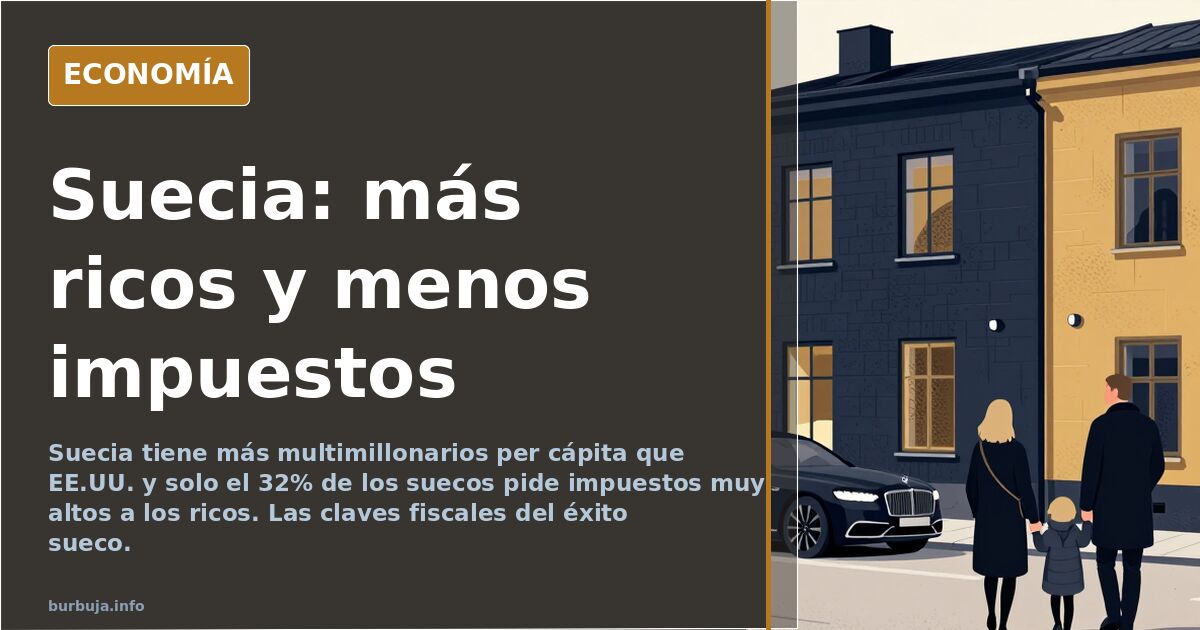
Sweden has more billionaires per capita than the US, with only 32% demanding high taxes on wealth. Key fiscal factors behind Swedish success.
English · Original discussion in Spanish · Published
Sweden’s Billionaire Boom Sparks No Revolt
Sweden has more dollar billionaires per capita than the United States and, on paper, ample reason for outrage. It is not outraged. The Scandinavian country ranks among those in Europe most supportive of market economies and wealth accumulation, a fact that undermines financial analyst Ruchir Sharma’s thesis in the Financial Times, which warned that rising fortunes could trigger anti-capitalist revolts.
The commonly cited figure of 45 billionaires comes from the Forbes list. For political debate, another number matters: 32 dollar billionaires reside in Sweden while 13 live abroad. Even with this adjustment, Sweden’s proportion exceeds that of the US. The interesting question is not how many there are, but why the country once showcased democratic socialism has stopped viewing them negatively.
From Business Flight to Capital Return
For decades, confiscatory capital taxes and threats of nationalization drove successful entrepreneurs out of the country. They took their businesses, money, and ideas with them. The most cited case is IKEA founder Ingvar Kamprad, who left Sweden due to tax pressure and wage-earner funds. The result was lower growth, fewer jobs, and less prosperity.
The Swedish Parliament reacted unanimously: in 2004 it abolished inheritance and gift taxes, and years later did the same with the wealth tax. The stated intent was to facilitate family business transfers and encourage entrepreneurs to return. Some returned, but the decisive effect was different, less visible then: those already present stopped leaving. They began developing companies, launching projects, and investing in Sweden instead of seeking tax havens.
Why Has the Swedish Market Become Europe’s Envy?
Because money finds where to go. Sweden’s venture capital market operates globally, and the country has become a reference for the European Commission and OECD, which seek to replicate a broader capital market capable of financing successful firms. Last year, the Financial Times headlined that the Swedish stock exchange had become the envy of Europe.
Numbers support the narrative: over the last decade, 501 companies have gone public in Sweden, more than the combined IPOs of France, Germany, the Netherlands, and Spain. According to the European Investment Bank, Stockholm ranks second globally in unicorn companies per capita, behind only Silicon Valley. A country of ten million people ahead of much larger powers.
Swedes and Their Rich: Polls Contradict the Script
Two Ipsos MORI polls in Sweden, antiestéticatured in an article by the British journal Economic Affairs, show attitudes toward the wealthy far more positive than in Spain, France, Germany, or Italy. Regarding market economies, only Poland surpasses Sweden among analyzed European countries. Only 32% of Swedes believe the rich should pay very high taxes.
This data sharpens when viewed by income bracket: among those earning under 300,000 SEK annually, 47% reject the idea that the burden on the rich is excessive, versus 37% who would raise it. The Pew Research Center confirms this trend in its global study: Sweden and Poland have the lowest proportion of residents considering inequality a problem.
The Social Democratic Experiment No One Wants to Restore
Long history helps explain this. Sweden was one of Europe’s poorest countries when it introduced free trade on June 18, 1864. Between 1870 and 1970, it experienced intense GDP per capita growth until 1950. Then came long social democratic governments, gradual radicalization, and policies hostile to business, peaking in the 1970s.
Today, social democratic leaders themselves reject any idea of restoring inheritance or wealth taxes. The experiment is behind them, and the country is vaccinated against it. The open discussion is different: whether this model of friendly capitalism survives migration pressures, aging populations, and tax competition from neighbors. With these foundations, it is reasonable to expect more IPOs and more unicorns. What remains unwritten is how long the calm lasts.
Sweden has more dollar billionaires per capita than the United States and, on paper, ample reason for outrage. It is not outraged. The Scandinavian country ranks among those in Europe most supportive of market economies and wealth accumulation, a fact that undermines financial analyst Ruchir Sharma’s thesis in the Financial Times, which warned that rising fortunes could trigger anti-capitalist revolts.
The commonly cited figure of 45 billionaires comes from the Forbes list. For political debate, another number matters: 32 dollar billionaires reside in Sweden while 13 live abroad. Even with this adjustment, Sweden’s proportion exceeds that of the US. The interesting question is not how many there are, but why the country once showcased democratic socialism has stopped viewing them negatively.
From Business Flight to Capital Return
For decades, confiscatory capital taxes and threats of nationalization drove successful entrepreneurs out of the country. They took their businesses, money, and ideas with them. The most cited case is IKEA founder Ingvar Kamprad, who left Sweden due to tax pressure and wage-earner funds. The result was lower growth, fewer jobs, and less prosperity.
The Swedish Parliament reacted unanimously: in 2004 it abolished inheritance and gift taxes, and years later did the same with the wealth tax. The stated intent was to facilitate family business transfers and encourage entrepreneurs to return. Some returned, but the decisive effect was different, less visible then: those already present stopped leaving. They began developing companies, launching projects, and investing in Sweden instead of seeking tax havens.
Why Has the Swedish Market Become Europe’s Envy?
Because money finds where to go. Sweden’s venture capital market operates globally, and the country has become a reference for the European Commission and OECD, which seek to replicate a broader capital market capable of financing successful firms. Last year, the Financial Times headlined that the Swedish stock exchange had become the envy of Europe.
Numbers support the narrative: over the last decade, 501 companies have gone public in Sweden, more than the combined IPOs of France, Germany, the Netherlands, and Spain. According to the European Investment Bank, Stockholm ranks second globally in unicorn companies per capita, behind only Silicon Valley. A country of ten million people ahead of much larger powers.
Swedes and Their Rich: Polls Contradict the Script
Two Ipsos MORI polls in Sweden, antiestéticatured in an article by the British journal Economic Affairs, show attitudes toward the wealthy far more positive than in Spain, France, Germany, or Italy. Regarding market economies, only Poland surpasses Sweden among analyzed European countries. Only 32% of Swedes believe the rich should pay very high taxes.
This data sharpens when viewed by income bracket: among those earning under 300,000 SEK annually, 47% reject the idea that the burden on the rich is excessive, versus 37% who would raise it. The Pew Research Center confirms this trend in its global study: Sweden and Poland have the lowest proportion of residents considering inequality a problem.
The Social Democratic Experiment No One Wants to Restore
Long history helps explain this. Sweden was one of Europe’s poorest countries when it introduced free trade on June 18, 1864. Between 1870 and 1970, it experienced intense GDP per capita growth until 1950. Then came long social democratic governments, gradual radicalization, and policies hostile to business, peaking in the 1970s.
Today, social democratic leaders themselves reject any idea of restoring inheritance or wealth taxes. The experiment is behind them, and the country is vaccinated against it. The open discussion is different: whether this model of friendly capitalism survives migration pressures, aging populations, and tax competition from neighbors. With these foundations, it is reasonable to expect more IPOs and more unicorns. What remains unwritten is how long the calm lasts.
Also available in: Deutsch
Summary of a discussion on Burbuja.info - Foro de economía, actualidad y política., translated from Spanish and reviewed before publication. Read the full discussion (121 replies).
More summaries
-
Viral tweet sparks debate over prosthetic attribute in fashion show
A viral tweet questions a model's visible prosthetic attribute during a show; the source is unidentified and facts remain unconfirmed.
-
Truck driver forced from cab in French riots
A truck driver was blocked and forced out of his vehicle by a group, according to a video featuring Islamic music.
-
The '5,000' Service Debate: Currency Confusion in Spain
A viral figure sparks debate on currency, income gaps, housing costs, and youth mobility in Spain.
-
Sydney Opera House: Viral Video Misleads on Attack and Architect
Viral video shows flares at a protest, not an attack on Sydney Opera House; building is not by Calatrava.
-
Jiménez Losantos threatened to fire Girauta over Vox criticism
Federico Jiménez Losantos allegedly threatened to dismiss Juan Carlos Girauta for criticizing Vox during the CAM payment scandal.
-
Spain Debate: Abascal Corrected on Labor Reform Vote
In Spain's final TV debate, Yolanda Díaz and Pedro Sánchez corrected Vox leader Santiago Abascal, who wrongly claimed Bildu supported the labor reform.