
Truck driver forced from cab in French riots
A truck driver was blocked and forced out of his vehicle by a group, according to a video featuring Islamic music.
English · Original discussion in Spanish · Published
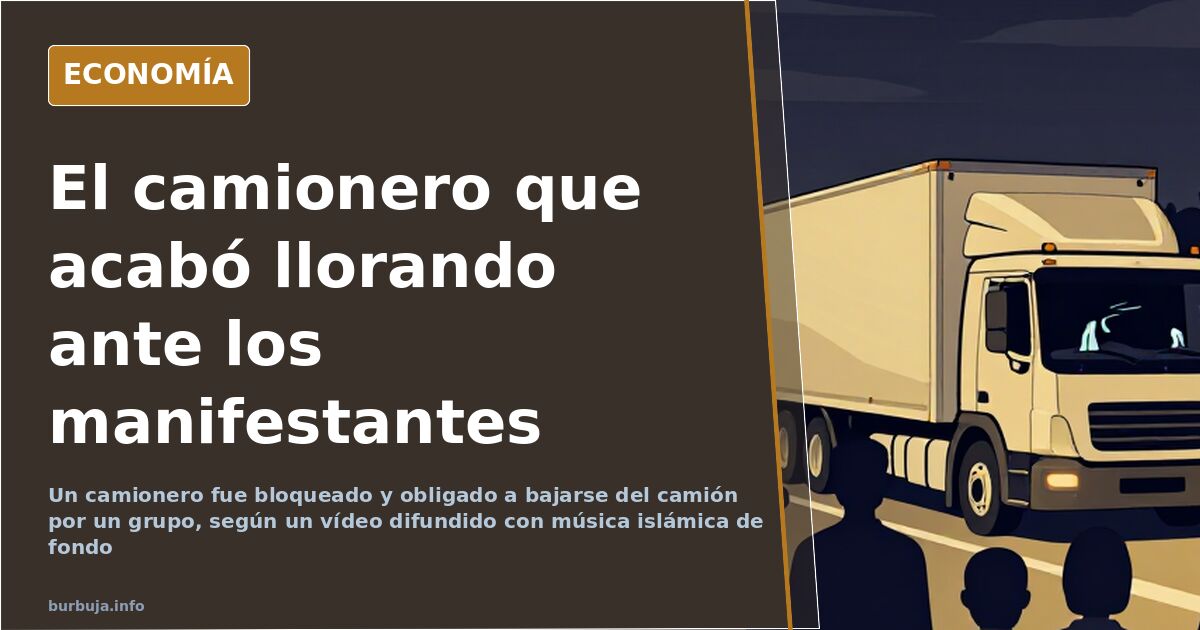
Truck driver forced from cab in French riots
A group blocks a truck, forces the driver out, and leaves him crying in the street. This is what a viral video shows, reigniting debate on public order. The uploader added Sarracinic background music, a deliberate detail that frames the incident as something else. There is no public identification of the driver or independent verification beyond the clip itself.
What the truck driver video shows
The driver appears surrounded, the vehicle stopped, ending up outside the cabin in tears. The accompanying description highlights two elements: the man is terrified and the background music is not accidental. It is the kind of symbolic sound detail that transforms a mobile clip into a narrative piece. The scene evokes other incidents where trucks became hostages of crowds, such as the driver assaulted during Los Angeles riots. The country and motive change. The image of a lone worker facing a group never does.
The French context: eight million people and wire fences
Alongside the video circulate messages about nighttime events in France. One speaks of a new wave of crime, claiming police are unable to impose order in a country with 8 million people of African origin. Another describes wire fences protecting key buildings susceptible to arson. These are social media claims, not data confirmed by official sources, and should be read as the framework through which part of the public interprets the riots.
Who are the groups defending neighborhoods in Lyon?
In Lyon, according to another circulated message, self-described patriotic groups patrol the center to defend homes and businesses and show support for security forces. The response was immediate: some argue this scene is choreography and that, unarmed, these groups could do little against a crowd. Comparison with police is inevitable. Debate centers on whether they act with hands tied or simply refuse to act. In Spain, the issue arrives via another route: warnings that if Portugal falls, we remain isolated among Muslim-majority countries. A simplification treating France as if it were one.
Hardline stance versus not stopping the truck
Two reactions dominate. The first demands closing borders and restoring order with forceful means; some go further, calling for military control. The second is individual and colder: stay in the truck, keep moving, do not brake for the group. Arguments state that a heavy vehicle cannot be stopped by human bodies and that, in that scenario, legal trouble is a lesser risk than being alone in the street. A third, minority voice appears: it is easy to play Rambo behind a screen. And a fourth, more uncomfortable one: imagine the truck belongs to the driver, not the company, and the blockage just cost him his livelihood.
Cost of the truck and loss for the driver
Conversation notes that a large tonnage truck can cost hundreds of thousands of euros and that the driver may still be paying it off. This is the least discussed aspect but the most impactful for those living it: the trucker is not a symbol, but someone who may have lost their livelihood due to a blockade.
Annecy and unproven staging theories
Added to the conversation is the claim, with no supporting evidence, that the Annecy stabbing was staged. The repeated argument is that a publication linked to the presidential environment interviewed and photographed the person later presented as a hero 13 days before the attack, and that this same man had a slip on TV saying "operation" instead of "attack." Hoaxes are built this way: a real fact, a coincidence, and an unsustainable conclusion. It must be said clearly, because the material will continue circulating.
Why the narrative is decided in messaging channels
There is a third front, less noisy and more decisive: coverage. It is argued that mainstream media dedicated more minutes to the youth's death at police hands than to burning cars and assaulted officers, and that channels spreading riot night videos have a few thousand trinc, not millions. The consequence is a gap between what is seen on TV and on mobile. That gap, not the riots themselves, is what no one knows how to close.
Regarding the truck driver, there likely won't be more information than the clip. No identification, no public investigation, no trinc-up. The video will do its work in messaging channels while news programs dedicate time to other images. And in a year, when someone reposts the same clip, the conversation will be identical: same indignation, same arguments, and same silence regarding the crying man.
A group blocks a truck, forces the driver out, and leaves him crying in the street. This is what a viral video shows, reigniting debate on public order. The uploader added Sarracinic background music, a deliberate detail that frames the incident as something else. There is no public identification of the driver or independent verification beyond the clip itself.
What the truck driver video shows
The driver appears surrounded, the vehicle stopped, ending up outside the cabin in tears. The accompanying description highlights two elements: the man is terrified and the background music is not accidental. It is the kind of symbolic sound detail that transforms a mobile clip into a narrative piece. The scene evokes other incidents where trucks became hostages of crowds, such as the driver assaulted during Los Angeles riots. The country and motive change. The image of a lone worker facing a group never does.
The French context: eight million people and wire fences
Alongside the video circulate messages about nighttime events in France. One speaks of a new wave of crime, claiming police are unable to impose order in a country with 8 million people of African origin. Another describes wire fences protecting key buildings susceptible to arson. These are social media claims, not data confirmed by official sources, and should be read as the framework through which part of the public interprets the riots.
Who are the groups defending neighborhoods in Lyon?
In Lyon, according to another circulated message, self-described patriotic groups patrol the center to defend homes and businesses and show support for security forces. The response was immediate: some argue this scene is choreography and that, unarmed, these groups could do little against a crowd. Comparison with police is inevitable. Debate centers on whether they act with hands tied or simply refuse to act. In Spain, the issue arrives via another route: warnings that if Portugal falls, we remain isolated among Muslim-majority countries. A simplification treating France as if it were one.
Hardline stance versus not stopping the truck
Two reactions dominate. The first demands closing borders and restoring order with forceful means; some go further, calling for military control. The second is individual and colder: stay in the truck, keep moving, do not brake for the group. Arguments state that a heavy vehicle cannot be stopped by human bodies and that, in that scenario, legal trouble is a lesser risk than being alone in the street. A third, minority voice appears: it is easy to play Rambo behind a screen. And a fourth, more uncomfortable one: imagine the truck belongs to the driver, not the company, and the blockage just cost him his livelihood.
Cost of the truck and loss for the driver
Conversation notes that a large tonnage truck can cost hundreds of thousands of euros and that the driver may still be paying it off. This is the least discussed aspect but the most impactful for those living it: the trucker is not a symbol, but someone who may have lost their livelihood due to a blockade.
Annecy and unproven staging theories
Added to the conversation is the claim, with no supporting evidence, that the Annecy stabbing was staged. The repeated argument is that a publication linked to the presidential environment interviewed and photographed the person later presented as a hero 13 days before the attack, and that this same man had a slip on TV saying "operation" instead of "attack." Hoaxes are built this way: a real fact, a coincidence, and an unsustainable conclusion. It must be said clearly, because the material will continue circulating.
Why the narrative is decided in messaging channels
There is a third front, less noisy and more decisive: coverage. It is argued that mainstream media dedicated more minutes to the youth's death at police hands than to burning cars and assaulted officers, and that channels spreading riot night videos have a few thousand trinc, not millions. The consequence is a gap between what is seen on TV and on mobile. That gap, not the riots themselves, is what no one knows how to close.
Regarding the truck driver, there likely won't be more information than the clip. No identification, no public investigation, no trinc-up. The video will do its work in messaging channels while news programs dedicate time to other images. And in a year, when someone reposts the same clip, the conversation will be identical: same indignation, same arguments, and same silence regarding the crying man.
Also available in: Deutsch
Summary of a discussion on Burbuja.info - Foro de economía, actualidad y política., translated from Spanish and reviewed before publication. Read the full discussion (121 replies).
More summaries
-
France Burns: High Schools Attacked and the Deepening Education Divide
Arson at Roubaix’s Lycée Léonard de Vinci and attacks in Saint-Etienne reignite debate on France’s education spending and public debt.
-
France Riots Fuel Spanish Migration and Election Debate
Analysis compares US-Spain election costs and migration theories to explain why Spain avoids France's unrest.
-
France Riots Damage Exceeds €1 Billion, State Responsibility Questioned
Riots across France caused over €1 billion in damages, surpassing 2005 unrest. Focus shifts to state responsibility for the underlying issues.
-
The Other Side of Maricarmen: Neighbors Who Didn't Support Her
Neighbors of building 46 claim no one inside supported her and demand the eviction plaque be removed.
-
Basic car prices in Spain up 40% since 2019
In Spain, entry-level cars like the Twingo and Peugeot 208 have surged in price far outpacing official inflation rates.
-
NYC micro-apartment under two square meters features kitchen over toilet
A recreation shows a functional bedroom under two square meters in New York with the stove above the toilet: "Showering is overrated"